
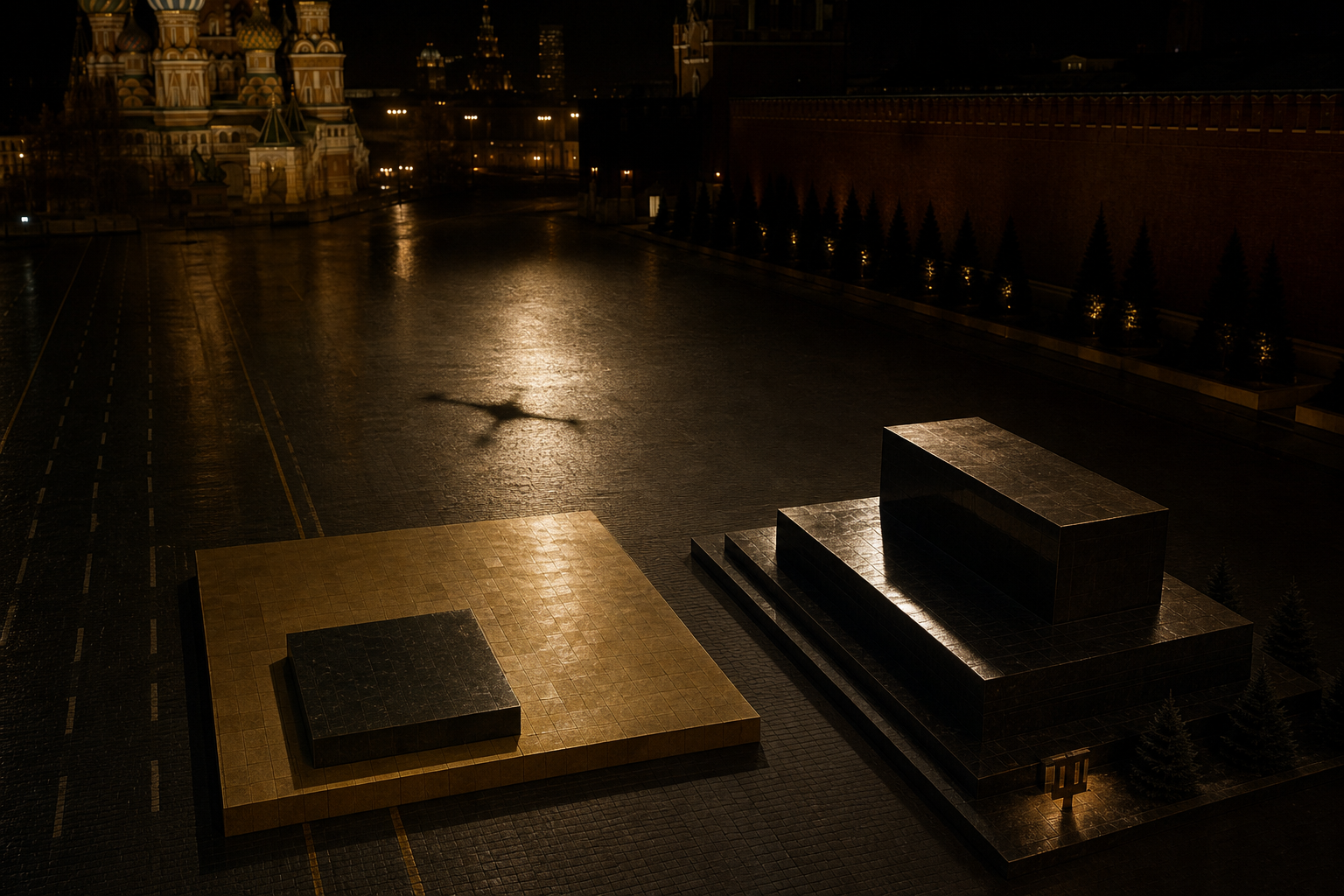
A drone hum over a Moscow suburb. A cracked refinery window in Ryazan. A presidential statement, delivered in that flat baritone, suggesting the war is "coming to a close" while the demands underneath it do not move an inch. The choreography is familiar by now: acknowledge the discomfort, concede nothing. Russians who spent 2022 being told the special operation was happening somewhere else are watching air defense tracers from their balconies in 2026, and the Kremlin's response is to adjust the music while keeping the steps identical. The question worth chewing on is what a leader formed inside the KGB actually does when the home front becomes the front. Concession is one possible answer. It is almost never his.
Most coverage of the moment sorts into two piles. One reads Putin's softer language as fatigue, a tell that sanctions and casualties are finally biting. The other treats every word from the rostrum as theater. Both skip the mechanical question: how does this specific person process pressure, and which inputs actually change his behavior? You can track troop numbers and ruble charts all afternoon without getting closer to that. The signal lives in his formation, his peer group, and the Russian historical script he believes he is performing. Fiona Hill and Clifford Gaddy spent years building that portrait, and the 2015 expanded edition of their study is the English-language book that takes the wiring seriously instead of the weather.
Hill and Gaddy organize Putin around six identities they argue he has accumulated over a career: the Statist, the History Man, the Survivalist, the Outsider, the Free Marketeer, and the Case Officer. The taxonomy sounds tidy on the page and is messier in practice, which is the point. Each identity carries its own decision rules, and the authors place the Case Officer, the recruiter trained to read people and run them, underneath the others as a working method. He runs operations on his own population the way he was once trained to run assets in Dresden.
The KGB chapters do the heavy lifting. Hill, a historian by training, and Gaddy, an economist who spent decades inside Russian institutional data, walk through Putin's Dresden years and the specific habits of mind that the First Chief Directorate cultivated: patience, plausible deniability, a preference for kompromat over confrontation. They connect this to the silovik networks, the security-service alumni who staff the upper Kremlin and who share both a worldview and a set of grudges left over from the 1990s. When the book argues that Putin treats domestic discontent as an intelligence problem rather than a political one, the claim is built on documented personnel patterns, not vibes.
The Survivalist material is where the book earns its keep for the current moment. Drawing on a 1997 dissertation Putin produced on strategic resource planning, the authors describe a leader who thinks in terms of stockpiles, reserves, and worst-case scenarios stretching decades out. Sanctions designed to inflict short-term pain run into a mind that was, by his own account, planning for exactly this kind of siege in the late 1990s. That does not make the sanctions pointless, but it does explain why the timeline for them to bend his behavior is longer than most Western political cycles can tolerate.
The Free Marketeer sections are where my pencil came out. The authors strain to reconcile Putin's stated economic philosophy with the kleptocratic reality around him, and they acknowledge the tension while treating his self-presentation more generously than the evidence warrants. A leader who runs Gazprom as a personal instrument is not meaningfully a market thinker, and the book occasionally lets the dissertation speak louder than the balance sheets. The chapter is the one stretch where the methodology, taking Putin at his own intellectual word, produces something closer to apologia than analysis. What you get by the end is a working model of how one man metabolizes threat.
The 2015 additions on Crimea, the confrontation with the West, and the annexation logic extend that model into territory the 2013 first edition could only gesture at. Read in 2026, with Ukrainian drones reaching Tatarstan and the Kremlin oscillating between menace and weariness, the model holds up unsettlingly well. Behavior that looks erratic from outside has internal consistency once you accept the premises he is operating from.
If the dinner conversation circles back to whether Putin is finally cracking, the more useful answer is that the question is built wrong. He was trained to perform cracking. The thing to watch is whether the silovik networks around him are still aligned, whether the stockpile logic still convinces the people running the books, whether the 1990s script he is performing starts to lose its grip on the people who have to enforce it. Hill and Gaddy give you the equipment to ask those questions in a register the cable chyrons cannot reach.