
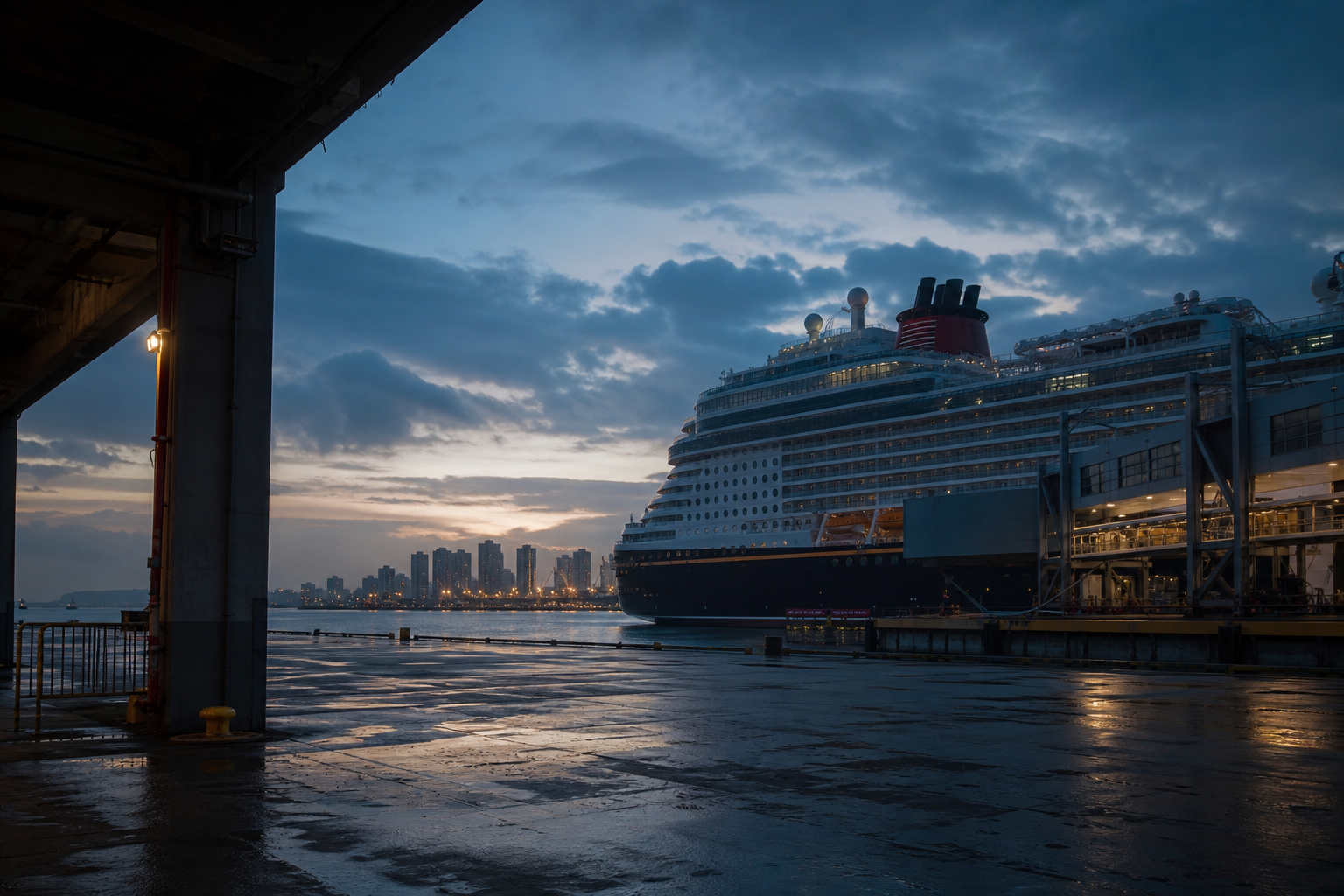
Picture a few thousand people on the Disney Adventure, docked in Singapore, watching their four-night sailing dissolve into refund emails and rebooking queues after a technical issue pulled the ship out of rotation. By this week in 2026, the vessel is back in service, the blog post is cheerful, and the operational machinery has moved on. The passengers who lost their week are somewhere else entirely, probably on hold with travel insurance. A cancelled cruise looks, from the outside, like weather: bad luck, force majeure, nobody's fault. From the inside of the company, it's a decision tree with cost lines attached. Which guests get what compensation, which dry-dock window absorbs the repair, which itineraries get quietly reshuffled three months from now. The headline flattens all of that into a single sentence. The version worth reading is the one where you can see the decision tree.
The reflex when a cruise cancellation hits the news is to treat it as a discrete incident: ship broke, ship fixed, passengers compensated, story over. That framing assumes the cruise line is reacting to a one-off problem rather than running a continuous logistics operation in which cancellations are a known category of event with pre-written playbooks. Disney Cruise Line has been doing this for almost thirty years across multiple oceans and an expanding fleet. The Singapore disruption is unusual in its visibility, not in its structure. Most coverage skips the layer where the company allocates risk between itself and the people who booked. Who eats the airfare. Which onboard credits show up automatically and which require a phone call. How rebooking priority actually works when a whole manifest needs new dates. That's the layer where a guidebook earns its keep.
Tammy Whiting and Len Testa have been writing the Unofficial Guide series long enough that the 2026 Disney Cruise Line edition reads like a consumer-protection document with deck plans. The premise is straightforward. Disney publishes the glossy version. An independent team of researchers rides the ships, times the lines, tastes the food, and writes down what actually happened. The result is organized around the assumption that you are spending real money and would like to know where it goes. The practical material is where the institutional posture shows up. Staterooms get ranked within categories, which matters because two cabins at the same price point can differ by obstructed views, connecting-door noise, or proximity to the laundry.
Restaurants get the same treatment. Children's programming is broken out by age band rather than marketing copy. Itineraries across Alaska, the Mediterranean, the Bahamas, and the newer private-island stops at Castaway Cay and Lookout Cay at Lighthouse Point get compared on what you actually do ashore versus what the brochure implies. The book's underlying argument, never stated this baldly, is that Disney Cruise Line is a premium-priced product operating in a category where the gap between the best and worst choices on a single ship is wide enough to justify research. A verandah on the wrong side of a westbound transatlantic is a different vacation than the same verandah eastbound.
The guide treats that kind of detail as load-bearing. The section logic around disruption is harder to find. Guidebooks of this kind tend to bury the contingency material, and this one is no exception. You have to read across chapters to assemble a picture of what happens when things go sideways: travel insurance recommendations, the case for booking flights separately versus through Disney's air program, the trade-offs of arriving a day early in the embarkation port. None of that is framed as crisis preparation. It's framed as ordinary prudence, which is closer to how the cruise line itself thinks about it.
The weakest stretch is the Asia coverage. The book is updated annually, and anything specific to the Disney Adventure's Singapore deployment is thinner than the Caribbean material where the authors have decades of accumulated data. Pricing benchmarks age quickly. The no-nonsense tone can also slide into a kind of cheerful exhaustiveness that makes a chapter feel like a spreadsheet wearing a Hawaiian shirt. You learn to skim the ranked lists and slow down for the prose analysis, where Whiting and Testa's actual judgment lives. The guide also refuses the two default registers for writing about Disney: breathless fandom and reflexive cynicism. It treats the company as a competent operator selling an expensive product to people who deserve straight information about it. That posture is rarer than it should be.
The dinner-party version is short. The Disney Adventure is sailing again. The interesting question was never whether it would. It was how a company with a fleet this size absorbs a four-night cancellation, and how the people on board absorb it very differently depending on what they booked and through whom. The Unofficial Guide is one way to see that second layer without committing to a vacation you're not sure you want. Borrow it from a library if you're curious. Buy it if you're actually going.