
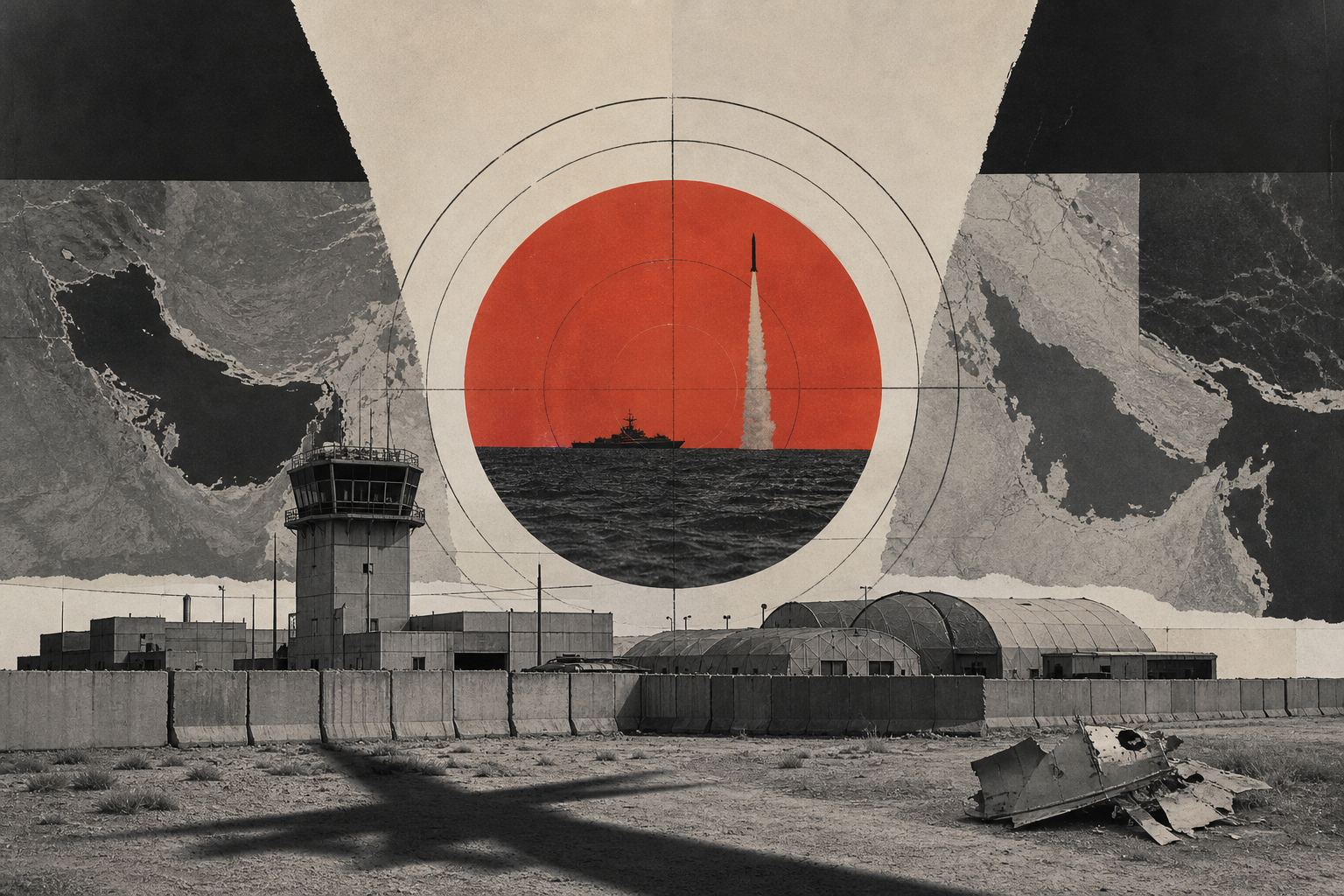
The argument over whether to keep big, fixed American bases near Iran usually plays out as a question of cost and risk: are they worth the missiles aimed at them? That framing is too small. The bases are the visible end of a policy that has been running, more or less continuously, for forty years, and the people debating their future rarely ask how they got there. Iran's targeting of those installations across a conflict now in its fourth month has revived old doubts about whether the whole posture makes sense. Those doubts are not new. Andrew J. Bacevich, a retired army colonel turned historian, has been making a version of this case for years, and his book gives you the long arc that turns a security headline into something closer to an accounting. The accounting is less comfortable than the headline version, which is the point.
Most coverage of the current standoff works within tight limits. It can tell you which base got hit, how air defenses performed, and what a Pentagon spokesperson said the next morning. It cannot explain why those bases sit where they sit, or why pulling back feels nearly impossible even when the costs climb. A piece written on deadline answers the question in front of it, not the question behind it. There is also a built-in bias toward continuity. Each individual deployment looks reasonable on its own; the cumulative weight of forty years of them never gets totaled up anywhere. Bacevich's project is to do that addition. He treats the present posture as the outcome of decisions, most of them made by people who thought they were solving a temporary problem.
Bacevich opens with a comparison that does most of the work. From the end of World War II until 1980, almost no American soldiers were killed in action in the Greater Middle East. Since 1990, almost none have been killed in action anywhere else. He treats that reversal as the signature of a single, sustained war the United States stumbled into and never named as such. The through-line runs from the Carter Doctrine of 1980, declared after the Iranian revolution and the Soviet move into Afghanistan, through the campaigns that followed across the Balkans, East Africa, the Persian Gulf, and Central Asia.
His claim is that these were installments, not separate episodes. Each one created conditions, and obligations, that made the next one likelier. The bases under discussion today are sediment left by that process. Read through the current standoff, the book's real value is in how Bacevich handles the word "temporary." Officials kept describing the American presence as a response to a specific crisis, due to wind down once stability arrived. Stability never arrived, and the response hardened into permanence. That is the mechanism behind "why are we still here," and it explains why abandoning the Gulf bases is so hard to answer cleanly: the posture was built by people who never decided to build it.
Where I would push back is on the tendency to read four decades as one coherent story. Bacevich is a forceful writer with a thesis, and a thesis that tidy can flatten real differences between, say, the 1991 Gulf War and the 2003 invasion, which had different aims, different coalitions, and different consequences. The continuity is real, but so are the breaks, and a more granular account would let some of those campaigns argue back against the frame. The ethical core holds up, and it is the part worth carrying into the present debate. Bacevich keeps asking who pays for an open-ended commitment that no single administration ever owned.
His answer lands on the soldiers sent on the campaigns and the populations on the receiving end, while the strategic rationale stays vague enough to survive any particular failure. A base getting shelled in 2026 is, in his telling, the predictable bill for a posture that was never honestly debated. You may finish disagreeing with his prescription, which leans toward retrenchment, while finding the diagnosis hard to shake.
The conflict is unresolved, and the doubts about the bases will outlast its fourth month whichever way the immediate fighting breaks. Bacevich offers a way of keeping score across decades, so that the next "temporary" deployment registers as part of a pattern instead of a fresh emergency. Read him if you want the standoff to make a different kind of sense than the briefing-room version, and read him skeptically, since his certainty is part of what makes him persuasive. The accounting he started is still open, and the bills, for now, keep coming due.