
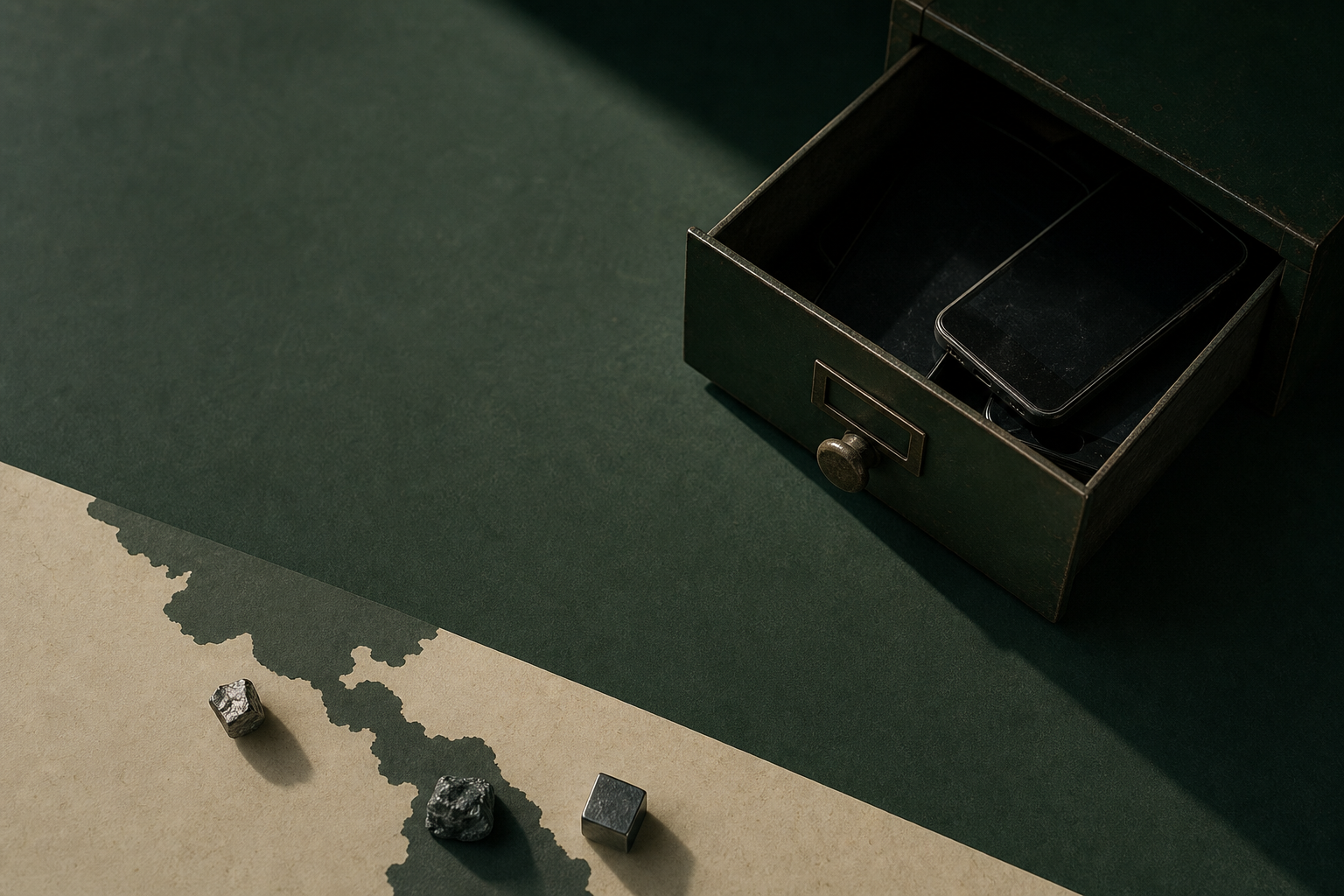
Somewhere in your home there is a drawer with two or three dead phones in it. Gold in the connectors, cobalt in the battery, a trace of palladium, small magnets made from rare earth metals so the speaker can push air. You will probably never open that drawer again. This summer the US Army moved its directed-energy system nicknamed Hammer of the Gods into larger joint experiments in southern California, and the coverage stayed on power output, range, and battlefield doctrine. The drawer and the emitter are close relatives. Both depend on a short list of metals that have to be dug up and then refined, and refining is the step almost nobody photographs. One country does most of it. That is public information, sitting in trade data, and it almost never makes a headline.
Defense writing is fluent in hardware and nearly silent on inputs. You can learn what a system does to a sensor at two kilometers and still have no idea which magnet plant, which permit fight, which smelter in an industrial park made the thing buildable. So the news arrives in unrelated pieces: a directed-energy test in California, a Chinese-built machine rattling the chip business, a trade fight over minerals. Each gets its own segment, and the thread between them stays unpulled, because that thread is boring in the way plumbing is boring, right up to the moment the water stops. Guillaume Pitron's book, translated by Bianca Jacobsohn, works that unglamorous layer, and it changes what a weapons test or a shortage actually looks like.
Pitron spent six years reporting across a dozen countries, following rare metals from the pit to the trading desk. Extraction turns out to be the dull half of the story. Ore is common enough. Turning ore into a usable oxide, then a metal, then an alloy, then a finished magnet is filthy, chemically demanding, capital-hungry work that wealthy countries were happy to hand off. China took the work and then took the ownership above it. Pitron traces that consolidation as a decades-long industrial policy carried out in daylight, with subsidies and patience, not with ambush.
He keeps the cost visible at ground level. The clean object at the end of the line, the sedan that never smells of gasoline, sits on top of ruined water tables, exposed workers, and towns built beside tailings ponds the color of weak tea. That contrast is the book's engine, and it earns its bluntness by taking you to the places product launches leave out of the video. From there comes the claim that gives the book its edge: leaving fossil fuels swaps one form of dependence for another and hands strategic advantage to whoever controls the inputs.
The reframe is sharp, and it is also slightly too tidy. Oil gets burned once, while cobalt and neodymium can be recycled, substituted, or engineered around, and Pitron's symmetry flattens that difference. Scarcity arguments age strangely, too, because price spikes tend to summon new mines and new chemistry. My sharper objection is the word quiet. Describing China's position as a quiet capture lets Europe and the United States off easy. They outsourced the poisoned rinse water on purpose, filed the resulting drop in domestic emissions under environmental progress, and kept the finished magnets. That is a policy choice with names and dates attached, and the book gestures at it more than it prosecutes it.
What survives the skepticism is the part that reaches your own budget and your own grid. The cheapness of a phone, the sticker price of an electric car, the timeline of a wind project, the readiness of a weapons program: all of it runs through the same handful of processing bottlenecks, controlled largely by one government with its own priorities. That is a very small number of choke points holding up a very large number of promises.
If the subject comes up over dinner, skip the wattage and go somewhere better: who refines the metals, why the consolidation took thirty years, and what it means that a democracy's weapons program and its climate targets now compete for the same scarce inputs. Pitron will not leave you optimistic, and he overstates the trap in places. He will leave you unable to see a solar panel or a rifle scope as a self-contained object. The metals came from somewhere, and someone else paid for the cleaning.