
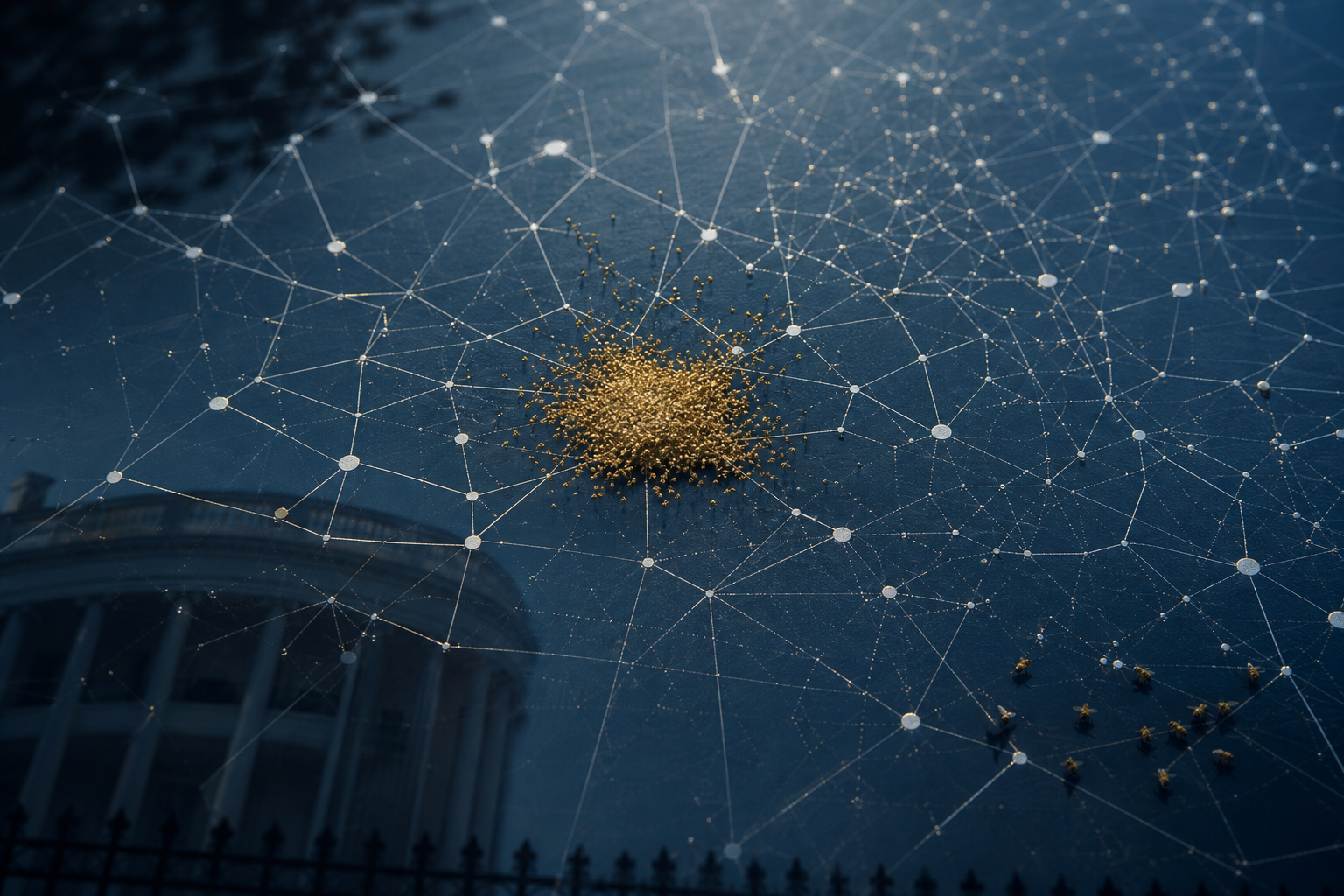
Friday on the North Lawn, thousands of honeybees decided the White House grounds looked like a reasonable place to regroup. Staff cordoned off a section, a beekeeper was called, and the photos did what photos of bees on federal property always do, which is travel quickly. The cluster was harmless. Swarming is what bees do when a colony outgrows its home and a portion of the workers leaves with a queen to find new lodging. It is ancient behavior, older than lawns and presidents. Everything happening around that swarm is newer and louder: the trucks, the contracts, the pathogens, the almond bloom in California that pulls in roughly two-thirds of the country's commercial hives every February. A swarm on the North Lawn is a small visible event riding on top of a very large invisible one.
The reflex when bees show up somewhere photogenic is to treat it as a tidy story about nature reasserting itself in a manicured place. That framing is comforting and mostly wrong. Most honeybees in the United States today are livestock. They live in stackable wooden boxes, ride interstates on flatbed trucks, and work pollination contracts the way session musicians work studio dates. A swarm escaping into a hedge is the exception. The question worth asking is what kind of shape the broader bee economy is in, who keeps it running, and why a trade that sounds pastoral has become one of the more financially brutal corners of American agriculture. For that, you want someone who has spent real time on the back of the truck.
Hannah Nordhaus's The Beekeeper's Lament follows John Miller, a fourth-generation migratory beekeeper whose operation moves billions of bees across state lines every year. Miller is the kind of subject nonfiction writers pray for: opinionated, funny, religiously devoted to his insects, and willing to let a reporter ride along while things go badly. Nordhaus uses him as the way into an industry most people never think about until a grocery store runs low on almonds. The central fact of modern beekeeping, as the book lays it out, is the California almond bloom. Almonds cannot set fruit without bees, and the orchards have expanded faster than any local pollinator population could support.
Every winter, semis full of hives converge on the Central Valley from the Dakotas, Florida, Texas, everywhere. Miller's bees pollinate almonds, then apples, then cherries, then clover for honey, in a circuit that resembles touring more than farming. Nordhaus is good on the texture of this work. Hives get dropped in the dark. Boxes get stolen. Trucks tip. A bad winter can wipe out forty percent of an operation's colonies, and the beekeeper eats the loss while still owing on the loan for next year's queens. Her reporting on colony collapse disorder, the wave of unexplained die-offs that peaked in the late 2000s, is careful in a way the cable coverage rarely was.
She walks through the suspects, varroa mites, neonicotinoid pesticides, viral loads, poor nutrition from monoculture diets, and resists the urge to crown a single villain. That restraint is the book's strongest move and, occasionally, its most frustrating one. You want her to push harder on the pesticide companies, or on the structural pressure that forces beekeepers to keep accepting almond contracts even as the almond circuit itself stresses the colonies. She prefers to let Miller's voice and the accumulating evidence do the arguing. Sometimes it reads as if she likes her sources too much to indict the system they depend on.
What comes through clearly is that honeybee decline is a labor story and a supply chain story wearing a nature story's clothes. The bees are sick partly because we ask them to do industrial work on an industrial schedule with an industrial diet, and partly because the parasites and viruses circulating through constantly mixed colonies behave the way diseases behave in any crowded, mobile population. Miller keeps going because he loves the bees and because quitting would mean admitting the math no longer works. Nordhaus respects that contradiction instead of resolving it.
The Beekeeper's Lament is fifteen years old now and some of its specific numbers have shifted, but the structure of the problem it describes has not. The almond acreage has grown and the margins have tightened. Pick it up if the photos from Friday made you curious about what happens to the bees once the groundskeepers wave them off, or if you have ever wondered who is on the other end of the contract when an orchard needs pollinating in February. Read it slowly, in the evening, with the windows open.