
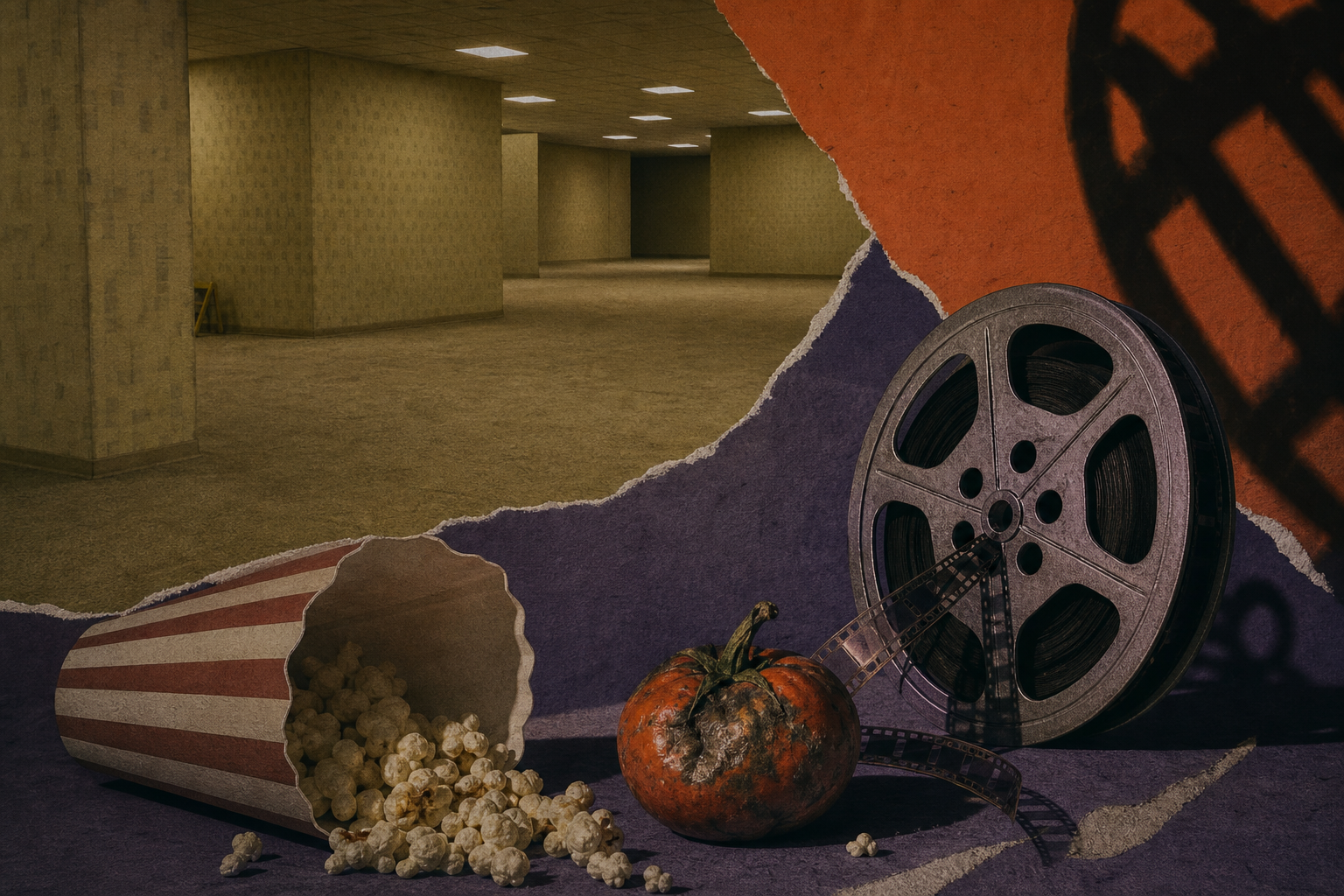
Horror is the genre most willing to say the quiet part out loud, and the box office keeps confirming that people show up to hear it. A24's Backrooms, spun out of a YouTube series about empty liminal hallways that should not exist, has landed its Rotten Tomatoes score with a projected $40 to 50 million opening in sight. That is a lot of money for dread. The usual read says audiences want a good scare and a clean exit. Maybe. But the films that survive, the ones still taught in seminars decades later, scared us about something real. Backrooms trades in disorientation, the dread of a space with no logic and no way back. The question worth asking is not whether it tests well. It is what, exactly, the test audience is afraid of.
Recap coverage stops at the score and the opening weekend, which tells you almost nothing about why this particular fear sells right now. The headline answers a marketing question and leaves the harder one untouched: what makes a horror image click with a mass audience in a given moment, and what cultural pressure is doing the translating. A liminal space, endless and indifferent, plays as fun on a Friday night. It can also play as a body or a future you no longer control. That second meaning is the part the Tomatometer cannot measure. Getting to it takes someone who has spent years watching how horror digests politics, frame by frame, instead of counting tickets.
Eleanor Johnson, who teaches one of Columbia's more crowded courses, found her way into that work by an accident of timing. In May 2022 she was screening the 1968 film Rosemary's Baby with her students when the Supreme Court reversed Roe v. Wade. Scream with Me grows out of that collision. Her claim is that classic horror has been arguing about women's rights, bodily autonomy, and reproductive agency the whole time, often more honestly than the culture around it. The through-line is the body that stops belonging to its owner. Rosemary, drugged and managed by a husband who has traded her pregnancy for his career, is the obvious case.
Johnson extends the pattern to The Stepford Wives, The Exorcist, Alien, and The Shining, treating each as a record of who gets to decide what happens inside a woman's skin. The Substance, with Demi Moore and Margaret Qualley, sits comfortably in the same line. The genre keeps staging the same fight because the fight keeps not resolving. The analysis convinces because Johnson refuses to flatten the films into slogans. She reads Rosemary's Baby as a feminist text and as the product of Roman Polanski, and she does not pretend that tension washes out. A movie can know something true about coercion while being made by people implicated in it.
She stays in that discomfort rather than tidying it up for you. My hesitation is about reach. The book is strongest on American and broadly Western cinema, and the thesis that horror specifically tracks women's rights can start to feel like a key that opens every door. Some monsters are just monsters. A reading this productive risks spotting patriarchy in the wallpaper of films that were mostly chasing a scare and a paycheck, and the case lands harder when it admits the genre also runs on cheaper fuel. The method holds up because it stays concrete.
Johnson is sharp on the final girl, on why she survives and what her survival costs, and she resists the easy move of calling her empowered. Survival on those terms is not freedom. That distinction matters for Backrooms, where there may be no survivor and no exit at all, only a space that will not let you out. The Atlantic called the book convincing and illuminating, and the praise fits the stretches where she stays close to the frame and lets the films talk.
Backrooms will make its money and slip out of the news within a few weeks, the way most horror hits do. The fear it rents you for two hours will not, because it has been working steadily since at least 1968 and shows no sign of running dry. Scream with Me is good company for the seasons ahead, when the next inexplicable hit lands and you want a better question than the one the headline asks. Not how it scored. What it was afraid of, and why that fear found you ready.