
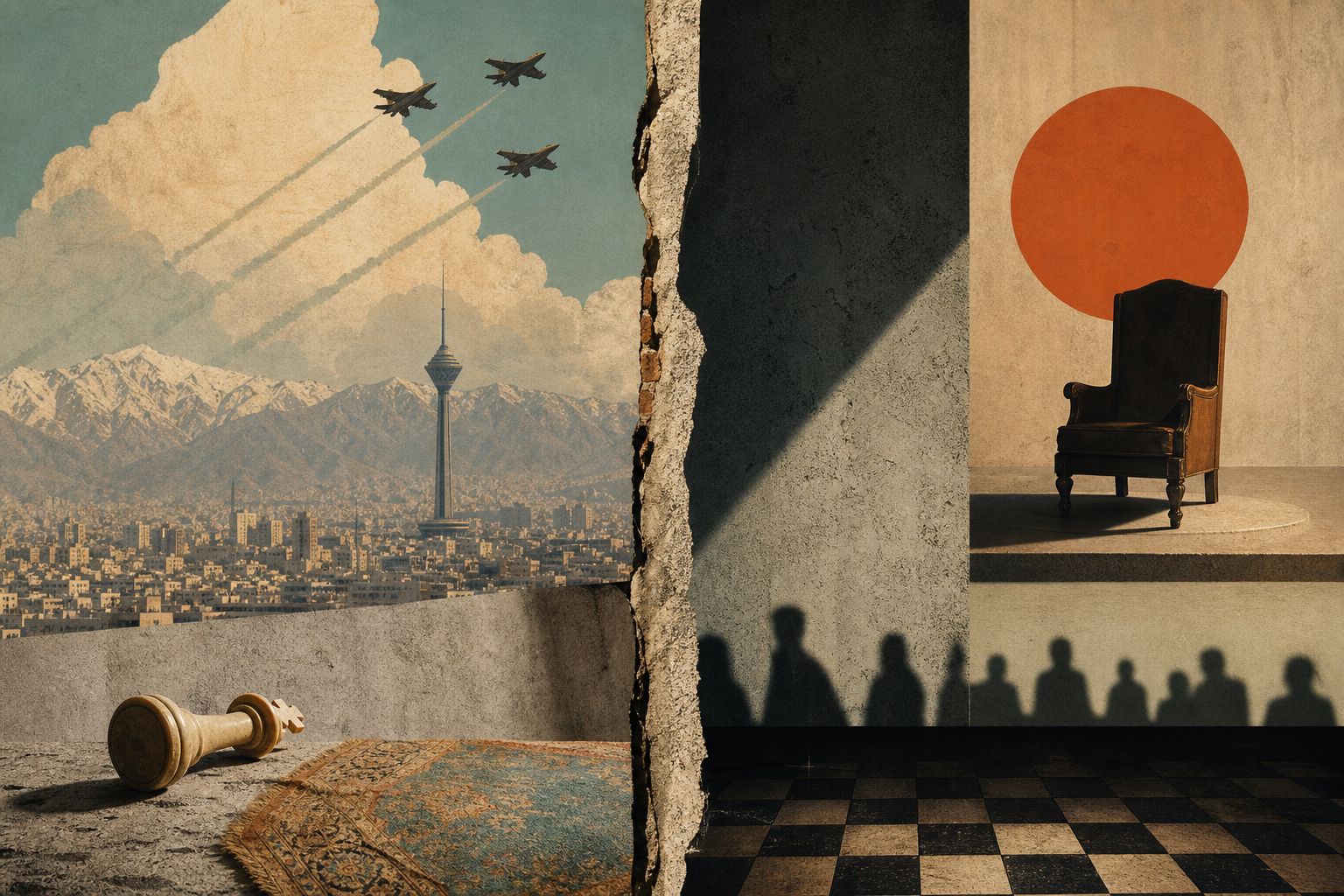
One reading of the recent reporting treats it as a twist: an Israeli strike, according to U.S. officials, aimed in part at springing Mahmoud Ahmadinejad from house arrest and installing him as a hard-line replacement for the current leadership in Tehran. The second reading is duller and more useful. Outside powers deciding who should run Iran is the house style of the past seventy-three years, with a brief intermission while the Islamic Republic pretended otherwise. The names rotate. The choreography is older than almost anyone involved. If you want to understand why an operation like this could even be sketched on a whiteboard in 2026, the cleanest place to start is a summer in 1953, a crowd in Tehran, and a CIA officer with a suitcase of cash.
There are two tempting framings here. Iran as victim of foreign meddling. Iran as author of its own hard-line turn. The country's politics have actually been shaped by a feedback loop in which outside intervention produces a domestic reaction, which then invites the next intervention, which hardens the next reaction. Ahmadinejad as a regime-change candidate is a node in that loop. To see the loop clearly you need a case where the wiring is fully exposed, where you can trace who decided what and who paid whom. The 1953 coup against Mohammad Mossadegh is that case, and Stephen Kinzer's account of it is the one most people who work this beat quietly rely on.
Kinzer's reconstruction of Operation Ajax reads like a procurement document with better verbs. Mossadegh, an elected prime minister with an aristocratic streak and a habit of receiving visitors in pajamas, had nationalized the Anglo-Iranian Oil Company. London wanted him gone. Washington, after some hesitation under Truman, signed on under Eisenhower. Kermit Roosevelt arrived in Tehran with cash, a list of contacts, and the authority to improvise. The strength of the book is the way Kinzer maps the actors. The Shah is hesitant and easily spooked. The clergy are divided, with Ayatollah Kashani drifting from Mossadegh's coalition at a convenient moment.
Bazaar merchants, paid demonstrators, sympathetic generals, and a handful of newspaper editors each get their function in the machine. The coup nearly fails on its first attempt. Roosevelt, against his instructions, tries again. The second attempt works, partly because the opposition is exhausted and partly because the right people were paid the right amounts. The mechanics are mundane, which is the point. The through-line Kinzer draws is the part that matters for current headlines. With Mossadegh removed, the Shah governs with growing reliance on SAVAK, the secret police trained with American and Israeli help. Political opposition gets pushed into mosques, the one institution the state cannot fully infiltrate.
When the 1979 revolution arrives, the clerical wing is the one with surviving networks, and the anti-American framing is already pre-written by twenty-six years of memory. The book has weaknesses worth naming. Kinzer leans hard on the coup as the originating sin, and at moments the causal chain gets tighter than the evidence strictly supports. Iran had its own clerical ambitions and its own oil-curse dynamics that would have warped the country with or without Kermit Roosevelt. Treating 1953 as the single hinge can let later Iranian leaders off a hook they deserve to stay on.
Abbas Milani's work on the Shah is the honest companion volume if you want a counterweight. The analytic payoff is still real. Once you have Kinzer's account in your head, the current reporting stops looking like a surprise. An external power identifying a preferred hard-liner, calculating that a sufficiently disruptive event will create an opening, and underestimating how the Iranian public will actually respond is a script that has been run before, by different stage managers, with results that rarely match the original deck. The 2026 version, if the U.S. officials quoted are right about Israeli intent, is the latest revision of a document first drafted in a Mayfair office in 1952.
Two hundred and ninety pages, brisk prose, and you come out with a working model of why U.S.-Iran relations resist every reset button. The book will not flatter anyone's preferred narrative completely, which is part of why it has aged better than most of the policy memoirs written about the same period. If the Ahmadinejad reporting nagged at you and the cable-news framing felt thin, this is the conversation worth having with yourself first.