
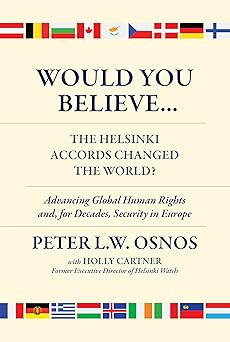
Book
Would You Believe...the Helsinki Accords Changed the World?
Human Rights And, for Decades, Security in Europe
Peter L. W. Osnos, Holly Cartner
Platform Books, LLC · Print & ebook · March 22, 2023
Reading lane: World Politics
Would You Believe. . .
At a Glance
Who It's For
Book Details
- Authors
- Peter L. W. Osnos, Holly Cartner
- Publisher
- Platform Books, LLC
- Published
- March 22, 2023
- Format
- Print & ebook
- Theme
- World Politics · Human Rights
- Reading lane
- World Politics
Affinity
Publisher Categories
World History
21st-Century History
World Politics
About This Book
Would You Believe. . . When the Helsinki Accords were signed on August 1, 1975, the likelihood they would have a profound and lasting impact on the world were very small. Which is why a book about them after a half century is both surprisingly topical and well worth reading for anyone with an interest in modern history. The thirty-five signatories were the nations of Europe, the United States and Canada at was formally known as the Conference of Security and Cooperation in E...
Read full description
Similar Books

Inventing Human Rights
Lynn Hunt · WW Norton
Affinity signal
Human Rights
Modern History

This Troubled World
Eleanor Roosevelt · Start Publishing LLC
Affinity signal
Politics in Literature
Human Rights

Humankind
Rutger Bregman, Erica Moore · Little, Brown and Company
Affinity signal
Social Theory
Physical Anthropology

Modern Times Revised Edition
Paul Johnson · HarperCollins
Affinity signal
Modern History
20th-Century History

In Europe
Geert Mak · Knopf Doubleday Publishing Group
Affinity signal
Eastern European History
Western European History
Age of Revolutions
Fareed Zakaria, Simon & Schuster Audio · WW Norton
Affinity signal
World Politics
Radical Politics