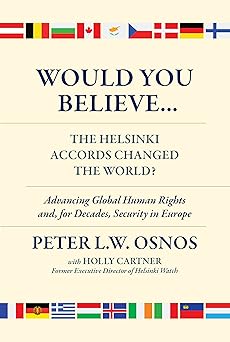
Would You Believe...The Helsinki Accords Changed the World?
Human Rights And, for Decades, Security in Europe
A history of the 1975 accords, their human-rights provisions, and Europe’s shifting borders.
Helsinki Accords
Come here for
- The Final Act’s human-rights provisions
- The accords’ place in Europe’s political turning point
Expect
- An account of Helsinki Watch becoming Human Rights Watch
Where it sits
How strongly BookFrontier reads the book as belonging to each subject.
Nearest books
Matched by our semantic model. Ordered by what its readers also loved.
 BalticOliver Moody48% subject match
 In EuropeGeert Mak45% subject match
 The Road to UnfreedomTimothy Snyder45% subject match
 Three Days in MoscowBret Baier, Catherine Whitney45% subject matchShares Cold War History
 To End a WarRichard Holbrooke45% subject matchShares Diplomacy
 The Cold War's Killing FieldsPaul Thomas Chamberlin44% subject matchShares Cold War History
For younger readers: Spies, Imperialism, Fault Lines in the Constitution
Start with three books, and this one can be the first.
Members get a new edition every morning: a route out from their books to essays, research and talks, with the reason for each.
Sign upAbout this book
Would You Believe. . . When the Helsinki Accords were signed on August 1, 1975, the likelihood they would have a profound and lasting impact on the world were very small. Which is why a book about them after a half century is both surprisingly topical and well worth reading for anyone with an interest in modern history.
Continue reading
The thirty-five signatories were the nations of Europe, the United States and Canada at was formally known as the Conference of Security and Cooperation in Europe. The Final Act of CSCE contained detailed provisions on respect for human rights and set country borders that essentially held until Russia invaded Ukraine in February,2022.
Only 15 years after the summit signing, the Soviet Union imploded and its Eastern European satellites broke with Communism and the broad range of human rights issues –civil, social, economic, and political – were a major factor in this historic turning point.
Peter L.W. Osnos’ expertise on the history of the accords is vast, as a journalist and publisher. His narrative writing skill is widely recognized. Holly Cartner provides a vivid account of how a small organization called Helsinki Watch became Human Rights Watch, the most important global NGO in its field.
Publisher details
Publisher categories
- World History
- 21st-Century History
- World Politics
- Authors
- Peter L. W. Osnos
- Publisher
- Platform Books, LLC
- Published
- March 22, 2023
- Format
- Print & ebook
- Reading lane
- World History