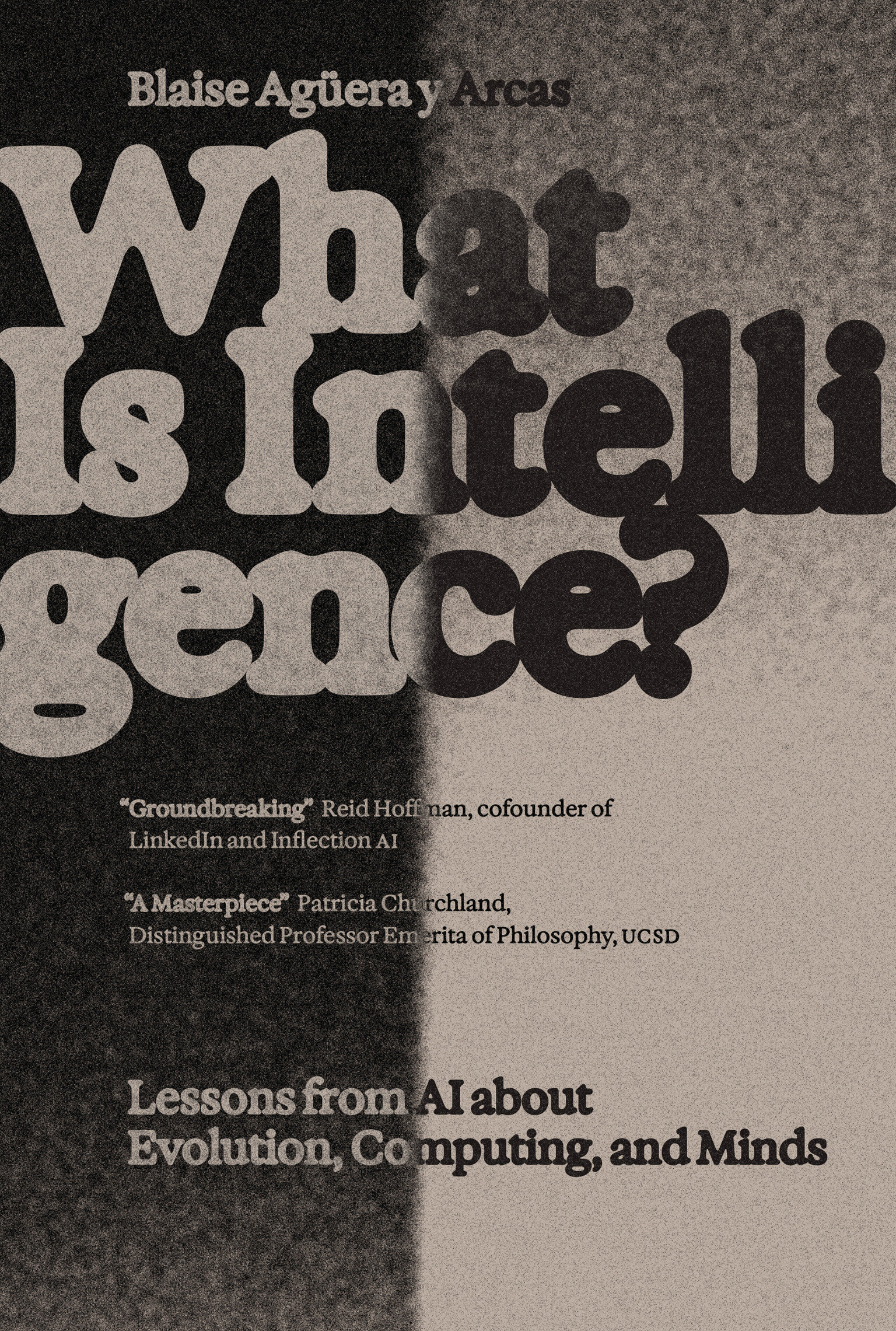
What Is Intelligence?
Lessons From AI About Evolution, Computing, and Minds
MIT Press · Print & ebook · September 23, 2025
What intelligence really is, and how AI’s emergence is a natural consequence of evolution.
We earn from qualifying purchases.
- Who it’s for
- A cross-disciplinary account connects prediction to intelligence, from living systems and societies to modern AI.
- Themes
- Prediction and intelligence, Evolution and artificial intelligence, Consciousness and free will
- Genres
- AI & Machine Learning, Neuroscience, Cognitive Science
Nearest books
Matched by what the books are about, then ordered by what their readers also loved. Most of these share its genre: AI & Machine Learning.
 If Anyone Builds It, Everyone DiesRafe Beckley, Eliezer Yudkowsky64% match
 Survival of the FriendliestBrian Hare, Vanessa Woods51% match
 SuperintelligenceNick Bostrom72% match
For younger readers: Future Tense, Basher Science Mini: Artificial Intelligence, What Is Artificial Intelligence?
Start with three books, and this one can be the first.
Members get a new edition every morning: a route out from their books to essays, research and talks, with the reason for each.
Join the waitlistAbout this book
What intelligence really is, and how AI’s emergence is a natural consequence of evolution. Included in the Financial Times's Best Books of 2025: Technology Included in Bloomberg News's "The 82 Books That Top Business Leaders Couldn’t Put Down" It has come as a shock to some AI researchers that a large neural net that predicts next words seems to produce a system with general intelligence.
Continue reading
Yet this is consistent with a long-held view among some neuroscientists that the brain evolved precisely to predict the future—the “predictive brain” hypothesis. In What Is Intelligence?, Blaise Agüera y Arcas takes up this idea—that prediction is fundamental not only to intelligence and the brain but to life itself—and explores the wide-ranging implications. These include radical new perspectives on the computational properties of living systems, the evolutionary and social origins of intelligence, the relationship between models and reality, entropy and the nature of time, the meaning of free will, the problem of consciousness, and the ethics of machine intelligence. The book offers a unified picture of intelligence from molecules to organisms, societies, and AI, drawing from a wide array of literature in many fields, including computer science and machine learning, biology, physics, and neuroscience. It also adds recent and novel findings from the author, his research team, and colleagues. Combining technical rigor and deep up-to-the-minute knowledge about AI development, the natural sciences (especially neuroscience), and philosophical literacy, What Is Intelligence? argues—quite against the grain—that certain modern AI systems do indeed have a claim to intelligence, consciousness, and free will.
Prediction, Reconsidered
A cross-disciplinary account connects prediction to intelligence, from living systems and societies to modern AI.
Come here for
- A predictive-brain lens spanning AI, neuroscience, evolution, and life
- Big questions about consciousness, free will, and machine intelligence
Expect
- Technical rigor alongside philosophical reach
- A bold case for taking some AI claims to intelligence seriously
Where it sits
| AI & Machine Learning | 79% |
|---|---|
| Neuroscience | 51% |
| Cognitive Science | 45% |
Percentages are BookFrontier’s reading of the book.
Publisher categories
- AI & Machine Learning
- Natural History
- Tech & Society
- Authors
- Blaise Aguera y Arcas
- Publisher
- MIT Press
- Published
- September 23, 2025
- Format
- Print & ebook
- Theme
- Prediction and intelligence · Evolution and artificial intelligence · Consciousness and free will
- Reading lane
- AI & Machine Learning