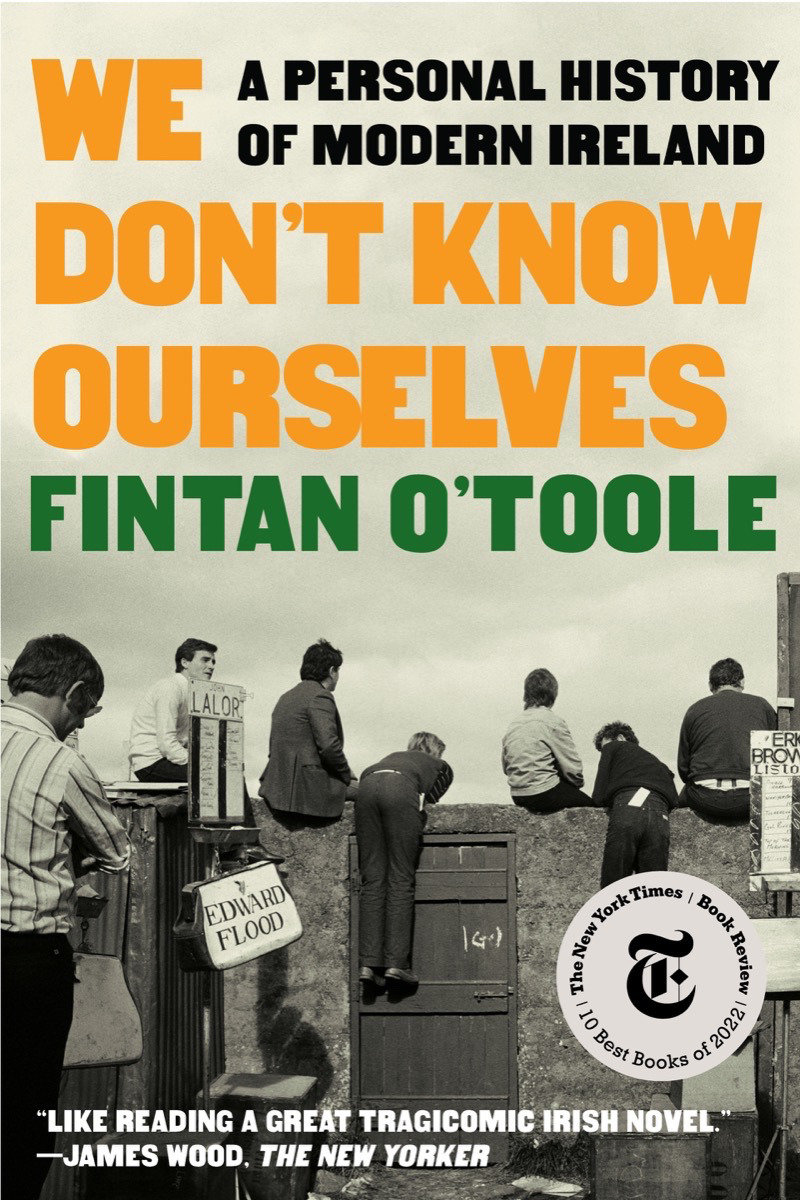
We Don't Know Ourselves
A Personal History of Modern Ireland
A reflective history that reads like an argument with memory, and stays lucid.
History, Lived
Come here for
- Ireland seen through a personal lens
- clean historical framing, no museum dust
Expect
- sustained narrative arc
- cultural context with a human scale
Where it sits
How strongly BookFrontier reads the book as belonging to each subject.
Nearest books
Matched by our semantic model. Ordered by what its readers also loved.
 An Unfinished Love StoryDoris Kearns Goodwin55% subject matchShares Personal Memoirs
 Say NothingPatrick Radden Keefe59% subject matchShares Irish History
 Age of RevolutionsFareed Zakaria51% subject match
 American MidnightAdam Hochschild50% subject match
 A Traveller's History of IrelandPeter Neville68% subject matchShares Irish History
 Heretics and HeroesThomas Cahill53% subject match
 This Is HappinessNiall Williams55% subject match
 The Immortal IrishmanTimothy Egan55% subject matchShares Irish History
For younger readers: The Storm Keeper's Island, Black Potatoes
Start with three books, and this one can be the first.
Members get a new edition every morning: a route out from their books to essays, research and talks, with the reason for each.
Sign upAbout this book
Fintan O’Toole was born in the year the revolution began. It was 1958, and the Irish government—in despair, because all the young people were leaving—opened the country to foreign investment and popular culture. So began a decades-long, ongoing experiment with Irish national identity.
Continue reading
In We Don’t Know Ourselves, O’Toole, one of the Anglophone world’s most consummate stylists, weaves his own experiences into Irish social, cultural, and economic change, showing how Ireland, in just one lifetime, has gone from a reactionary “backwater” to an almost totally open society—perhaps the most astonishing national transformation in modern history.
Born to a working-class family in the Dublin suburbs, O’Toole served as an altar boy and attended a Christian Brothers school, much as his forebears did. He was enthralled by American Westerns suddenly appearing on Irish television, which were not that far from his own experience, given that Ireland’s main export was beef and it was still not unknown for herds of cattle to clatter down Dublin’s streets. Yet the Westerns were a sign of what was to come. O’Toole narrates the once unthinkable collapse of the all-powerful Catholic Church, brought down by scandal and by the activism of ordinary Irish, women in particular. He relates the horrific violence of the Troubles in Northern Ireland, which led most Irish to reject violent nationalism. In O’Toole’s telling, America became a lodestar, from John F. Kennedy’s 1963 visit, when the soon-to-be martyred American president was welcomed as a native son, to the emergence of the Irish technology sector in the late 1990s, driven by American corporations, which set Ireland on the path toward particular disaster during the 2008 financial crisis.
A remarkably compassionate yet exacting observer, O’Toole in coruscating prose captures the peculiar Irish habit of “deliberate unknowing,” which allowed myths of national greatness to persist even as the foundations were crumbling. Forty years in the making, We Don’t Know Ourselves is a landmark work, a memoir and a national history that ultimately reveals how the two modes are entwined for all of us.
Publisher details
Publisher categories
- Political Lives
- Lives in Journalism
- Irish History
- Authors
- Fintan O'Toole
- Publisher
- WW Norton
- Published
- February 7, 2023
- Format
- Print & ebook
- Reading lane
- Political Lives