
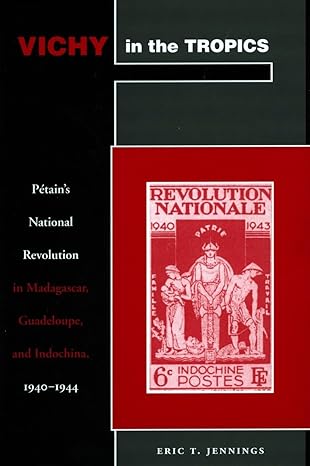
Book
Vichy in the Tropics
Pétain’s National Revolution in Madagascar, Guadeloupe, and Indochina, 1940-44
Eric T. Jennings
Stanford University Press · Print & ebook · January 5, 2004
Reading lane: North African History
This book examines the role of the Vichy regime in bringing about profound changes in the French colonial empire after World War II.
Disclosure: Some outbound links are affiliate links. If you buy through them, we may earn a commission. It doesn't affect which books we include. Learn more in our disclosure policy.
At a Glance
Who It's For
Book Details
- Authors
- Eric T. Jennings
- Publisher
- Stanford University Press
- Published
- January 5, 2004
- Format
- Print & ebook
- Theme
- North African History · 19th‑Century History
- Reading lane
- North African History
Affinity
Publisher Categories
European History
20th‑Century History
About This Book
This book examines the role of the Vichy regime in bringing about profound changes in the French colonial empire after World War II. In the war's aftermath, the French colonial system began to break down. Indochina erupted into war in 1945 and Madagascar in 1947, while Guadeloupe chose an opposite course, becoming territorially part of France in 1946. The book traces the introduction of an integralist ideology of "National Revolution" to the French colonial realm, shedding n...
Read full description
Similar Books

Thunder at Twilight
Frederic Morton · Hachette Books
Shared affinity
North African History

The Dawn Watch
Maya Jasanoff · Penguin Publishing Group
Shared affinity
North African History

Resistance and Revenge
Jacques Derogy · Transaction Publishers
Shared affinity
North African History

Profiles in Courage
John F. Kennedy, John Fitzgerald Kennedy · HarperCollins
Shared affinity
Affinity match is still building for this title.

A Fistful of Shells
Toby Green · Penguin UK
Shared affinity
Affinity match is still building for this title.

1848
Mike Rapport, Hugh Kermode · Basic Books
Shared affinity
North African History
East Africa Campaign 1940-41
Pier Paolo Battistelli, Johnny Shumate · Osprey
Shared affinity
Affinity match is still building for this title.

The Black Count
Tom Reiss · Crown
Shared affinity
North African History