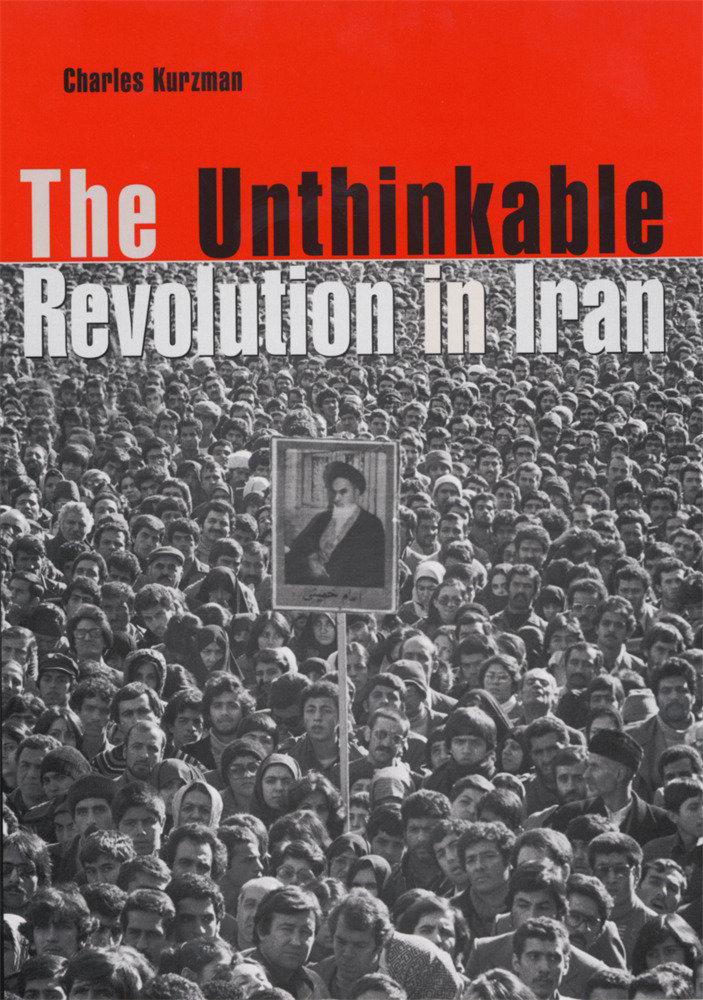
Unthinkable Revolution in Iran
Charles Kurzman traces how confusion, expectation, and collective action shaped Iran’s revolution.
When Certainty Breaks
Come here for
- A close look at why Iran’s revolution seemed unimaginable until it happened
- Protest movements without the comfort of hindsight
Expect
- Interviews, eyewitness accounts, declassified documents, and underground pamphlets
- A challenge to the idea that revolutions look inevitable in retrospect
Where it sits
How strongly BookFrontier reads the book as belonging to each subject.
Nearest books
Matched by our semantic model. Ordered by what its readers also loved. Most of these share its genres: Iranian History and Middle Eastern Politics.
 All the Shah's MenStephen Kinzer69% subject match
 Shah of ShahsRyszard Kapuscinski73% subject matchAlso shares Revolutionary History
 Revolutionary IranMichael Axworthy72% subject matchAlso shares Revolutionary History
 The Fall of HeavenAndrew Scott Cooper72% subject match
 King of KingsScott Anderson68% subject matchAlso shares Revolutionary History
 Iran's Rise and Rivalry with the US in the Middle EastMohsen M. Milani65% subject match
 A History of IranMichael Axworthy62% subject match
 What Iranians WantArash Azizi62% subject match
For younger readers: Lost Boys, The Teacher of Nomad Land, Everything Sad Is Untrue (A true story)
Start with three books, and this one can be the first.
Members get a new edition every morning: a route out from their books to essays, research and talks, with the reason for each.
Sign upAbout this book
The shah of Iran, Mohammad Reza Pahlavi, would remain on the throne for the foreseeable future: This was the firm conclusion of a top-secret CIA analysis issued in October 1978. One hundred days later the shah--despite his massive military, fearsome security police, and superpower support was overthrown by a popular and largely peaceful revolution.
Continue reading
But the CIA was not alone in its myopia, as Charles Kurzman reveals in this penetrating work; Iranians themselves, except for a tiny minority, considered a revolution inconceivable until it actually occurred. Revisiting the circumstances surrounding the fall of the shah, Kurzman offers rare insight into the nature and evolution of the Iranian revolution and into the ultimate unpredictability of protest movements in general.
As one Iranian recalls, "The future was up in the air." Through interviews and eyewitness accounts, declassified security documents and underground pamphlets, Kurzman documents the overwhelming sense of confusion that gripped pre-revolutionary Iran, and that characterizes major protest movements. His book provides a striking picture of the chaotic conditions under which Iranians acted, participating in protest only when they expected others to do so too, the process approaching critical mass in unforeseen and unforeseeable ways. Only when large numbers of Iranians began to "think the unthinkable," in the words of the U.S. ambassador, did revolutionary expectations become a self-fulfilling prophecy. A corrective to 20-20 hindsight, this book reveals shortcomings of analyses that make the Iranian revolution or any major protest movement seem inevitable in retrospect.
Publisher details
Publisher categories
- Middle Eastern History
- International Relations
- Authors
- Charles Kurzman
- Publisher
- WW Norton
- Published
- September 6, 2005
- Format
- Print & ebook
- Reading lane
- Middle Eastern History