
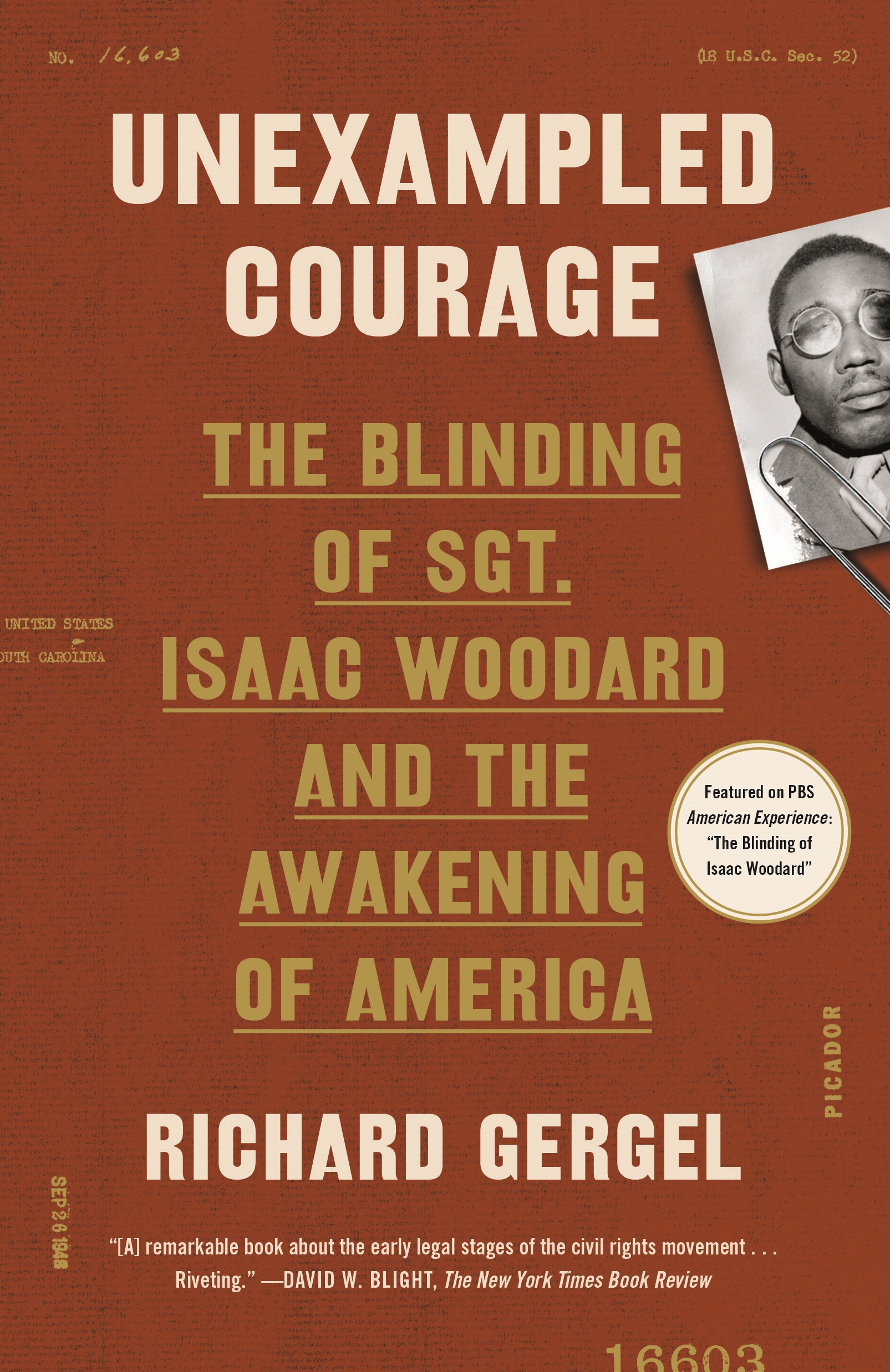
Book
Unexampled Courage
The Blinding of Sgt. Isaac Woodard and the Awakening of America
Richard Gergel
Picador · Print & ebook · February 18, 2020
Reading lane: Civil War Era
*The book that inspired the 2021 PBS American Experience documentary, The Blinding of Isaac Woodard.* How the blinding of Sergeant Isaac Woodard changed the course of America’s civil rights history.
At a Glance
Why This Clicks
History in Motion
Trace how one act of racial violence reverberated through presidential action and judicial dissent.
Come here for
- The connection between Woodard’s case and landmark civil rights decisions
- A close look at Truman’s response and Waring’s changing convictions
Expect
- A focused account of outrage, legal failure, and consequential dissent
- Clear links between one episode and wider civil rights change
Book Details
- Authors
- Richard Gergel
- Publisher
- Picador
- Published
- February 18, 2020
- Format
- Print & ebook
- Theme
- Civil War Era · 20th-Century America
- Reading lane
- Civil War Era
Affinity
Publisher Categories
20th-Century America
Civil Rights
African American Studies
About This Book
*The book that inspired the 2021 PBS American Experience documentary, The Blinding of Isaac Woodard.* How the blinding of Sergeant Isaac Woodard changed the course of America’s civil rights history. Richard Gergel’s Unexampled Courage details the impact of the blinding of Sergeant Woodard on the racial awakening of President Truman and Judge Waring, and traces their influential roles in changing the course of America’s civil rights history. On February 12, 1946, Sergeant Isa...
Read full description
Similar Books

The Rest I Will Kill
Brian McGinty · WW Norton
Affinity signal
Civil War Era
19th-Century America
Waging a Good War
Thomas E Ricks · Picador
Affinity signal
U.S. Military History
Guerrilla Warfare

The Record of Murders and Outrages
William A. Blair · The University of North Carolina Press
Affinity signal
Civil War Era
19th-Century America

Stony the Road
Henry Louis Gates Jr. · Penguin Publishing Group
Affinity signal
Black & African American Lives
19th-Century America

Freedom Lost, Freedom Won
Eugene Robinson · Simon & Schuster
Affinity signal
Black & African American Lives
19th-Century America

Stolen Justice: the Struggle for African American Voting Rights (scholastic Focus)
Lawrence Goldstone · Scholastic Inc.
Affinity signal
Civil & Human Rights for Teens
African American U.S. History for Teens

The Flag Never Touched the Ground
Kekla Magoon, Amerigo Pinelli · Pushkin Press
Affinity signal
Civil War Era (U.S.)
Civil War Era
Stride Toward Freedom
Dr. Martin Luther King, Jr. · Beacon Press
Affinity signal
Black & African American Lives
African American U.S. History for Teens