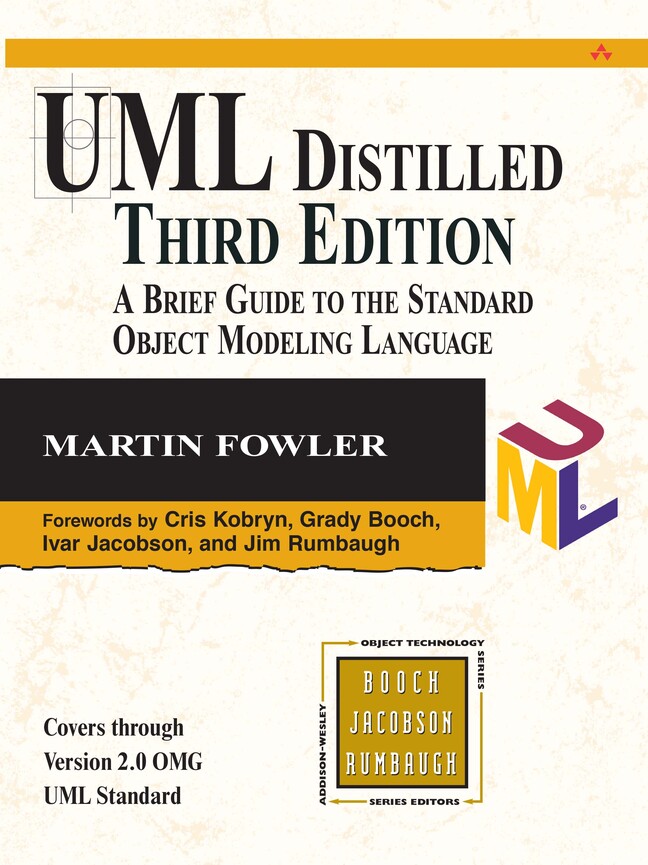
UML Distilled
A Brief Guide to the Standard Object Modeling Language
A concise guide for getting oriented in UML and finding your way back to its notation.
- Themes
- UML notation and diagrams, Object-oriented software design, Software modeling
- Pacing
- Fast
UML, Unpacked
Come here for
- Clear explanations of what major UML diagrams are used for
- The design logic behind notation, without a long detour
Expect
- A focused overview suited to learning or quick reference
- A quick reference to useful notation and UML 2.0 diagram types
Where it sits
How strongly BookFrontier reads the book as belonging to each subject.
Nearest books
Matched by our semantic model. Ordered by what its readers also loved. Most of these share its genre: Object-Oriented Programming.
 Extreme Programming ExplainedKent Beck, Cynthia Andres48% subject match
 Patterns of Enterprise Application ArchitectureMartin Fowler60% subject matchAlso shares Systems Design
 Java in a NutshellBenjamin Evans, David Flanagan49% subject matchAlso shares Computer Resources
 Effective JavaJoshua Bloch53% subject match
 Growing Object-Oriented Software, Guided by TestsSteve Freeman, Nat Pryce54% subject matchAlso shares Systems Design
 Docker in Action, Second EditionJeffrey Nickoloff, Stephen Kuenzli47% subject match
 Agile Software Development, Principles, Patterns, and PracticesRobert C. Martin65% subject matchAlso shares Systems Design
 Code CompleteSteve McConnell51% subject match
Start with three books, and this one can be the first.
Members get a new edition every morning: a route out from their books to essays, research and talks, with the reason for each.
Sign upAbout this book
More than 300,000 developers have benefited from past editions of UML Distilled . This third edition is the best resource for quick, no-nonsense insights into understanding and using UML 2.0 and prior versions of the UML.
Some readers will want to quickly get up to speed with the UML 2.0 and learn the essentials of the UML. Others will use this book as a handy, quick reference to the most common parts of the UML.
Continue reading
The author delivers on both of these promises in a short, concise, and focused presentation.
This book describes all the major UML diagram types, what they're used for, and the basic notation involved in creating and deciphering them. These diagrams include class, sequence, object, package, deployment, use case, state machine, activity, communication, composite structure, component, interaction overview, and timing diagrams. The examples are clear and the explanations cut to the fundamental design logic. Includes a quick reference to the most useful parts of the UML notation and a useful summary of diagram types that were added to the UML 2.0.
If you are like most developers, you don't have time to keep up with all the new innovations in software engineering. This new edition of Fowler's classic work gets you acquainted with some of the best thinking about efficient object-oriented software design using the UML--in a convenient format that will be essential to anyone who designs software professionally.
Publisher details
Publisher categories
- Object-Oriented Programming
- Authors
- Martin Fowler
- Publisher
- Pearson Education
- Published
- September 15, 2003
- Format
- Print & ebook
- Reading lane
- Object-Oriented Programming