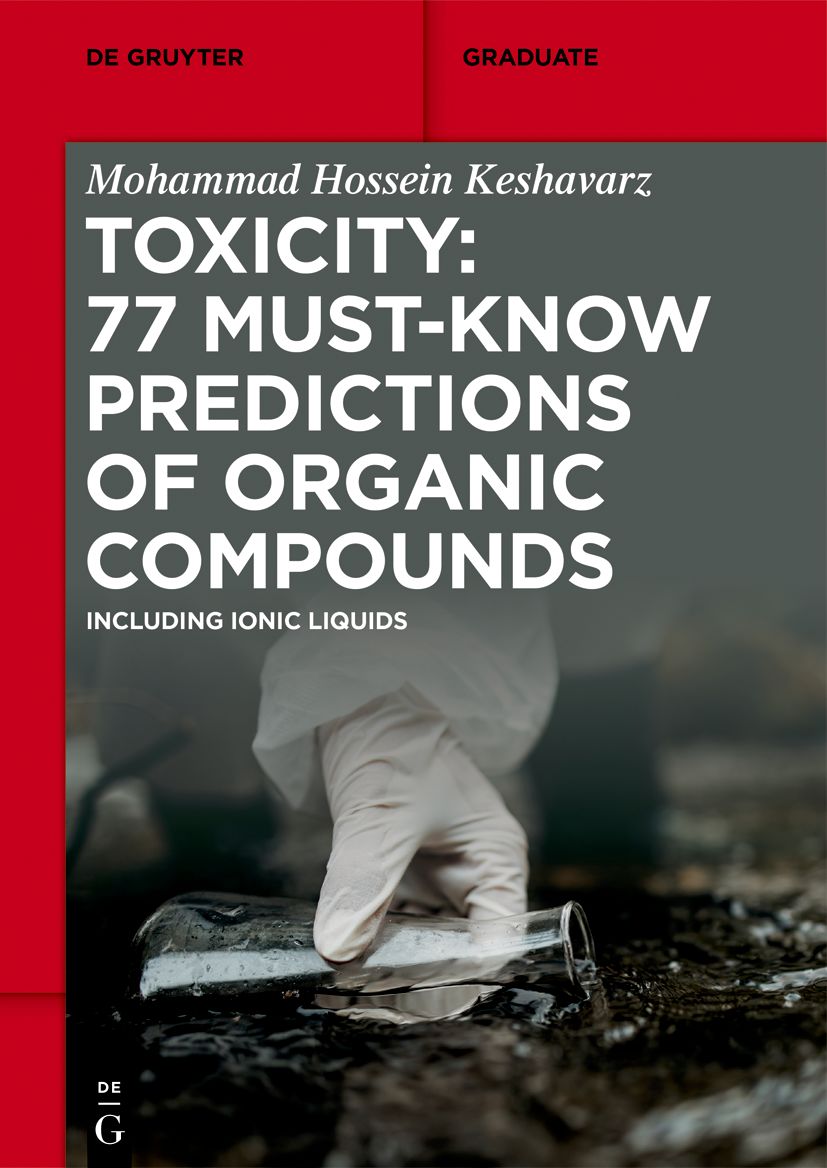
Toxicity: 77 Must-Know Predictions of Organic Compounds
Including Ionic Liquids
Series: De Gruyter Textbook
Explore QSTR models, toxicity parameters, and comparisons of predictive methods for organic compounds and ionic liquids.
QSTR Toxicity Models
Come here for
- QSTR models for predicting toxicity in organic compounds and ionic liquids
- Comparisons of model reliability and shortcomings
Expect
- Coverage of LD₅₀, EC₅₀, and log(IGC₅₀⁻¹)
- Chapter problems with answers
Where it sits
How strongly BookFrontier reads the book as belonging to each subject.
Nearest books
Matched by our semantic model. Ordered by what its readers also loved.
 Drug-Like PropertiesLi Di, Edward H Kerns56% subject matchShares Toxicology
 A Practical Guide to Toxicology and Human Health Risk AssessmentLaura Robinson54% subject match
 Chemometrics and Cheminformatics in Aquatic ToxicologyKunal Roy54% subject matchShares Toxicology and Molecular Modeling
 Effect-Directed Analysis of Complex Environmental ContaminationWerner Brack53% subject matchShares Toxicology
 Principles of ToxicologyStephen M. Roberts, Robert C. James52% subject match
 Environmental ToxicologyMohd. Salim Reshi, Darakhshan Javaid52% subject matchShares Toxicology
 Essentials of ToxicologyJaenette Mountford52% subject match
 Essentials of ToxicologyBraylon Holden51% subject match
Start with three books, and this one can be the first.
Members get a new edition every morning: a route out from their books to essays, research and talks, with the reason for each.
Sign upAbout this book
Due to the advances of various methods for the prediction of toxicity of organic compounds and ionic liquids (ILs), it is necessary to review these methods for scientists and students. It is essential to compare the advantages and shortcomings of these methods. Since many organic compounds and ILs are synthesized each year, this book introduces suitable models for the assessment of their toxicities.
Continue reading
This book reviews the best predictive methods for the prediction of toxicity of organic compounds and ILs, which were derived by in vitro or in vivo experiments. Different available quantitative structure‐toxicity relationship (QSTR) models based on various descriptors have been discussed to predict toxicity parameters such as LD50 (50% lethal dose), EC50 (the concentration of the desired IL that produces mortality of 50 percent of the bacterial population) and log(IGC50-1) (logarithm of 50% growth inhibitory concentration of T. pyriformis) of various classes of organic compounds and ILs. The reliability of these methods is compared and discussed. Each chapter contains some complimentary problems with their answers, which can improve the experience of students and researchers.
The introduced subjects are suitable for advanced students in chemistry, biochemistry, medicinal chemistry, and chemical engineering.
Publisher details
Publisher categories
- Analytical Chemistry
- Organic Chemistry
- Physical Chemistry
- Toxicology
Show all 5 publisher categories
- Chemical & Biochemical Engineering
- Authors
- Mohammad Hossein Keshavarz
- Publisher
- De Gruyter
- Published
- October 4, 2023
- Format
- Print & ebook
- Reading lane
- Analytical Chemistry