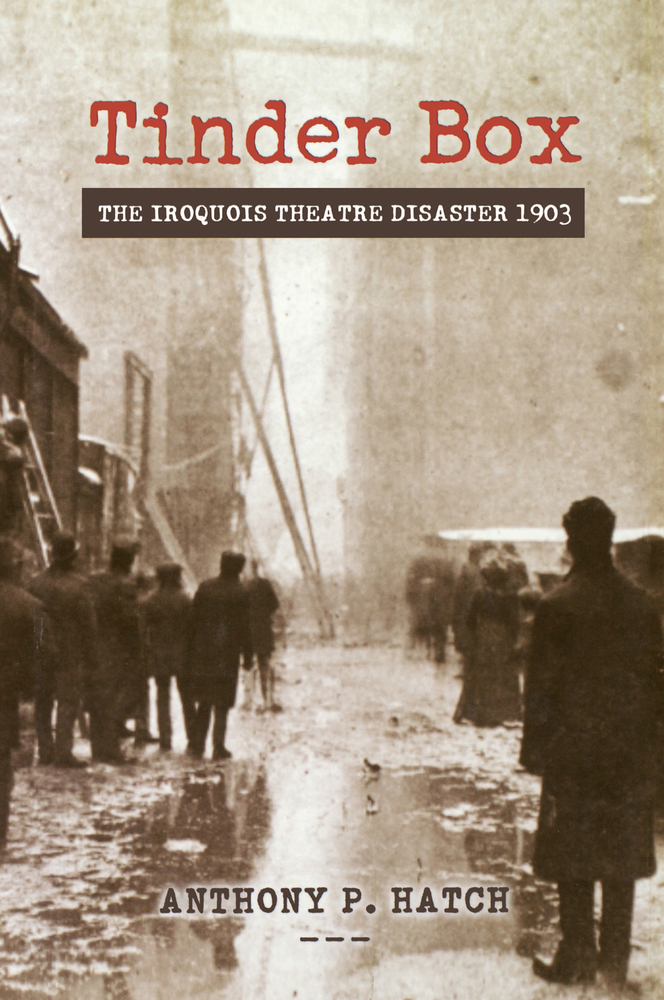
Tinder Box
The Iroquois Theatre Disaster 1903
A celebrated Chicago theater’s promise of safety gave way to catastrophe and public scandal.
- Themes
- Theater fire, Institutional corruption, Mass-casualty disaster
Theater’s Darkest Night
Come here for
- The uneasy intersection of theater history and public safety
- A case where official assurances met glaring failures
Expect
- A devastating fire during a crowded matinee
- Questions of access, oversight, and accountability
Where it sits
How strongly BookFrontier reads the book as belonging to each subject.
Nearest books
Matched by our semantic model. Ordered by what its readers also loved.
 The Children's BlizzardDavid Laskin39% subject match
 The Flight 981 DisasterSamme Chittum44% subject match
 Fire on the MountainJohn N. Maclean39% subject matchShares 20th-Century America
 Hellfire BoysTheo Emery40% subject match
 Gramercy ParkPaula Cohen42% subject match
 Johnstown FloodDavid McCullough47% subject match
 Flight 232Laurence Gonzales45% subject matchShares Disaster & Crisis Studies
 FirestormJacob Soboroff41% subject matchShares Disaster & Crisis Studies
For younger readers: I Survived the Great Chicago Fire, 1871, I Survived the Galveston Hurricane, 1900, Spooked!
Start with three books, and this one can be the first.
Members get a new edition every morning: a route out from their books to essays, research and talks, with the reason for each.
Sign upAbout this book
The Iroquois Theater in Chicago, boasting every modern convenience, advertised itself proudly as “absolutely fireproof” when it opened in November, 1903. Mr. Bluebeard, a fairy tale musical imported from the Drury Lane Theatre in London was the opening production. And leading the troupe of nearly 400 was one of the most popular comedians of the time, Eddie Foy.
Continue reading
None of the many socialites and journalists who flocked to the shows were aware that city building inspectors and others had been bribed to certify that the theater was in good shape. In fact, the building was without a sprinkler system or even basic fire fighting equipment; there was no backstage telephone, fire alarm box, exit signs, a real asbestos curtain or ushers trained for emergencies.
A month later, at a Christmas week matinee, the theater was illegally overcrowded with a standing room only crowd of mostly women and children. During the second act, a short circuit exploded a back stage spotlight touching off a small fire which spread in minutes throughout the theater. Panic set in as people clawed at each other to get out, but they could not find the exits, which were draped. The doorways, locked against gate-crashers, were designed to open in instead of out, creating almost impossible egress.
The tragedy, which claimed more than 600 lives, became a massive scandal and it remains the worst theater fire in the history of the country.
Publisher details
Publisher categories
- 20th-Century America
- Midwest History
- Disaster & Crisis Studies
- Authors
- Anthony P. Hatch
- Publisher
- Chicago Review Press
- Published
- February 1, 2003
- Format
- Print & ebook
- Reading lane
- 20th-Century America