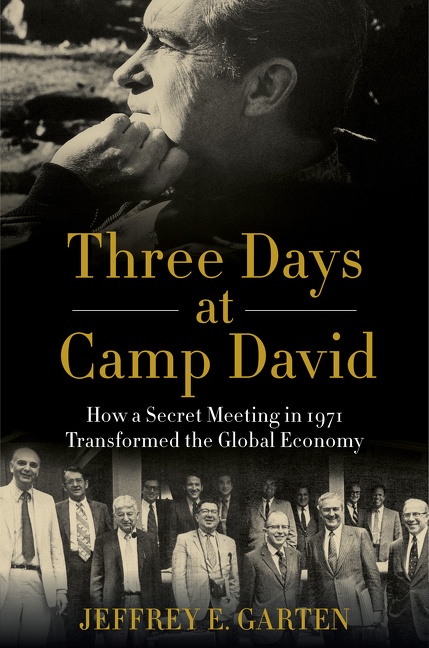
Three Days at Camp David
How a Secret Meeting in 1971 Transformed the Global Economy
A secret 1971 decision becomes a clear-eyed account of how the global monetary system changed.
- Themes
- Global monetary system, End of the gold standard, Market instability and trade
A Monetary Turning Point
Come here for
- The high-stakes intersection of presidential power and international finance
- A pivotal weekend with consequences for markets, trade, and America’s role
Expect
- A focused historical narrative grounded in research and participant interviews
- An account that weighs instability against the growth of cross-border trade
Where it sits
How strongly BookFrontier reads the book as belonging to each subject.
Nearest books
Matched by our semantic model. Ordered by what its readers also loved.
 America's BankRoger Lowenstein58% subject matchShares Money & Monetary Policy and 20th-Century America
 America in the WorldRobert B. Zoellick53% subject match
 The Wizards of ArmageddonFred Kaplan48% subject match
 The Oil KingsAndrew Scott Cooper59% subject matchShares 20th-Century America
Start with three books, and this one can be the first.
Members get a new edition every morning: a route out from their books to essays, research and talks, with the reason for each.
Sign upAbout this book
The former dean of the Yale School of Management and Undersecretary of Commerce in the Clinton administration chronicles the 1971 August meeting at Camp David, where President Nixon unilaterally ended the last vestiges of the gold standard—breaking the link between gold and the dollar—transforming the entire global monetary system.
Continue reading
Over the course of three days—from August 13 to 15, 1971—at a secret meeting at Camp David, President Richard Nixon and his brain trust changed the course of history. Before that weekend, all national currencies were valued to the U.S. dollar, which was convertible to gold at a fixed rate. That system, established by the Bretton Woods Agreement at the end of World War II, was the foundation of the international monetary system that helped fuel the greatest expansion of middle-class prosperity the world has ever seen.
In making his decision, Nixon shocked world leaders, bankers, investors, traders and everyone involved in global finance. Jeffrey E. Garten argues that many of the roots of America’s dramatic retrenchment in world affairs began with that momentous event that was an admission that America could no longer afford to uphold the global monetary system. It opened the way for massive market instability and speculation that has plagued the world economy ever since, but at the same time it made possible the gigantic expansion of trade and investment across borders which created our modern era of once unimaginable progress.
Based on extensive historical research and interviews with several participants at Camp David, and informed by Garten’s own insights from positions in four presidential administrations and on Wall Street, Three Days at Camp David chronicles this critical turning point, analyzes its impact on the American economy and world markets, and explores its ramifications now and for the future.
Publisher details
Publisher categories
- Business Ethics
- Economic History
- International Economics
- Development Studies
Show all 8 publisher categories
- 20th-Century America
- World History
- Political Philosophy
- State & Provincial Government
- Authors
- Jeffrey E. Garten
- Publisher
- HarperCollins
- Published
- July 6, 2021
- Format
- Print & ebook
- Reading lane
- Business Ethics