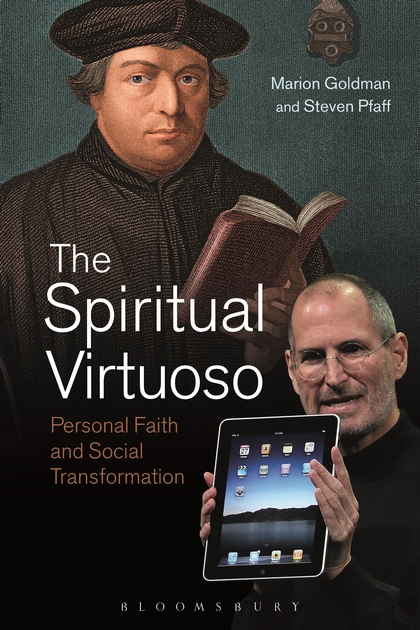
The Spiritual Virtuoso
Personal Faith and Social Transformation
A history of how personal spiritual striving has shaped movements and institutions.
Spiritual Practice, Social Change
Come here for
- Spiritual virtuosity traced from the Reformation through the twentieth century
- Connections between personal faith and social transformation
Expect
- Examples include the Anti-Slavery and Human Potential movements
- Attention to religious equality and changing spiritual practice
Where it sits
How strongly BookFrontier reads the book as belonging to each subject.
Nearest books
Matched by our semantic model. Ordered by what its readers also loved.
 Kingdom CallingAmy L. Sherman49% subject match
 The Great WithinHan F. de Wit47% subject match
 Christian SpiritualityDonald Alexander46% subject match
 Transcendentalism and the Cultivation of the SoulBarry M. Andrews46% subject matchShares Spirituality
 The Life You've Always WantedJohn Ortberg46% subject match
 PrimalMark Batterson46% subject match
 ConflagrationJohn A. Buehrens45% subject match
 Calling in ContextSusan L. Maros45% subject match
For younger readers: Inner Dynamics of the People of Hizmet, Stories of the Spirit of Justice
Start with three books, and this one can be the first.
Members get a new edition every morning: a route out from their books to essays, research and talks, with the reason for each.
Sign upAbout this book
Marion Goldman and Steven Pfaff define a spiritual virtuoso as someone who works toward personal purification and a sense of holiness with the same perseverance and intensity that virtuosi strive to excel in the arts or athletics. Since the Protestant Reformation, activist virtuosi have come together in large and small social movements to redefine the meanings of spiritual practice, support religious equality, and transform a wide range of social institutions.
Continue reading
Tracing the impact of spiritual virtuosi from the sixteenth century Reformation through the nineteenth-century Anti-Slavery Movement to the twentieth-century Human Potential Movement and beyond, Marion Goldman and Steven Pfaff explore how personal virtuosity can become a social force. Martin Luther began to expand spiritual possibilities in the West when he charted paths that did not require the Church's intercession between the individual and God. He believed thateveryonecould and should reach toward sacred truths and transcendent moments. Over the centuries, millions of people have built on his innovations and embarked on spiritual quests that offer new possibilities for sacred relationships and social change.
Publisher details
Publisher categories
- Religion & Spirituality
- Authors
- Marion Goldman, Steven Pfaff
- Publisher
- Bloomsbury Academic
- Published
- December 14, 2017
- Format
- Print & ebook
- Reading lane
- Religion & Spirituality