
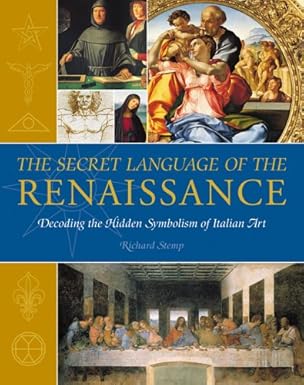
Book
The Secret Language of the Renaissance
Decoding the Hidden Symbolism of Italian Art
Richard Stemp
Duncan Baird · Print & ebook · October 28, 2006
Reading lane: Renaissance Art History
During the Renaissance, artists traditionally encoded meanings into symbols, some of which drew upon a traditional repertoire available to educated people in the era.
At a Glance
Who It's For
Book Details
- Authors
- Richard Stemp
- Publisher
- Duncan Baird
- Published
- October 28, 2006
- Format
- Print & ebook
- Theme
- Renaissance Art History · Renaissance History
- Reading lane
- Renaissance Art History
Affinity
Publisher Categories
Renaissance Art History
About This Book
During the Renaissance, artists traditionally encoded meanings into symbols, some of which drew upon a traditional repertoire available to educated people in the era. These hidden messages?which ranged from the esoteric to the political to the religious?could be communicated in everything from the position of a hand to the placement of the sun and moon. The Secret Language of the Renaissance helps us discover them anew, as lecturer, author, and director Richard Stemp teaches...
Read full description
Similar Books

Renaissance Art Reconsidered
Carol M. Richardson, Kim W. Woods · Wiley
Affinity signal
Renaissance Art History
Renaissance History
Botticelli's Secret
Joseph Luzzi · WW Norton
Affinity signal
Renaissance Art History
Renaissance History
The Sistine Secrets
Benjamin Blech, Roy Doliner · HarperCollins
Affinity signal
Renaissance Art History
Renaissance History

The Feud That Sparked the Renaissance
Paul Robert Walker, Simon Vance · HarperCollins
Affinity signal
Renaissance History
Renaissance Art History

Leonardo and the Last Supper
Ross King · Bloomsbury USA
Affinity signal
Renaissance Art History
Renaissance History