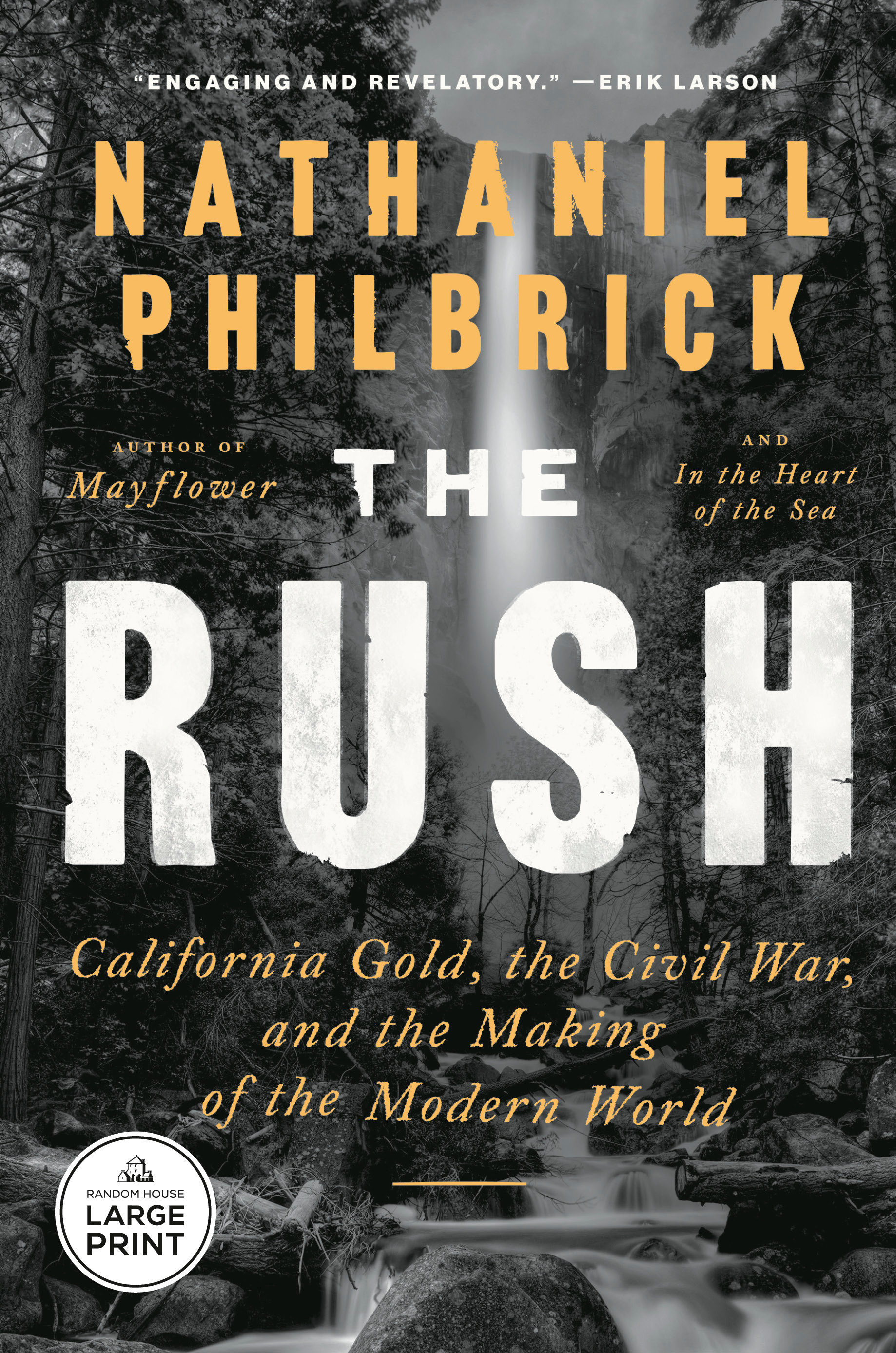
The Rush
California Gold, the Civil War, and the Making of the Modern World
Diversified Publishing · Print & ebook · Forthcoming
National Book Award winner and Pulitzer Prize finalist Nathaniel Philbrick, author of In the Heart of the Sea and Mayflower, reveals how California’s Gold Rush forged the modern United States—and lit the long fuse to civil war In January 1848, a carpenter spotted flecks of gold in a shallow stream at Sutter’s Mill in California—triggering the greatest voluntary migration in U.S. history and jolting a fragile republic already sliding toward crisis.
We earn from qualifying purchases.
- Who it’s for
- Readers interested in how California's Gold Rush shaped the United States and Civil War
- Themes
- California Gold Rush and Civil War, Xenophobia and dispossession, Freedom, labor, and belonging
- Genres
- Western U.S. History, Civil War Era, 19th-Century America
Nearest books
Matched by what the books are about, then ordered by what their readers also loved.
 RushStephen Fried56% match
 The Undiscovered CountryPaul Andrew Hutton63% matchShares Western U.S. History and 19th-Century America
 1861Jay Winik55% matchShares Civil War Era
 Strangers in the LandEric Yang, Michael Luo54% match
 In the Hurricane's EyeNathaniel Philbrick53% match
 Golden StateMichael Hiltzik75% matchShares Western U.S. History and 19th-Century America
 War Without MercyMark Edward Lender, James Kirby Martin55% match
 The American RevolutionGeoffrey C. Ward, Ken Burns62% match
For younger readers: Two Miserable Presidents, King George: What Was His Problem?, History Comics: the Transcontinental Railroad
Start with three books, and this one can be the first.
Members get a new edition every morning: a route out from their books to essays, research and talks, with the reason for each.
Start with this bookAbout this book
National Book Award winner and Pulitzer Prize finalist Nathaniel Philbrick, author of In the Heart of the Sea and Mayflower, reveals how California’s Gold Rush forged the modern United States—and lit the long fuse to civil war In January 1848, a carpenter spotted flecks of gold in a shallow stream at Sutter’s Mill in California—triggering the greatest voluntary migration in U.S. history and jolting a fragile republic already sliding toward crisis.
Continue reading
In The Rush, Nathaniel Philbrick transforms the Gold Rush from a tale of sudden riches into the origin story of America’s modern contradictions: capital consolidated at dizzying speed, democracy in thrall to private power, xenophobia weaponized in the name of liberty—and a stubborn belief in the American experiment that refuses to die. This is the story of a nation tearing at the seams—a republic tested by its own ideals. From the feverish gold-mining camps of the Sierra Nevada mountains to the wharves and vigilance committees of San Francisco, Philbrick renders a combustible, all-world society: Chilean brothers reinventing themselves to outrun prejudice; Native communities navigating dispossession and violence; the merchant-showman Samuel Brannan, drawn into the center of early vigilantism; and the politicians vying for control of California’s future—the ambitious free-soil political boss David Broderick, who squared off against William Gwin, the Southern power broker intent on tilting the state toward slavery and the Confederacy. Not until a year after the outbreak of the Civil War, when President Lincoln signed legislation that would unite the nation east to west by building a transcontinental railroad, was California’s loyalty secured. Philbrick follows the gold as it moves from riverbed to countinghouse to the halls of power, revealing how vigilantism hardened into law and how debates over slavery in the West tipped the balance in Washington. The result is a clear, human story of how a scramble for wealth reshaped ideas of freedom, labor, and belonging—and how California's rise helped push a fractured nation toward war. The Rush is alive with characters whose choices still reverberate: a searing, panoramic epic that captures both the fury and the promise of America.
Who it’s for
- Readers interested in how California's Gold Rush shaped the United States and Civil War
- Readers interested in the Gold Rush's effects on freedom, labor, and belonging
Where it sits
| 19th-Century America | 78% |
|---|---|
| Civil War Era | 69% |
| Western U.S. History | 60% |
Percentages are BookFrontier’s reading of the book.
Publisher categories
- U.S. State & Local History
- 19th-Century America
- Exploration & Discovery
- Authors
- Nathaniel Philbrick
- Publisher
- Diversified Publishing
- Published
- Forthcoming
- Format
- Print & ebook
- Theme
- California Gold Rush and Civil War · Xenophobia and dispossession · Freedom, labor, and belonging
- Reading lane
- U.S. State & Local History