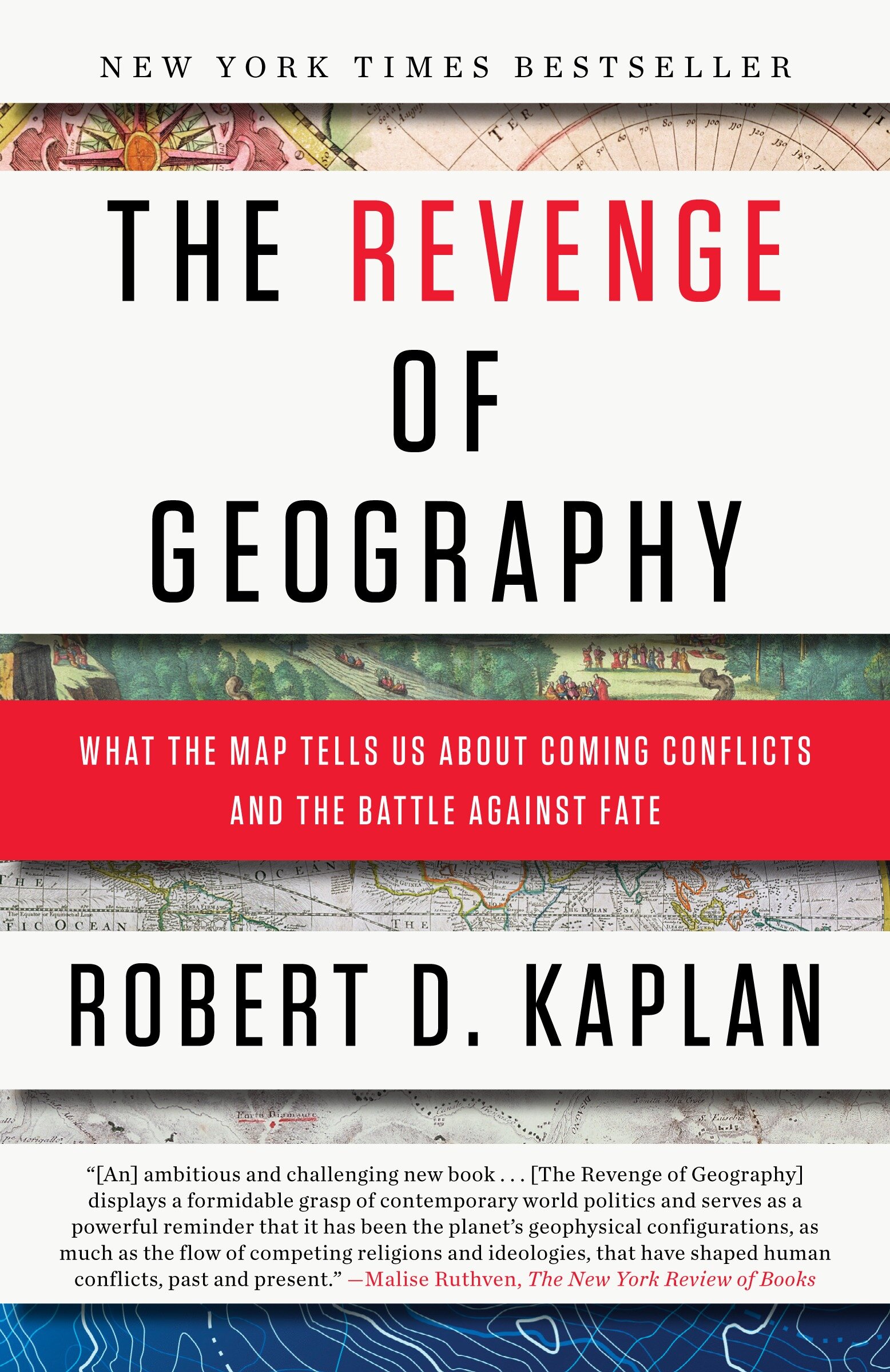
The Revenge of Geography
What the Map Tells Us About Coming Conflicts and the Battle Against Fate
Explore how terrain, climate, and proximity shape the pressures behind global conflict.
- Themes
- Geography and geopolitics, Historical roots of conflict, Global crises
Reading the Map
Come here for
- A geographic lens on history and present-day crises
- Connections between physical constraints and political choices
Expect
- A serious, contemplative view of geopolitics
- A broad sweep across Eurasia and beyond
Where it sits
How strongly BookFrontier reads the book as belonging to each subject.
Nearest books
Matched by our semantic model. Ordered by what its readers also loved.
 The Power of GeographyTim Marshall67% subject matchShares Geopolitics, International Relations and Human Geography
 Balkan GhostsRobert D. Kaplan61% subject match
 Age of RevolutionsFareed Zakaria64% subject matchShares Geopolitics
 MapheadKen Jennings54% subject matchShares Human Geography
 Lawrence in ArabiaScott Anderson54% subject match
For younger readers: The Kingfisher Atlas of the Modern World
Start with three books, and this one can be the first.
Members get a new edition every morning: a route out from their books to essays, research and talks, with the reason for each.
Sign upAbout this book
NEW YORK TIMES BESTSELLER • In this “ambitious and challenging” (The New York Review of Books) work, the bestselling author of Monsoon and Balkan Ghosts offers a revelatory prism through which to view global upheavals and to understand what lies ahead for continents and countries around the world.
Continue reading
In The Revenge of Geography, Robert D. Kaplan builds on the insights, discoveries, and theories of great geographers and geopolitical thinkers of the near and distant past to look back at critical pivots in history and then to look forward at the evolving global scene. Kaplan traces the history of the world’s hot spots by examining their climates, topographies, and proximities to other embattled lands. The Russian steppe’s pitiless climate and limited vegetation bred hard and cruel men bent on destruction, for example, while Nazi geopoliticians distorted geopolitics entirely, calculating that space on the globe used by the British Empire and the Soviet Union could be swallowed by a greater German homeland.
Kaplan then applies the lessons learned to the present crises in Europe, Russia, China, the Indian subcontinent, Turkey, Iran, and the Arab Middle East. The result is a holistic interpretation of the next cycle of conflict throughout Eurasia. Remarkably, the future can be understood in the context of temperature, land allotment, and other physical certainties: China, able to feed only 23 percent of its people from land that is only 7 percent arable, has sought energy, minerals, and metals from such brutal regimes as Burma, Iran, and Zimbabwe, putting it in moral conflict with the United States. Afghanistan’s porous borders will keep it the principal invasion route into India, and a vital rear base for Pakistan, India’s main enemy. Iran will exploit the advantage of being the only country that straddles both energy-producing areas of the Persian Gulf and the Caspian Sea. Finally, Kaplan posits that the United States might rue engaging in far-flung conflicts with Iraq and Afghanistan rather than tending to its direct neighbor Mexico, which is on the verge of becoming a semifailed state due to drug cartel carnage.
A brilliant rebuttal to thinkers who suggest that globalism will trump geography, this indispensable work shows how timeless truths and natural facts can help prevent this century’s looming cataclysms.
Publisher details
Publisher categories
- Historical Geography
- International Relations
- Human Geography
- Authors
- Robert D. Kaplan
- Publisher
- Random House Publishing Group
- Published
- September 10, 2013
- Format
- Print & ebook
- Reading lane
- Historical Geography