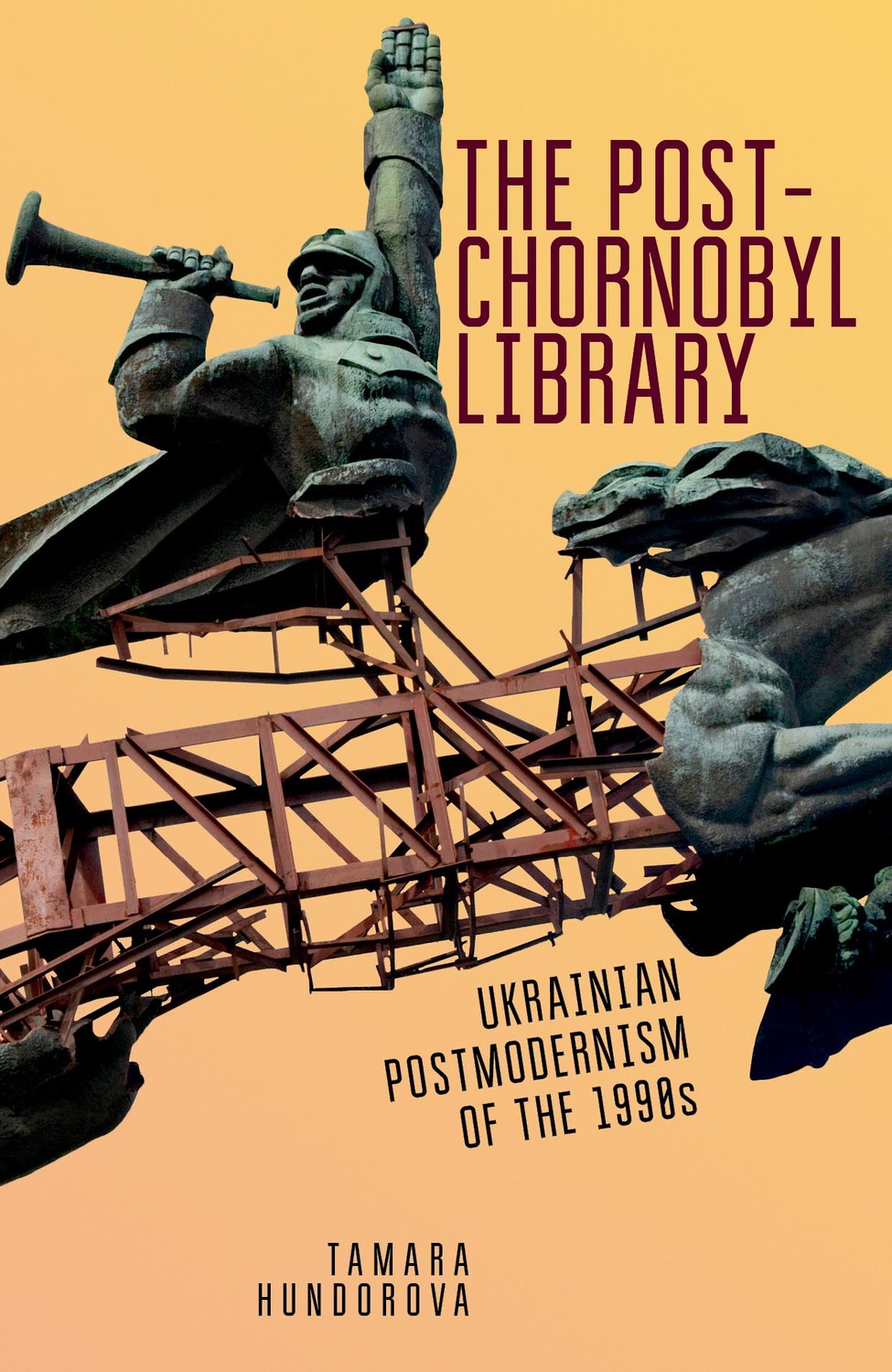
Tamara Hundorova reads 1990s Ukrainian postmodernism through Chornobyl trauma and cultural decolonization.
Post-Chornobyl Writing
Come here for
- A reading of Chornobyl trauma in 1990s Ukrainian literature
- Ukrainian postmodernism and cultural decolonization
Expect
- Carnivalization of the apocalypse
- Ironic language games and taboo-breaking
Where it sits
How strongly BookFrontier reads the book as belonging to each subject.
Nearest books
Matched by our semantic model. Ordered by what its readers also loved.
 ChernobylSerhii Plokhy60% subject match
 Voices from ChernobylSvetlana Alexievich60% subject match
 Death and the PenguinAndrey Kurkov54% subject match
 Midnight in ChernobylAdam Higginbotham54% subject match
 Grey BeesAndrey Kurkov54% subject match
 Worlds ApartBenjamin Paloff52% subject match
 My Final TerritoryYuri Andrukhovych51% subject match
For younger readers: The Blackbird Girls, 83 Days in Mariupol: A War Diary, The Winter Horses
Start with three books, and this one can be the first.
Members get a new edition every morning: a route out from their books to essays, research and talks, with the reason for each.
Sign upAbout this book
Honorable Mention - American Association for Ukrainian Studies (AAUS) 2018-2019 Book Prize
Having exploded on the margins of Europe, Chornobyl marked the end of the Soviet Union and tied the era of postmodernism in Western Europe with nuclear consciousness. The Post-Chornobyl Library in Tamara Hundorova’s book becomes a metaphor of a new Ukrainian literature of the 1990s, which emerges out of the Chornobyl nuclear trauma of the 26th of April, 1986.
Continue reading
Ukrainian postmodernism turns into a writing of trauma and reflects the collisions of the post-Soviet time as well as the processes of decolonization of the national culture. A carnivalization of the apocalypse is the main paradigm of the post-Chornobyl text, which appeals to “homelessness” and the repetition of “the end of histories.” Ironic language game, polymorphism of characters, taboo breaking, and filling in the gaps of national culture testify to the fact that the Ukrainians were liberating themselves from the totalitarian past and entering the society of the spectacle. Along this way, the post-Chornobyl character turns into an ironist, meets with the Other, experiences a split of his or her self, and witnesses a shift of geo-cultural landscapes.
Publisher details
Publisher categories
- 20th-Century History
- East European Literary Criticism
- Russian Lit Crit
- 20th-Century Literary Criticism
Show all 6 publisher categories
- Literature & History
- Politics in Literature
- Authors
- Tamara Hundorova
- Publisher
- Academic Studies Press
- Published
- November 26, 2019
- Format
- Print & ebook
- Reading lane
- 20th-Century History