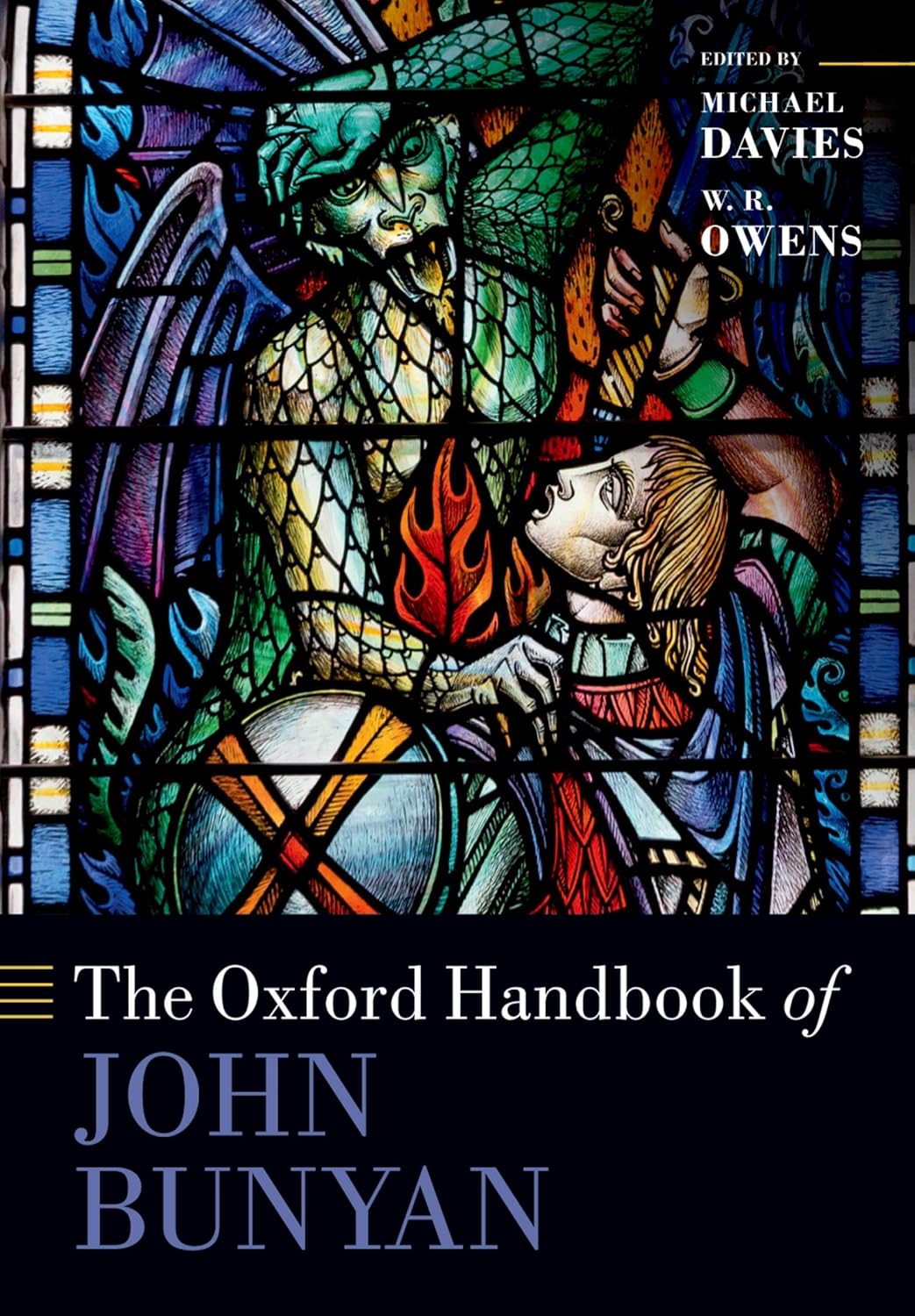
Essays examine Bunyan’s life, writings, religious contexts, criticism, and global journeys.
Bunyan Across Contexts
Come here for
- Bunyan’s church at Bedford, theology, and seventeenth-century Dissent
- Critical approaches from literary theory to post-colonial criticism
Expect
- Chapters on his major works, from Grace Abounding to The Holy War
- Studies of The Pilgrim’s Progress and its travels across literary periods
Where it sits
How strongly BookFrontier reads the book as belonging to each subject.
Nearest books
Matched by our semantic model. Ordered by what its readers also loved.
 The Oxford Handbook of the Victorian NovelLisa Rodensky53% subject matchShares British & Irish Literary Criticism
 The Oxford Guide to The Book of Common PrayerCharles Hefling, Cynthia Shattuck53% subject match
 A Plain Account of Christian PerfectionJohn Wesley53% subject match
 The Sovereignty of GodArthur W. Pink52% subject match
 The New TestamentEveryman's Library, John Drury51% subject match
 The New Oxford Annotated BibleMichael Coogan, Marc Brettler51% subject match
 The Bible: Authorized King James VersionRobert Carroll, Stephen Prickett51% subject match
 A History of the BibleJohn Barton51% subject match
Start with three books, and this one can be the first.
Members get a new edition every morning: a route out from their books to essays, research and talks, with the reason for each.
Sign upAbout this book
The Oxford Handbook of John Bunyan is the most extensive volume of original essays ever published on the seventeenth-century nonconformist preacher and writer, John Bunyan. Its thirty-eight chapters examine Bunyan's life and works, their religious and historical contexts, and the critical reception of his writings, in particular his allegorical narrative, The Pilgrim's Progress.
Continue reading
Interdisciplinary and comprehensive, it provides unparalleled scope and expertise, ranging from literary theory to religious history and from theology to post-colonial criticism. The Handbook is structured in four sections. The first, 'Contexts', deals with the historical Bunyan in relation to various aspects of his life, background, and work as a nonconformist: from basic facts of biography to the nature of his church at Bedford, his theology, and the religious and political cultures of seventeenth-century Dissent. Part 2 considers Bunyan's literary output: from his earliest printed tracts to his posthumously published works. Offering discrete chapters on Bunyan's major works - Grace Abounding to the Chief of Sinners (1666), The Pilgrim's Progress, Parts I and II (1678; 1684); The Life and Death of Mr. Badman (1680), and The Holy War (1682) - this section nevertheless covers Bunyan's oeuvre in its entirety: controversial and pastoral, narrative and poetic. Section 3, 'Directions in Criticism', engages with Bunyan in literary critical terms, focusing on his employment of form and language and on theoretical approaches to his writings: from psychoanalytic to post-secular criticism. Section 4, 'Journeys', tackles some of the ways in which Bunyan's works, and especially The Pilgrim's Progress, have travelled throughout the world since the late seventeenth century, assessing Bunyan's place within key literary periods and their distinctive developments: from the eighteenth-century novel to the writing of 'empire'.
Publisher details
Publisher categories
- Literary Criticism
- Authors
- Michael Davies, W. R. Owens
- Publisher
- Oxford University Press
- Published
- November 11, 2021
- Format
- Ebook
- Reading lane
- Literary Criticism