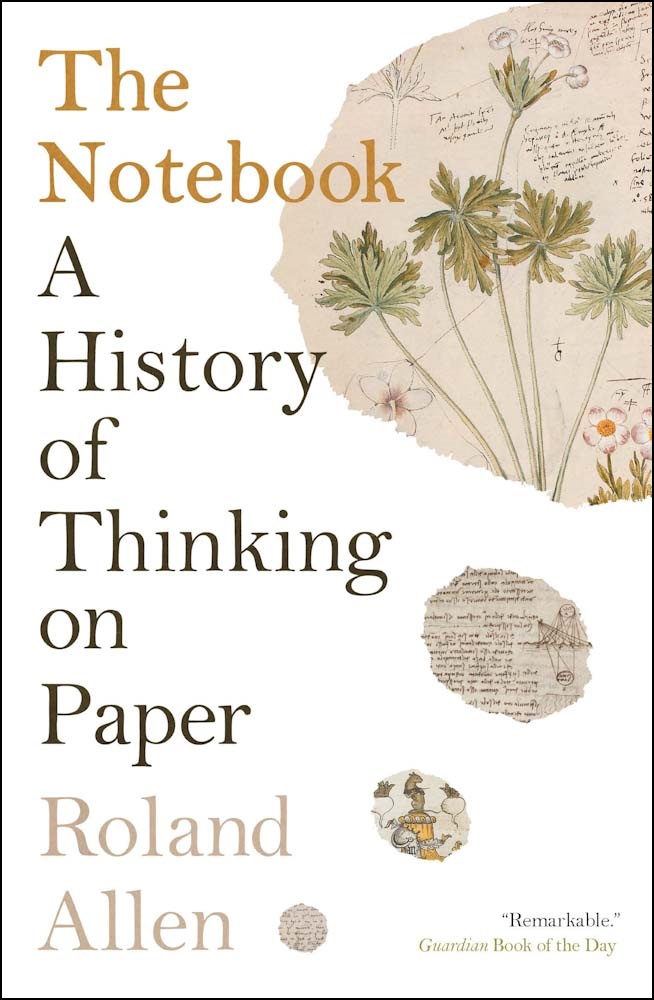
The Notebook
A History of Thinking on Paper
Roland Allen traces how notebooks shaped creative thought, from historical figures to everyday life.
Thinking on Paper
Come here for
- A cultural history of the notebook as a tool for thinking
- Familiar names seen through the pages they filled
Expect
- A wide-ranging history spanning science, literature, and daily work
- Reflections on what pen and paper can do in a digital age
Where it sits
How strongly BookFrontier reads the book as belonging to each subject.
Nearest books
Matched by our semantic model. Ordered by what its readers also loved.
 The Extended MindAnnie Murphy Paul55% subject match
 PaperMark Kurlansky67% subject matchShares History of Technology
 The InnovatorsWalter Isaacson51% subject matchShares History of Technology
 The BookshopEvan Friss49% subject match
For younger readers: A Writer's Notebook, The Story of Clocks and Calendars, Leonardo da Vinci
Start with three books, and this one can be the first.
Members get a new edition every morning: a route out from their books to essays, research and talks, with the reason for each.
Sign upAbout this book
A Globe 100 Best Book of 2024 • A New Yorker Best Book of 2024 • A Kirkus Most Anticipated Book of Fall 2024
The first history of the notebook, a simple invention that changed the way the world thinks.
We see notebooks everywhere we go. But where did these indispensable implements come from? How did they revolutionize our lives? And how can using a notebook help change the way you think?
Continue reading
In this wide-ranging history, Roland Allen reveals how the notebook became our most dependable and versatile tool for creative thinking. He tells the notebook stories of Leonardo and Frida Kahlo, Isaac Newton and Marie Curie, and writers from Chaucer to Henry James; shows how Darwin developed his theory of evolution in tiny pocket books and Agatha Christie plotted a hundred murders in scrappy exercise books; and introduces a host of cooks, kings, sailors, fishermen, musicians, engineers, politicians, adventurers, and mathematicians, all of whom used their notebooks as a space to think—and in doing so, shaped the modern world.
In an age of AI and digital overload, the humble notebook is more relevant than ever. Allen shows how bullet points can combat ADHD, journals can ease PTSD, and patient diaries soften the trauma of reawakening from coma. The everyday act of moving a pen across paper, he finds, can have profound consequences, changing the way we think and feel: making us more creative, more productive—and maybe even happier.
Publisher details
Publisher categories
- World History
- Modern History
- Civilizations
- Creative Writing
Show all 5 publisher categories
- How Cultures Work
- Authors
- Roland Allen
- Publisher
- Biblioasis
- Published
- September 3, 2024
- Format
- Print & ebook
- Reading lane
- World History