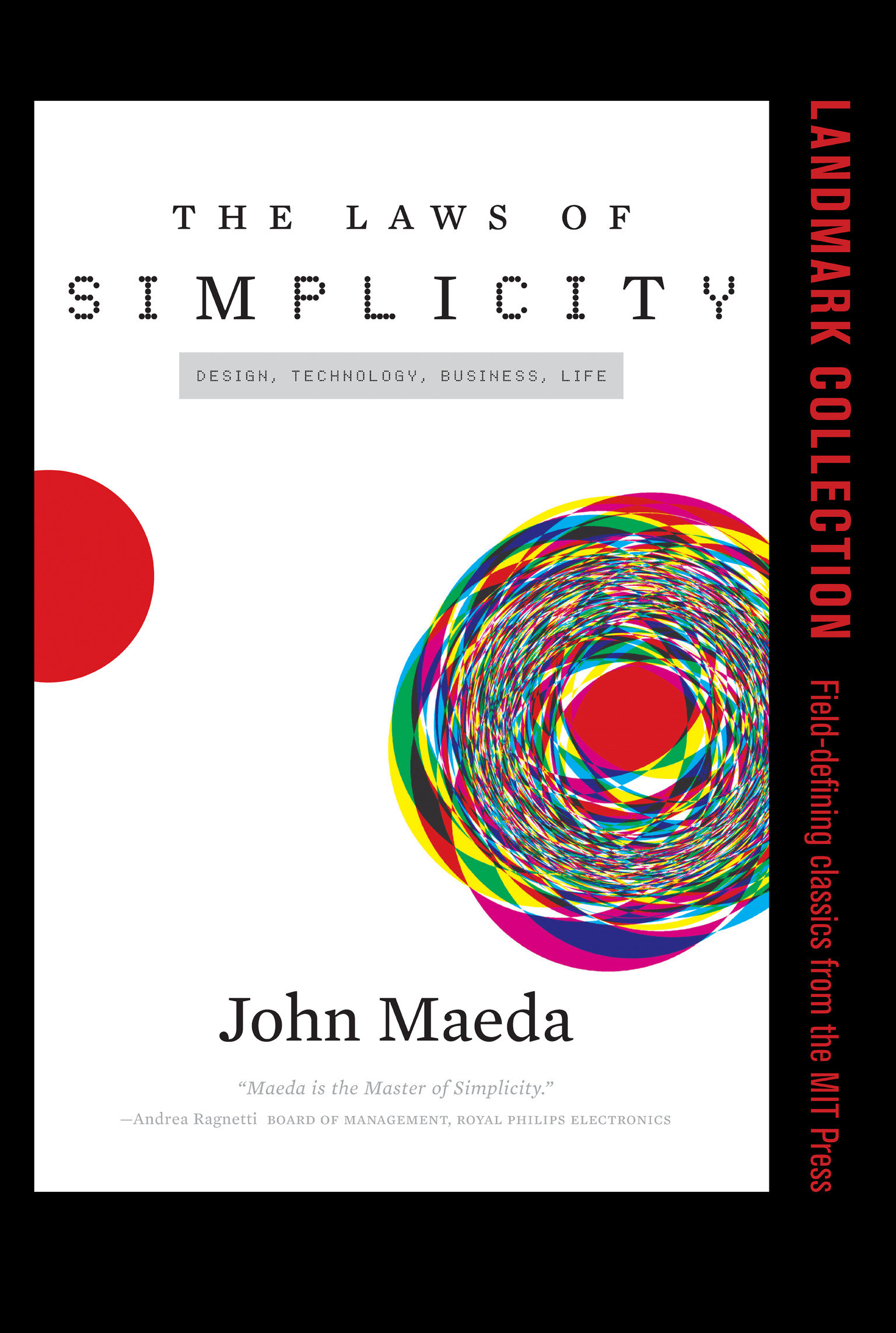
The Laws of Simplicity
MIT Press · Paperback · September 1, 2020
Ten laws of simplicity for business, technology, and design that teach us how to need less but get more.
We earn from qualifying purchases.
- Who it’s for
- Readers interested in design and technology innovation
- Themes
- simplicity, design philosophy, technology
- Pacing
- Reflective
Nearest books
Matched by what the books are about, then ordered by what their readers also loved.
 Creative Strategy and the Business of DesignDouglas Davis46% match
 Good to GreatJim Collins45% match
 StructuresJ. E. Gordon50% match
 The ONE ThingGary Keller, Jay Papasan51% match
 This Is Service Design ThinkingMarc Stickdorn, Jakob Schneider45% matchShares Product Design
 The 22 Immutable Laws of MarketingAl Ries, Jack Trout54% match
 Making Numbers CountChip Heath, Karla Starr43% match
 Articulating Design DecisionsTom Greever46% matchShares Human-Computer Interaction
For younger readers: Easy Electronics
Start with three books, and this one can be the first.
Members get a new edition every morning: a route out from their books to essays, research and talks, with the reason for each.
Join the waitlistAbout this book
Ten laws of simplicity for business, technology, and design that teach us how to need less but get more. Finally, we are learning that simplicity equals sanity. We're rebelling against technology that's too complicated, DVD players with too many menus, and software accompanied by 75-megabyte "read me" manuals. The iPod's clean gadgetry has made simplicity hip.
Continue reading
But sometimes we find ourselves caught up in the simplicity paradox: we want something that's simple and easy to use, but also does all the complex things we might ever want it to do. In The Laws of Simplicity, John Maeda offers ten laws for balancing simplicity and complexity in business, technology, and design—guidelines for needing less and actually getting more. Maeda—a professor in MIT's Media Lab and a world-renowned graphic designer—explores the question of how we can redefine the notion of "improved" so that it doesn't always mean something more, something added on. Maeda's first law of simplicity is "Reduce." It's not necessarily beneficial to add technology features just because we can. And the features that we do have must be organized (Law 2) in a sensible hierarchy so users aren't distracted by features and functions they don't need. But simplicity is not less just for the sake of less. Skip ahead to Law 9: "Failure: Accept the fact that some things can never be made simple." Maeda's concise guide to simplicity in the digital age shows us how this idea can be a cornerstone of organizations and their products—how it can drive both business and technology. We can learn to simplify without sacrificing comfort and meaning, and we can achieve the balance described in Law 10. This law, which Maeda calls "The One," tells us: "Simplicity is about subtracting the obvious, and adding the meaningful."
Who it’s for
- Readers interested in design and technology innovation
- Professionals seeking practical guidelines for simplifying products and business processes
Where it sits
| Human-Computer Interaction | 48% |
|---|---|
| Product Design | 27% |
| UI/UX Design | 24% |
Percentages are BookFrontier’s reading of the book.
Publisher categories
- Product Design
- Authors
- John Maeda
- Publisher
- MIT Press
- Published
- September 1, 2020
- Format
- Paperback
- Theme
- simplicity · design philosophy · technology
- Reading lane
- Product Design