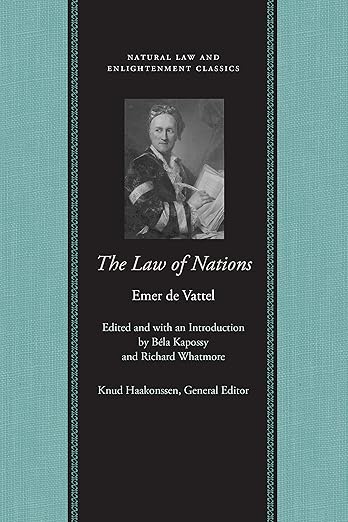
The Law of Nations
Vattel draws on natural law to frame how states should conduct international affairs.
Natural Law and States
Come here for
- Vattel’s model of international conduct, distilled from natural law
- Its influence across the political orders of 1789–1815
Expect
- A Liberty Fund edition based on the anonymous 1797 English translation
- Notes Vattel prepared for the second French edition
Where it sits
How strongly BookFrontier reads the book as belonging to each subject.
Nearest books
Matched by our semantic model. Ordered by what its readers also loved.
 The Rule of LawsFernanda Pirie47% subject match
 The Books that Made the European EnlightenmentGary Kates46% subject matchShares 18th-Century History
 Hero of Two WorldsMike Duncan46% subject match
 The Rights of ManThomas Paine46% subject matchShares Political Philosophy
 The Thomas Paine ReaderThomas Paine45% subject matchShares Political Philosophy
For younger readers: Discovering Life’s Story: The Evolution of an Idea
Start with three books, and this one can be the first.
Members get a new edition every morning: a route out from their books to essays, research and talks, with the reason for each.
Sign upAbout this book
The great eighteenth-century theorist of international law Emer de Vattel (1714–1767) was a key figure in sustaining the practical and theoretical influence of natural jurisprudence through the Revolutionary and Napoleonic eras.
Continue reading
Coming toward the end of the period when the discourse of natural law was dominant in European political theory, Vattel’s contribution is cited as a major source of contemporary wisdom on questions of international law in the American Revolution and even by opponents of revolution, such as Cardinal Consalvi, at the Congress of Vienna of 1815.
The significance of The Law of Nations resides in its distillation from natural law of an apt model for international conduct of state affairs that carried conviction in both the Old Regime and the new political order of 1789–1815.
The Liberty Fund edition is based on the anonymous English translation of 1797, which includes Vattel’s notes for the second French edition (posthumous, 1773).
Emer de Vattel (1714–1767) was a Swiss philosopher and jurist in the service of Saxony.
Béla Kapossy is Professeur Suppléant of History at the University of Lausanne.
Richard Whatmore is a Reader in Intellectual History at the University of Sussex.
Publisher details
Publisher categories
- Philosophy Overviews
- Authors
- Emer de Vattel, Béla Kapossy
- Publisher
- Liberty Fund, Inc.
- Published
- June 9, 2008
- Format
- Print & ebook
- Reading lane
- Philosophy Overviews