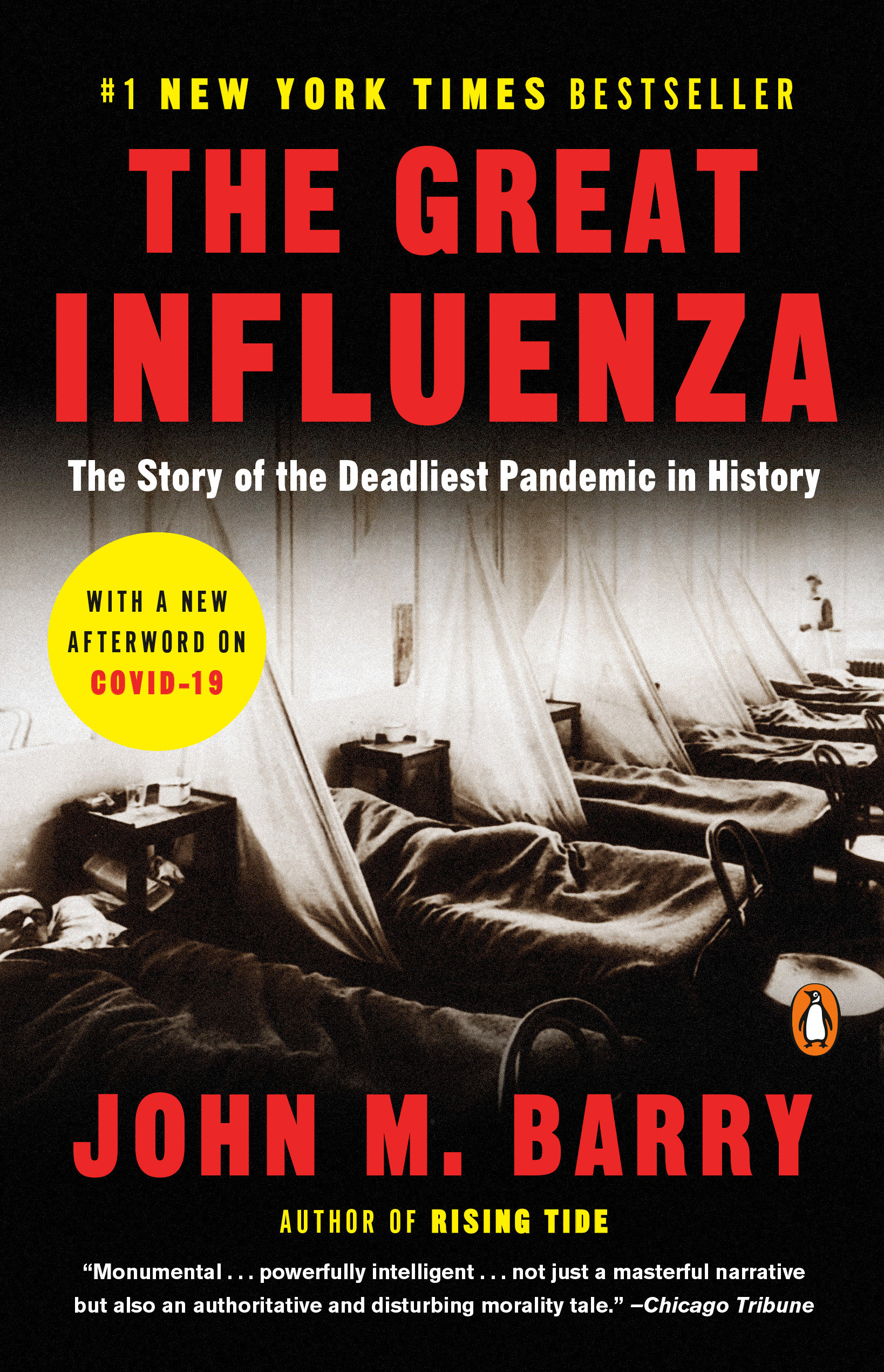
The Great Influenza
The Story of the Deadliest Pandemic in History
A sweeping, sobering history connects the 1918 influenza pandemic with the hard demands of public trust.
- Themes
- 1918 influenza pandemic, Science and epidemic disease, Public trust in leadership
Epidemic and Authority
Come here for
- A rigorous meeting of epidemic history, science, and wartime crisis
- Questions about truth and public trust in a crisis
Expect
- A broad, sobering account with consequences that reach beyond 1918
- The collision of science, epidemic disease, and authority
Where it sits
How strongly BookFrontier reads the book as belonging to each subject.
Nearest books
Matched by our semantic model. Ordered by what its readers also loved.
 Isaac's StormErik Larson54% subject match
 American MidnightAdam Hochschild56% subject matchShares World War I History
 The Great MortalityJohn Kelly70% subject matchShares Medical History
 The PremonitionMichael Lewis69% subject matchShares Epidemiology
 The Demon in the FreezerRichard Preston59% subject match
 VaccinatedPaul A. Offit, M.D.55% subject matchShares Medical History
For younger readers: An American Plague, Very, Very, Very Dreadful, Fever Year
Start with three books, and this one can be the first.
Members get a new edition every morning: a route out from their books to essays, research and talks, with the reason for each.
Sign upAbout this book
#1 New York Times bestseller
“Barry will teach you almost everything you need to know about one of the deadliest outbreaks in human history.”—Bill Gates
"Monumental... an authoritative and disturbing morality tale."—Chicago Tribune
The strongest weapon against pandemic is the truth. Read why in the definitive account of the 1918 Flu Epidemic.
Continue reading
Magisterial in its breadth of perspective and depth of research, The Great Influenza provides us with a precise and sobering model as we confront the epidemics looming on our own horizon. As Barry concludes, "The final lesson of 1918, a simple one yet one most difficult to execute, is that...those in authority must retain the public's trust. The way to do that is to distort nothing, to put the best face on nothing, to try to manipulate no one. Lincoln said that first, and best. A leader must make whatever horror exists concrete. Only then will people be able to break it apart."
At the height of World War I, history’s most lethal influenza virus erupted in an army camp in Kansas, moved east with American troops, then exploded, killing as many as 100 million people worldwide. It killed more people in twenty-four months than AIDS killed in twenty-four years, more in a year than the Black Death killed in a century. But this was not the Middle Ages, and 1918 marked the first collision of science and epidemic disease.
Publisher details
Publisher categories
- Contagious Diseases
- 20th-Century America
- History of Science
- Authors
- John M. Barry
- Publisher
- Penguin Publishing Group
- Published
- October 4, 2005
- Format
- Print & ebook
- Reading lane
- Contagious Diseases