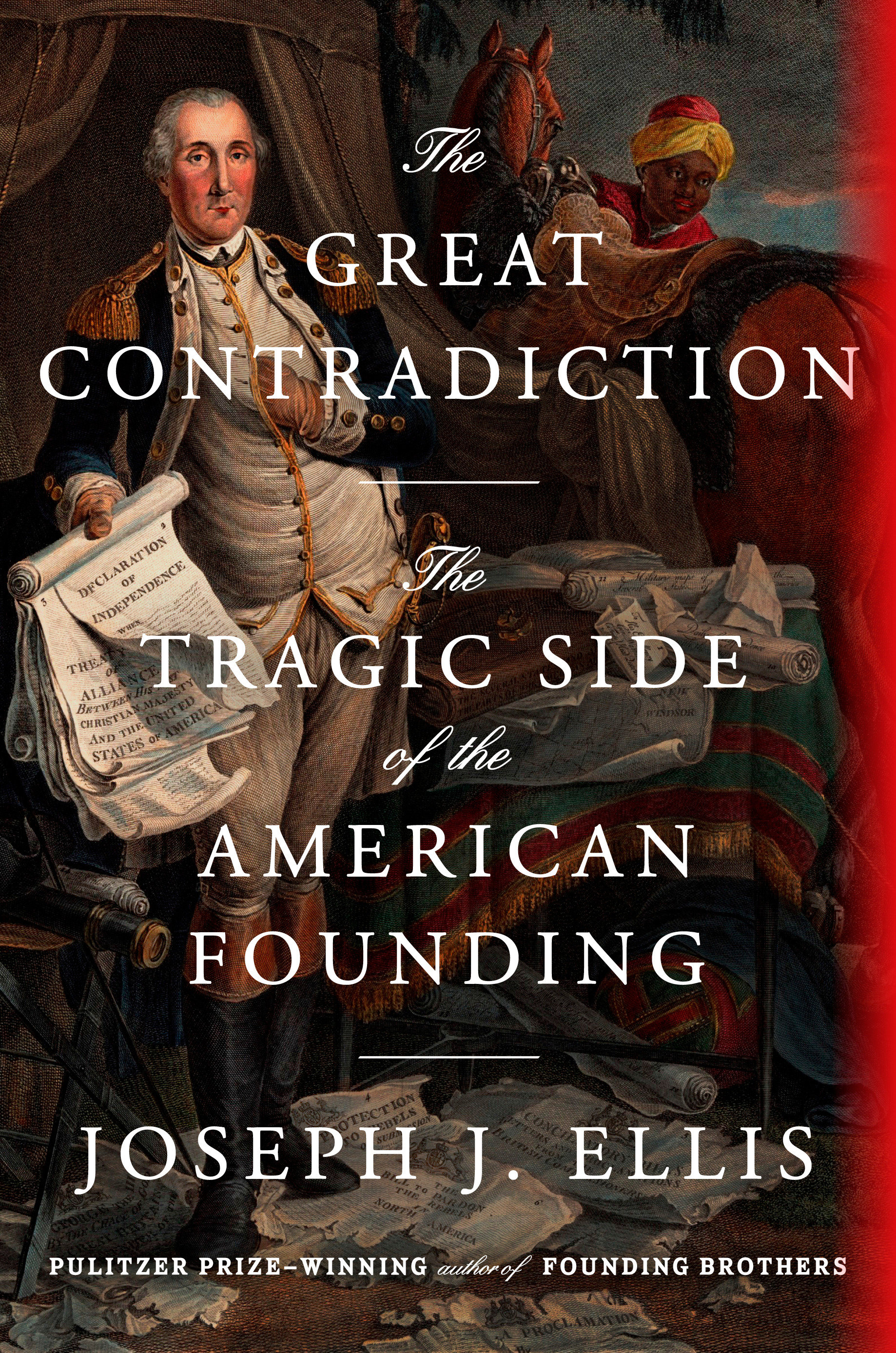
The Great Contradiction
The Tragic Side of the American Founding
A readable look at the founding’s tragic contradiction, with Ellis’s calm, unsentimental clarity.
Why It Works
Come here for
- clear-eyed founding history
- accessible, sustained narrative
Expect
- practical historical explanation
- measured, reflective prose
Where it sits
How strongly BookFrontier reads the book as belonging to each subject.
Nearest books
Matched by our semantic model. Ordered by what its readers also loved. Most of these share its genre: Revolutionary America (1775-1800).
 Shots Heard Round the WorldJohn Ferling59% subject match
 The Zealot and the EmancipatorH. W. Brands68% subject match
 John HancockWillard Sterne Randall58% subject match
 The CauseJoseph J Ellis82% subject match
 American CreationJoseph J. Ellis79% subject match
 Charles SumnerZaakir Tameez59% subject match
 War Without MercyMark Edward Lender, James Kirby Martin64% subject match
 African FoundersDavid Hackett Fischer70% subject matchAlso shares Slavery Studies and Black History
For younger readers: Black Indians, Countdown to Independence, King George: What Was His Problem?
Start with three books, and this one can be the first.
Members get a new edition every morning: a route out from their books to essays, research and talks, with the reason for each.
Sign upAbout this book
A major new history from our most trusted voice on the Revolutionary era, the author of the Pulitzer Prize–winning Founding Brothers and the National Book Award winner American Sphinx, and featured in THE AMERICAN REVOLUTION, a film by Ken Burns, Sarah Botstein, and David Schmidt, on PBS.
Continue reading
An astounding look at how America’s founders—Washington, Jefferson, Franklin, Madison, Adams—regarded the issue of slavery as they drafted the Declaration of Independence and the Constitution. A daring and important work that ultimately reckons with the two great failures of America’s founding: the failure to end slavery and the failure to avoid Indian removal.
On the eve of the American Revolution, half a million enslaved African Americans were embedded in the North American population. The slave trade was flourishing, even as the thirteen colonies armed themselves to defend against the idea of being governed without consent. This paradox gave birth to what one of our most admired historians, Joseph J. Ellis, calls the “great contradiction”: How could a government that had been justified and founded on the principles articulated in the Declaration of Independence institutionalize slavery? How could it permit a tidal wave of western migration by settlers who understood the phrase “pursuit of happiness” to mean the pursuit of Indian lands?
With narrative grace and a flair for irony and paradox, Ellis addresses the questions that lie at America’s twisted roots—questions that turned even the sharpest minds of the Revolutionary generation into mental contortionists. He discusses the first debates around slavery and the treatment of Native Americans, from the Constitutional Convention to the Treaty of New York, revealing the thinking and rationalizations behind Jay, Hamilton, and Madison’s revisions of the Articles of Confederation, and highlights the key role of figures like Quaker abolitionist Anthony Benezet and Creek chief Alexander McGillivray.
Ellis writes with candor and deftness, his clarion voice rising above presentist historians and partisans who are eager to make the founders into trophies in the ongoing culture wars. Instead, Ellis tells a story that is rooted in the coexistence of grandeur and failure, brilliance and blindness, grace and sin.
Publisher details
Publisher categories
- Revolutionary America (1775-1800)
- Social History
- Slavery Studies
- Authors
- Joseph J. Ellis
- Publisher
- Knopf Doubleday Publishing Group
- Published
- October 28, 2025
- Format
- Print & ebook
- Reading lane
- Revolutionary America (1775-1800)