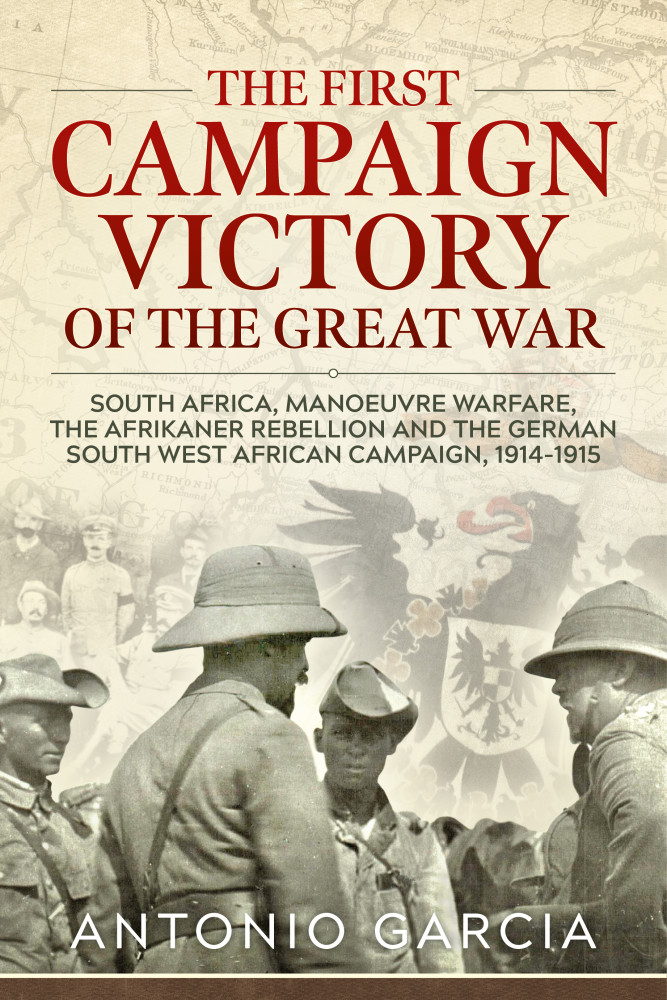
The First Campaign Victory of the Great War
South Africa, Manoeuvre Warfare, the Afrikaner Rebellion and the German South West African Campaign, 1914-1915.
A campaign history weighs South African manoeuvre warfare against numerical strength and political pressures.
South West Africa Campaign
Come here for
- The 1914–1915 campaign in German South West Africa
- Manoeuvre theory alongside South Africa’s wartime political divisions
Expect
- Analysis of mobility, rapidity, and surprise as military principles
- The question of strategy versus numerical superiority
Where it sits
How strongly BookFrontier reads the book as belonging to each subject.
Nearest books
Matched by our semantic model. Ordered by what its readers also loved.
 The Campaigns of NapoleonDavid G. Chandler44% subject matchShares Military Strategy
 The East Africa Campaign 1914-18David Smith66% subject matchShares World War I History
 South African Armour of the Border War 1975-89Kyle Harmse, Simon Dunstan61% subject matchShares South Africa History
 Blood River 1838Ian Knight61% subject matchShares South Africa History
 The Chameleon and the FlyDavid Snape61% subject match
 Diamonds, Gold, and WarMartin Meredith61% subject matchShares South Africa History
 Striking Inside Angola with 32 BattalionMarius Scheepers59% subject matchShares South Africa History
 Total OnslaughtPaul Moorcraft58% subject match
For younger readers: World War One: 1914-1918, What Was World War I?, The Flag Never Touched the Ground
Start with three books, and this one can be the first.
Members get a new edition every morning: a route out from their books to essays, research and talks, with the reason for each.
Sign upAbout this book
The First World War moulded the global landscape and had a lasting effect on much of the World. Where the majority of international research focusses on the European theatre, Antonio Garcia explores one of the peripheral campaigns of the Great War. South Africa's First World War campaign in German South West Africa was a daring military undertaking epitomised by manoeuvre and rapidity. The author takes a novel approach in comparing the campaign to manoeuvre warfare theory.
Continue reading
Manoeuvre theory is based on the principles of mobility, rapidity and surprise which attempts to achieve victory with the least loss of resources and in the shortest time possible. In order to achieve a rapid victory against the German forces, the South African soldiers were pushed to the limits of exhaustion to achieve the Union of South Africa's strategic objectives. The campaign in the deserts of German South Africa became the setting for adventure and war, where Briton, Boer and People of Colour served together as a Dominion of the British Empire. Blacks, Coloureds and Indians fought for the hopes of better political franchise, an ambition which was not to be achieved until 80 years later. The book addresses the complex political dynamics in South Africa at the time of the Great War, the deep division between Afrikaners and British South Africans and the Afrikaner Rebellion. With the backdrop of political difficulties and a lack of overwhelming support for the entry into the Great War, the Botha government needed a quick result so as to maintain the delicate balance of power. The author provides an analysis on the campaign through the lens of military theory so as to determine how the swift victory was achieved. The book answers the question of whether the campaign was won through numerical superiority or through the use of a superior operational strategy. The victory was the first campaign victory led by a British Dominion.
Publisher details
Publisher categories
- History
- Authors
- Antonio Garcia
- Publisher
- Helion and Company
- Published
- July 19, 2019
- Format
- Print & ebook
- Reading lane
- History