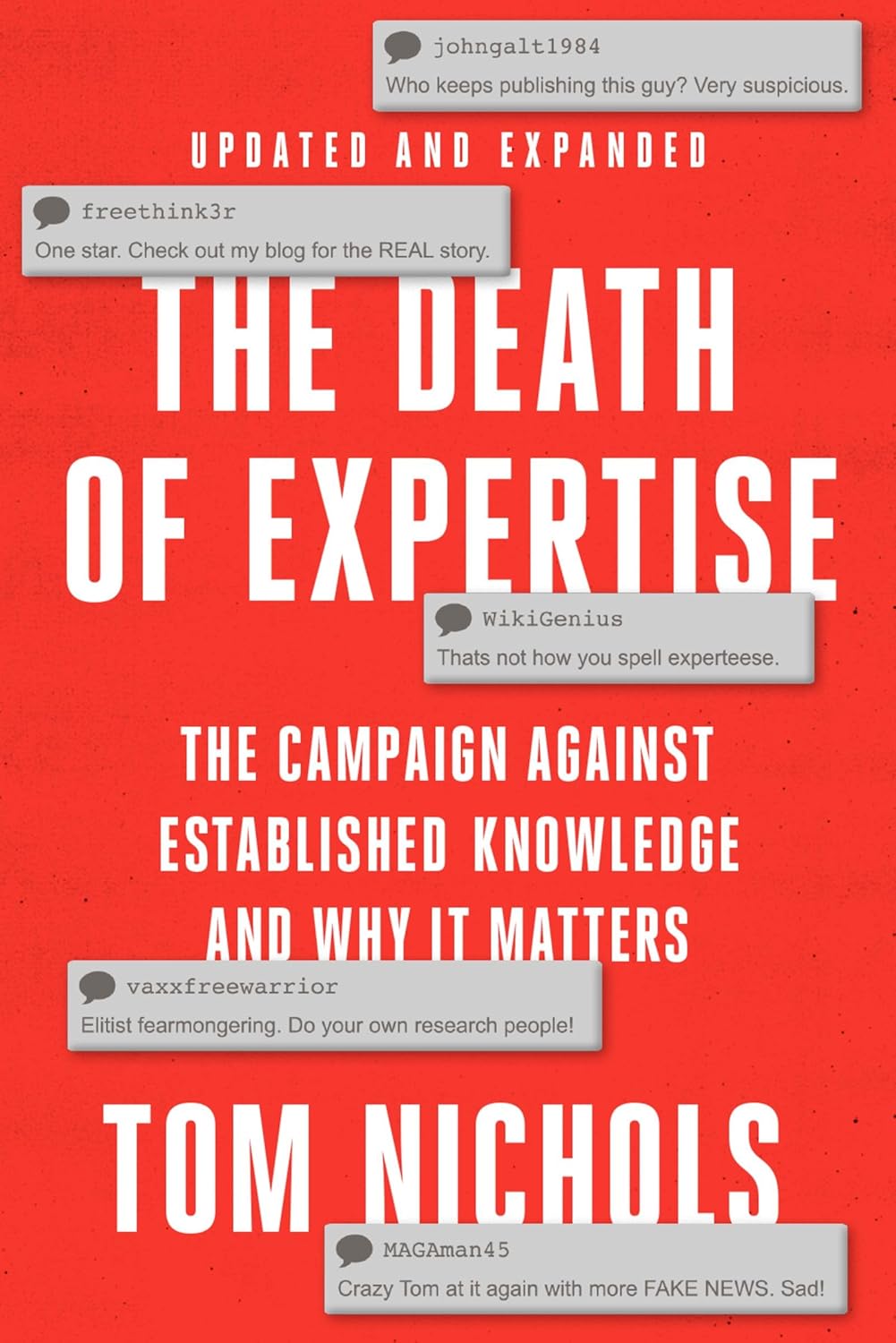
The Death of Expertise
The Campaign against Established Knowledge and Why it Matters
A sharp look at why expertise has become contested in public life.
- Themes
- Rejection of expertise, Populism and conspiracy theories, Threats to democratic institutions
Expertise Under Pressure
Come here for
- The collision of online information, populism, and trust in experts
Expect
- A forceful argument about what expert skepticism means for democratic institutions
Where it sits
How strongly BookFrontier reads the book as belonging to each subject.
Nearest books
Matched by our semantic model. Ordered by what its readers also loved.
 What Were We ThinkingCarlos Lozada53% subject matchShares Political Commentary
 The Road to UnfreedomTimothy Snyder55% subject match
 Democracy AwakeningHeather Cox Richardson53% subject match
For younger readers: Big Lies, What the Fact?
Start with three books, and this one can be the first.
Members get a new edition every morning: a route out from their books to essays, research and talks, with the reason for each.
Sign upAbout this book
Building on his enormously successful first edition, Tom Nichols confirms his thesis that events, such as the COVID pandemic, prove that the assault on expertise has only intensified. Fully updated chapters continue to address how technology and increasing levels of education have exposed people to more information than ever before.
Continue reading
These societal gains, however, have also helped fuel a surge in narcissistic and misguided intellectual egalitarianism that has crippled informed debates on any number of issues. Over the past several years, the rise of populism and conspiracy theories have taken this to new levels. All voices, even the most ridiculous, demand to be taken with equal seriousness, and any claim to the contrary is dismissed as undemocratic elitism. Tom Nichols' The Death of Expertise, Second Edition, follows up on how this rejection of experts has occurred: the openness of the internet, the emergence of a customer satisfaction model in higher education, the transformation of the news industry into a 24-hour entertainment machine, and importantly, the election of Donald Trump. Paradoxically, the increasingly democratic dissemination of information, rather than producing an educated public, has instead created an army of ill-informed and angry citizens who denounce intellectual achievement. When ordinary citizens believe that no one knows more than anyone else, democratic institutions themselves are in danger of falling either to populism or to technocracy or, in the worst case, a combination of both.
Publisher details
Publisher categories
- Politics & Government
- Authors
- Tom Nichols
- Publisher
- Oxford University Press
- Published
- March 13, 2024
- Format
- Print & ebook
- Reading lane
- Politics & Government