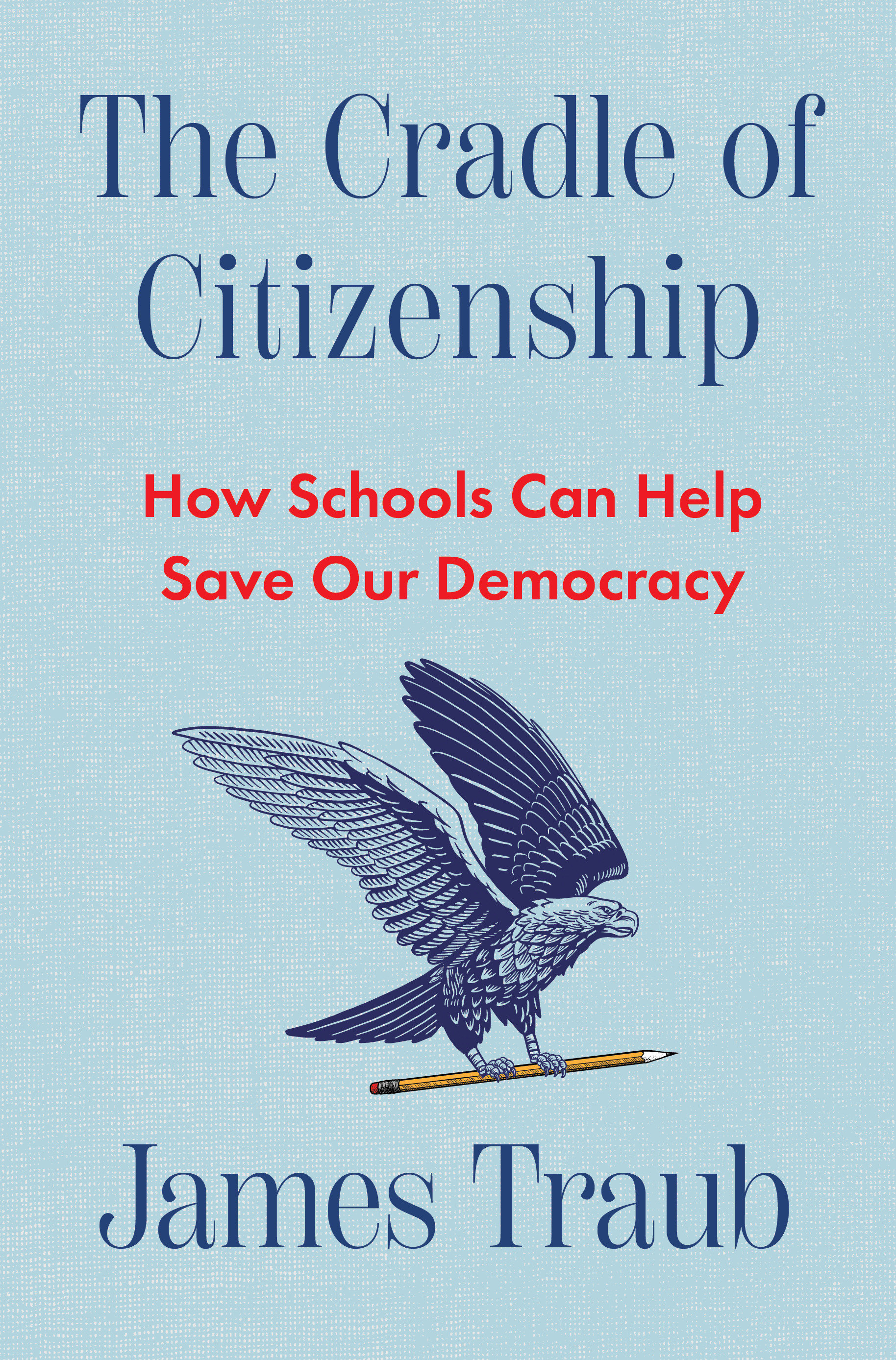
The Cradle of Citizenship
How Schools Can Help Save Our Democracy
James Traub examines how schools teach civics, amid political divides and competing ideas about citizenship.
- Themes
- Civic education, Political polarization, Democratic citizenship
Schools and Citizenship
Come here for
- A year observing public schools across the country
- Teachers’ approaches to political debate and students’ own views
Expect
- Disagreement over what civic education means
- A cross-ideological roadmap for teaching civics
Where it sits
How strongly BookFrontier reads the book as belonging to each subject.
Nearest books
Matched by our semantic model. Ordered by what its readers also loved.
 The Death of TruthSteven Brill54% subject match
 OutclassedJoan C. Williams55% subject match
 The Declassification EngineMatthew Connelly54% subject match
 Democracy AwakeningHeather Cox Richardson69% subject match
For younger readers: You Call This Democracy?, Fault Lines in the Constitution, America Redux: Visual Stories from Our Dynamic History
Start with three books, and this one can be the first.
Members get a new edition every morning: a route out from their books to essays, research and talks, with the reason for each.
Sign upAbout this book
A devastating critique of our failure to prepare students for citizenship—and a roadmap to a better way.
America’s Founders placed great confidence in schools, which they believed would teach young people to understand our political system and to engage in reasoned political debate as adults. Yet today, when virtually all Americans graduate from high school, we remain stunningly ignorant of history and government.
Continue reading
In 2022, the National Assessment of Educational Progress found that only 13 percent of students scored a “proficient” level in history. Adults do no better: only 40 percent can name the three branches of government.
In The Cradle of Citizenship, James Traub chronicles his year of observing public schools across the country, talking to teachers, scholars, and curriculum designers. He finds teachers in Florida who are afraid of discussing topics that might be seen as “woke”; a red-blue war incarnated in the 1619 Project and 1776 Report; a profound disagreement over what exactly civic education means; and, most dismayingly, ever-diminishing expectations of students with ever-dwindling attention spans.
Yet The Cradle of Citizenship also finds sources of hope. Traub learns that, despite endless right-wing critiques, virtually all social studies teachers keep their personal views to themselves and encourage students to develop views of their own. He describes the extraordinary collaboration between liberal and conservative scholars that led to the creation of “Educating for American Democracy,” a roadmap for the teaching of civics. Finally, Traub describes the “classical school,” a traditional model based on the study of great books and the conscious molding of character, which is derided as reactionary in progressive circles yet prompts students to discuss books and ideas with depth. Shedding light on one of the most divisive issues of our time, The Cradle of Citizenship upholds a vision of civics education as it could be.
Publisher details
Publisher categories
- Teaching Social Studies
- Education Policy
- Philosophy of Education
- Authors
- James Traub
- Publisher
- WW Norton
- Published
- January 13, 2026
- Format
- Print & ebook
- Reading lane
- Teaching Social Studies