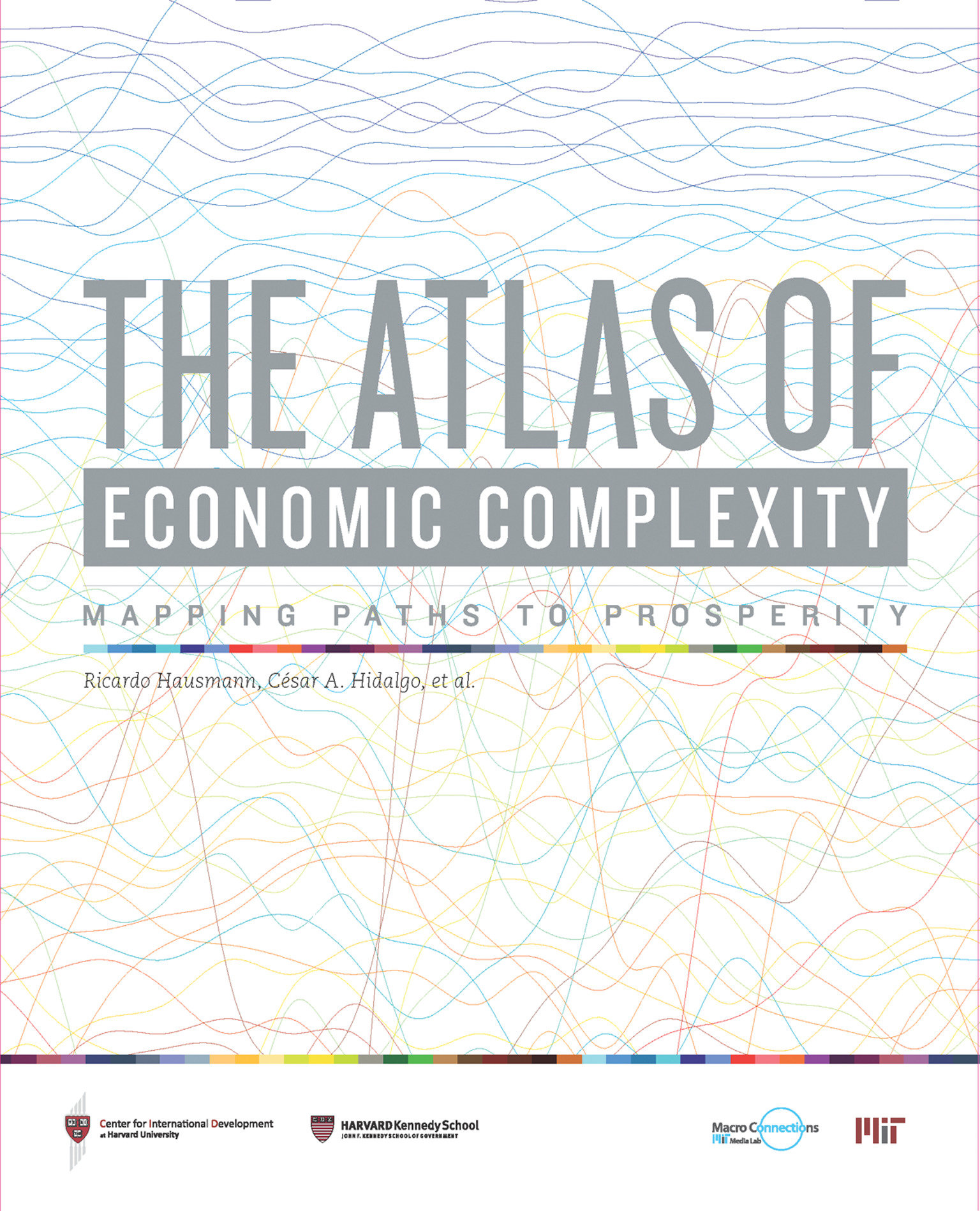
The Atlas of Economic Complexity
Mapping Paths to Prosperity
Maps and country pages trace productive knowledge, complexity rankings, and potential paths to economic diversification.
- Themes
- Economic complexity, Productive knowledge, Economic diversification and growth
The Product Space
Come here for
- Maps placing countries in the Product Space
- Country pages detailing capabilities and diversification options
Expect
- Visualizations of 128 countries’ complexity and growth potential rankings
- A guide to each country’s current capabilities and diversification options
Where it sits
How strongly BookFrontier reads the book as belonging to each subject.
Nearest books
Matched by our semantic model. Ordered by what its readers also loved. Most of these share its genre: Economic Development.
 How Africa WorksJoe Studwell54% subject match
 Economic Growth and DevelopmentMatthew McCartney54% subject matchAlso shares Macroeconomics
 The Power of GeographyTim Marshall53% subject match
 The DivideJason Hickel50% subject match
For younger readers: The Kingfisher Atlas of the Modern World, Children's Picture Atlas, 1493 for Young People
Start with three books, and this one can be the first.
Members get a new edition every morning: a route out from their books to essays, research and talks, with the reason for each.
Sign upAbout this book
Maps capture data expressing the economic complexity of countries from Albania to Zimbabwe, offering current economic measures and as well as a guide to achieving prosperity
Why do some countries grow and others do not? The authors of The Atlas of Economic Complexity offer readers an explanation based on "Economic Complexity," a measure of a society's productive knowledge.
Continue reading
Prosperous societies are those that have the knowledge to make a larger variety of more complex products. The Atlas of Economic Complexity attempts to measure the amount of productive knowledge countries hold and how they can move to accumulate more of it by making more complex products.
Through the graphical representation of the "Product Space," the authors are able to identify each country's "adjacent possible," or potential new products, making it easier to find paths to economic diversification and growth. In addition, they argue that a country's economic complexity and its position in the product space are better predictors of economic growth than many other well-known development indicators, including measures of competitiveness, governance, finance, and schooling.
Using innovative visualizations, the book locates each country in the product space, provides complexity and growth potential rankings for 128 countries, and offers individual country pages with detailed information about a country's current capabilities and its diversification options. The maps and visualizations included in the Atlas can be used to find more viable paths to greater productive knowledge and prosperity.
Publisher details
Publisher categories
- Macroeconomics
- International Economics
- Library & Info Science
- Authors
- Ricardo Hausmann, Cesar A. Hidalgo, Sebastian Bustos
- Publisher
- MIT Press
- Published
- January 17, 2014
- Format
- Print & ebook
- Reading lane
- Macroeconomics