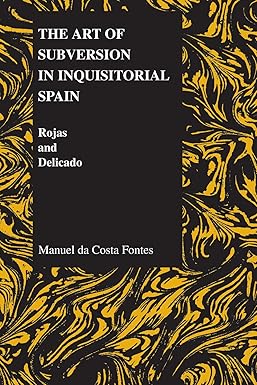
The Art of Subversion in Inquisitorial Spain
Rojas and Delicado
Manuel De Costa Fontes traces how Rojas and Delicado encoded religious critique beneath bawdy surfaces.
Inquisitorial Subversion
Come here for
- A reading of Celestina and La Lozana andaluza as covert religious critique
- Textual evidence focused on four Christian dogmas
Expect
- Analysis of the Annunciation, Virgin Birth, Incarnation, and Trinity
- Context on New Christian writers under the Inquisition
Where it sits
How strongly BookFrontier reads the book as belonging to each subject.
Nearest books
Matched by our semantic model. Ordered by what its readers also loved.
 The Life of Lazarillo de TormesW. S. Merwin, Juan Goytisolo64% subject match
 The Lead Books of GranadaE. Drayson59% subject match
 The Inquisitor's WifeJeanne Kalogridis58% subject match
 Gender and Nation in the Spanish Modernist NovelRoberta Johnson57% subject matchShares Iberian Lit Crit
For younger readers: I, Juan de Pareja, Emerald Lizard, Woven in Moonlight
Start with three books, and this one can be the first.
Members get a new edition every morning: a route out from their books to essays, research and talks, with the reason for each.
Sign upAbout this book
Rojas's Celestina (1499) is perhaps the second greatest work of Spanish literature, right after Don Quixote, and Delicado sought to surpass it with La Lozana andaluza (1530), an important precedent of the picaresque novel.
Continue reading
Both works were written during the height of the Inquisition, when the only relatively safe way for New Christian writers of Jewish extraction like Rojas and Delicado to express what they felt about the discrimination they suffered and their doubts regarding the faith that had been forced upon their ancestors was in a covert, indirect manner. Some scholars have detected this subversive element in Rojas' and Delicado's corrosive view of the Christian societies in which they lived, but this book goes far beyond such impressionism, showing through abundant textual evidence that these two authors used superficial bawdiness and claims regarding the morality of their respective works as cover to encode attacks against the central dogmas of Christianity: the Annunciation, the Virgin Birth, the Incarnation, and the Holy Trinity. This book, which will generate controversy among Hispanists, many of whom have refused to examine these works for non-Catholic views, will be of interest not only to students and scholars of Spanish literature, but also to those involved in Jewish studies, Medieval European history, and cultural studies.
Publisher details
Publisher categories
- Iberian Lit Crit
- 16th-Century Literary Criticism
- Religion in Literature
- Authors
- Manuel De Costa Fontes
- Publisher
- Purdue University Press
- Published
- January 18, 2005
- Format
- Print & ebook
- Reading lane
- Iberian Lit Crit