
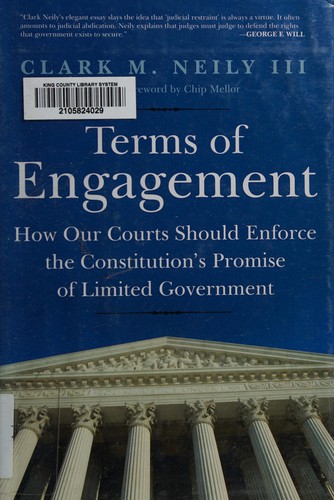
Book
Terms of Engagement
How Our Courts Should Enforce the Constitution's Promise of Limited Government
Clark M. Neily III
Encounter Books · Print & ebook · October 8, 2013
Reading lane: Courts & the Judiciary
Government at every level is too big, too powerful, and too intrusive.
At a Glance
Who It's For
Book Details
- Authors
- Clark M. Neily III
- Publisher
- Encounter Books
- Published
- October 8, 2013
- Format
- Print & ebook
- Theme
- Courts & the Judiciary · Conservatism & Liberalism
- Reading lane
- Courts & the Judiciary
Affinity
Publisher Categories
Constitutional Law
Courts & Judicial System
Courts & the Judiciary
About This Book
Government at every level is too big, too powerful, and too intrusive. But don’t blame just legislators and members of the executive branch for constantly overstepping their constitutional bounds. As Clark Neily argues in The Terms of Engagement , judges have more than their fair share of the blame. While liberals seek court rulings creating positive rights to things like free health care and conservatives call for judicial ?restraint,” the end result is same: greater govern...
Read full description
Similar Books
Making Our Democracy Work
Stephen Breyer · Knopf Doubleday Publishing Group
Affinity signal
Courts & the Judiciary
Conservatism & Liberalism

The Battle for the Court
Lawrence Baum, David Klein · University of Virginia Press
Affinity signal
Teaching Social Studies
Courts & the Judiciary
We the People
Erwin Chemerinsky · Picador
Affinity signal
Courts & the Judiciary
Conservatism & Liberalism
Over Ruled
Neil Gorsuch, Janie Nitze · HarperCollins
Affinity signal
Courts & the Judiciary
Conservatism & Liberalism
The Hidden History of the Supreme Court and the Betrayal of America
Thom Hartmann, Sean Pratt · Berrett-Koehler Publishers
Affinity signal
Courts & the Judiciary
Conservatism & Liberalism

A Republic, If You Can Keep It
Neil Gorsuch · PRH Christian Publishing
Affinity signal
Courts & the Judiciary
Conservatism & Liberalism

The Shadow Docket
Stephen Vladeck · Basic Books
Affinity signal
Courts & the Judiciary
Conservatism & Liberalism
How to Read the Constitution--and Why
Kim Wehle · HarperCollins
Affinity signal
Courts & the Judiciary
Conservatism & Liberalism