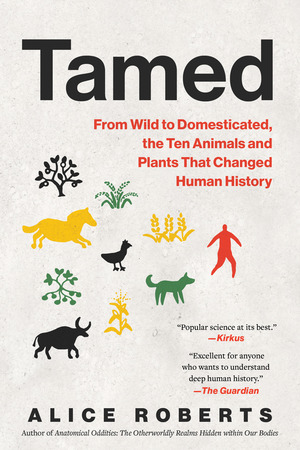
Tamed
From Wild to Domesticated, the Ten Animals and Plants That Changed Human History
- Themes
- Domestication and human history, Human relationships with nature, Origins of domesticated species
Who it’s for
- Readers interested in how domesticated species shaped human history
- Readers interested in genetics, archaeology, evolutionary biology, and anthropology
Where it sits
How strongly BookFrontier reads the book as belonging to each subject.
Nearest books
Matched by our semantic model. Ordered by what its readers also loved. Most of these share its genres: Physical Anthropology and Evolution.
 Almost HumanLee Berger50% subject match
 KindredRebecca Wragg Sykes48% subject match
 Survival of the FriendliestBrian Hare, Vanessa Woods65% subject match
 A History of the World in 100 ObjectsNeil MacGregor51% subject matchAlso shares Civilizations
For younger readers: Unstoppable Us, Volume 1: How Humans Took Over the World, Horses!, The Botany of Desire Young Readers Edition
Start with three books, and this one can be the first.
Members get a new edition every morning: a route out from their books to essays, research and talks, with the reason for each.
Sign upAbout this book
Dogs became our companions.
Wheat fed booming populations.
Cattle gave us meat and milk.
Corn fueled the growth of empires.
Potatoes brought feast and famine.
Chickens inspired new branches of science.
Rice promised a golden future.
Horses gave us strength and speed.
Apples provided harvestable sweetness.
Humans tamed them all.
For hundreds of thousands of years, our ancestors were just one wild species among many, their survival dependent on the whims of nature.
Continue reading
Then, gradually, we began to tame the plants and animals all around us—and ourselves.
Combining genetics, archaeology, evolutionary biology, and anthropology, Tamed tells the story of the greatest revolution in human history, revealing the fascinating origins of crucial domesticated species and how they, in turn, transformed us. Dogs, our first natural ally, aided Ice Age?era hunters and gatherers. Domesticated horses led to new ideas about hunting and combat in the Eurasian Steppe. The reliability of wheat and corn allowed humans to settle down and build civilizations of unprecedented complexity.
As she uncovers the astounding global implications of domestication, Alice Roberts urges us to look again at our relationship with the natural world—and our incredible influence upon it.
Publisher details
Publisher categories
- Civilizations
- Evolution
- Paleontology & Fossils
- How Cultures Work
- Authors
- Alice Roberts
- Publisher
- The Experiment
- Published
- February 25, 2025
- Format
- Print & ebook
- Reading lane
- Civilizations