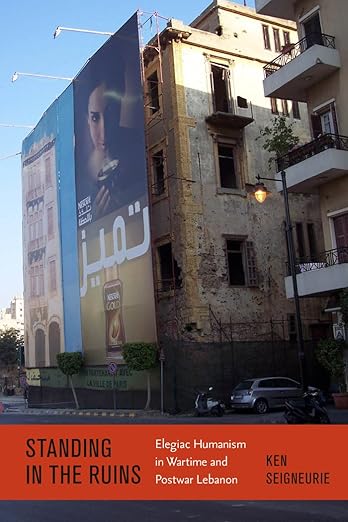
Standing by the Ruins
Elegiac Humanism in Wartime and Postwar Lebanon
Fordham University Press · Print & ebook · August 17, 2011
Since the mid-1970s, Lebanon has been at the center of the worldwide rise in sectarian extremism.
We earn from qualifying purchases.
- Who it’s for
- Ken Seigneurie traces how Lebanese cultural forms resisted sectarianism from 1975 to 2005.
- Genres
- Middle Eastern Lit Crit, Race & Culture in Literature, 20th-Century Literary Criticism
- Published
- Fordham University Press, August 17, 2011
Nearest books
Matched by what the books are about, then ordered by what their readers also loved. Most of these share its genres: Middle Eastern Lit Crit and Race & Culture in Literature.
 Trials of Arab ModernityTarek El-Ariss58% matchAlso shares 20th-Century Literary Criticism
 Contemporary Arab-american LiteratureCarol Fadda-Conrey56% match
 StatelessTalar Chahinian55% match
 Scheherazade's LegacySusan M. Darraj, Susan Muaddi Darraj55% match
 Fictions of DignityElizabeth S. Anker54% match
 Creative ReckoningsJessica Winegar54% match
 Modern Arab American FictionSteven Salaita54% match
 Modern Arabic FictionSalma Khadra Jayyusi53% match
For younger readers: Tasting the Sky, Tagging Freedom, 19 Varieties of Gazelle
Start with three books, and this one can be the first.
Members get a new edition every morning: a route out from their books to essays, research and talks, with the reason for each.
Join the waitlistAbout this book
Since the mid-1970s, Lebanon has been at the center of the worldwide rise in sectarian extremism. Its cultural output has both mediated and resisted this rise. Standing by the Ruins reviews the role of culture in supporting sectarianism, yet argues for the emergence of a distinctive aesthetic of resistance to it.
Continue reading
Focusing on contemporary Lebanese fiction, film, and popular culture, this book shows how artists reappropriated the twin legacies of commitment literature and the ancient topos of “standing by the ruins” to form a new “elegiac humanism” during the tumultuous period of 1975 to 2005. It redirects attention to the critical role of culture in conditioning attitudes throughout society and is therefore relevant to other societies facing sectarian extremism. Standing by the Ruins is also a strong intervention in the burgeoning field of World Literature. Elaborating on the great Arabist Hilary Kilpatrick’s crucial insight that ancient Arabic forms and topoi filter into modern literature, the author details how the “standing by the ruins” topos—and the structure of feeling it conditions—has migrated over time. Modern Arabic novels, feature films, and popular culture, far from being simply cultural imports, are hybrid forms deployed to respond to the challenges of contemporary Arab society. As such, they can take their place within a World Literature paradigm: they are cultural products that travel and intervene in the world.
Lebanese Cultural Resistance
Ken Seigneurie traces how Lebanese cultural forms resisted sectarianism from 1975 to 2005.
Come here for
- Contemporary Lebanese fiction, film, and popular culture
- The migration of an ancient Arabic literary topos
Expect
- An account of culture’s role in supporting sectarianism
- An argument for a distinct aesthetic of resistance
Where it sits
| Middle Eastern Lit Crit | 99% |
|---|---|
| Race & Culture in Literature | 38% |
| 20th-Century Literary Criticism | 25% |
Percentages are BookFrontier’s reading of the book.
Publisher categories
- Middle Eastern Lit Crit
- Political History & Ideas
- Authors
- Ken Seigneurie
- Publisher
- Fordham University Press
- Published
- August 17, 2011
- Format
- Print & ebook
- Reading lane
- Middle Eastern Lit Crit