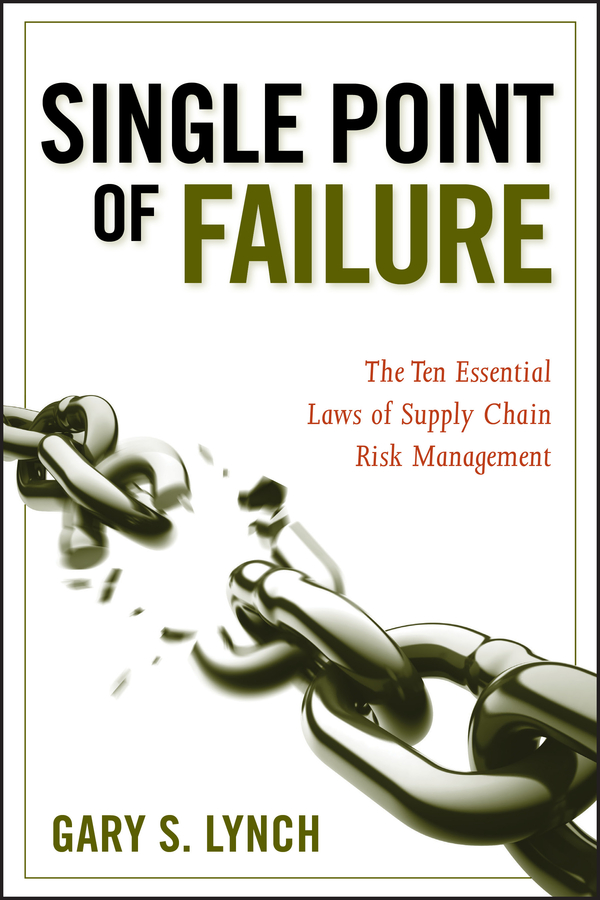
Single Point of Failure
The 10 Essential Laws of Supply Chain Risk Management
Case histories and analogies map supply-chain exposure and ways to address it.
- Themes
- Supply-chain risk management, Systemic risk and interdependence, Organizational resilience
Supply Chain Fault Lines
Come here for
- Analogies about supply-chain risk
- Dozens of case histories
Expect
- Questions about measurable impact
- Methods to neutralize supply-chain risk
Where it sits
How strongly BookFrontier reads the book as belonging to each subject.
Nearest books
Matched by our semantic model. Ordered by what its readers also loved.
 Surviving and Thriving in UncertaintyFrederick Funston, Stephen Wagner63% subject matchShares Risk Assessment & Management
 Operational Risk Management in Financial ServicesElena Pykhova56% subject matchShares Risk Assessment & Management
 Governance, Risk Management, and ComplianceRichard M. Steinberg55% subject match
 The 22 Immutable Laws of MarketingAl Ries, Jack Trout55% subject match
 Release It!Michael T. Nygard52% subject match
 The New Successful Large Account ManagementRobert B. Miller, Stephen E. Heiman52% subject match
 Risk RouletteGraham Ruddick52% subject matchShares Risk Assessment & Management
 Operational Risk ManagementAriane Chapelle51% subject matchShares Risk Assessment & Management
Start with three books, and this one can be the first.
Members get a new edition every morning: a route out from their books to essays, research and talks, with the reason for each.
Sign upAbout this book
Over the past decade organizations have faced relentless customer demand for better value at less cost, individual customization, greater choice, faster delivery, higher quality, exceptional service, and more recently – increased environmental and social consciousness. The organization’s weapon of choice to address this increasing demand has been the supply chain.
Continue reading
However, as the supply chain footprint changed (e.g. outsourcing, off-shoring and customer/vendor empowerment) so did the organization’s exposure to uncertainty. Organizations were taken by surprise since this exposure was unanticipated, complex and beyond their ability to manage. As customers become more demanding and change occurs at an even greater pace, supply chain risk continues to propagate like a parasite. Organizations and societies are at much greater risk of systemic failure because of the massive interdependency throughout global supply chains. The priority now is two-fold; play catch-up and address these massive gaps while deploying more intelligent and integrated strategies (i.e. social aware, instinctive, dynamic and predictive) for dealing with continuous change.
Single Point of Failure: The 10 Essential Laws of Supply Chain Risk Management uses analogies and dozens of case histories to describe the risk parasite that infects all supply chains while revealing methods to neutralize that parasite. The book addresses the questions: What are the "single points of failure"? How exposed are customers, investors, other stakeholders and ultimately the organization? What is the measurable impact (i.e. brand, financial, strategic, and non-compliance)? Who establishes the "risk paradigm"? How does the organization efficiently and effectively allocate precious resources - time, people, management attention, and capital? How is success measured? This book is both technically powerful and effectively realistic, based on today's complex global economy.
Publisher details
Publisher categories
- Managerial Accounting
- Authors
- Gary S. Lynch
- Publisher
- Wiley
- Published
- November 2, 2009
- Format
- Print & ebook
- Reading lane
- Managerial Accounting