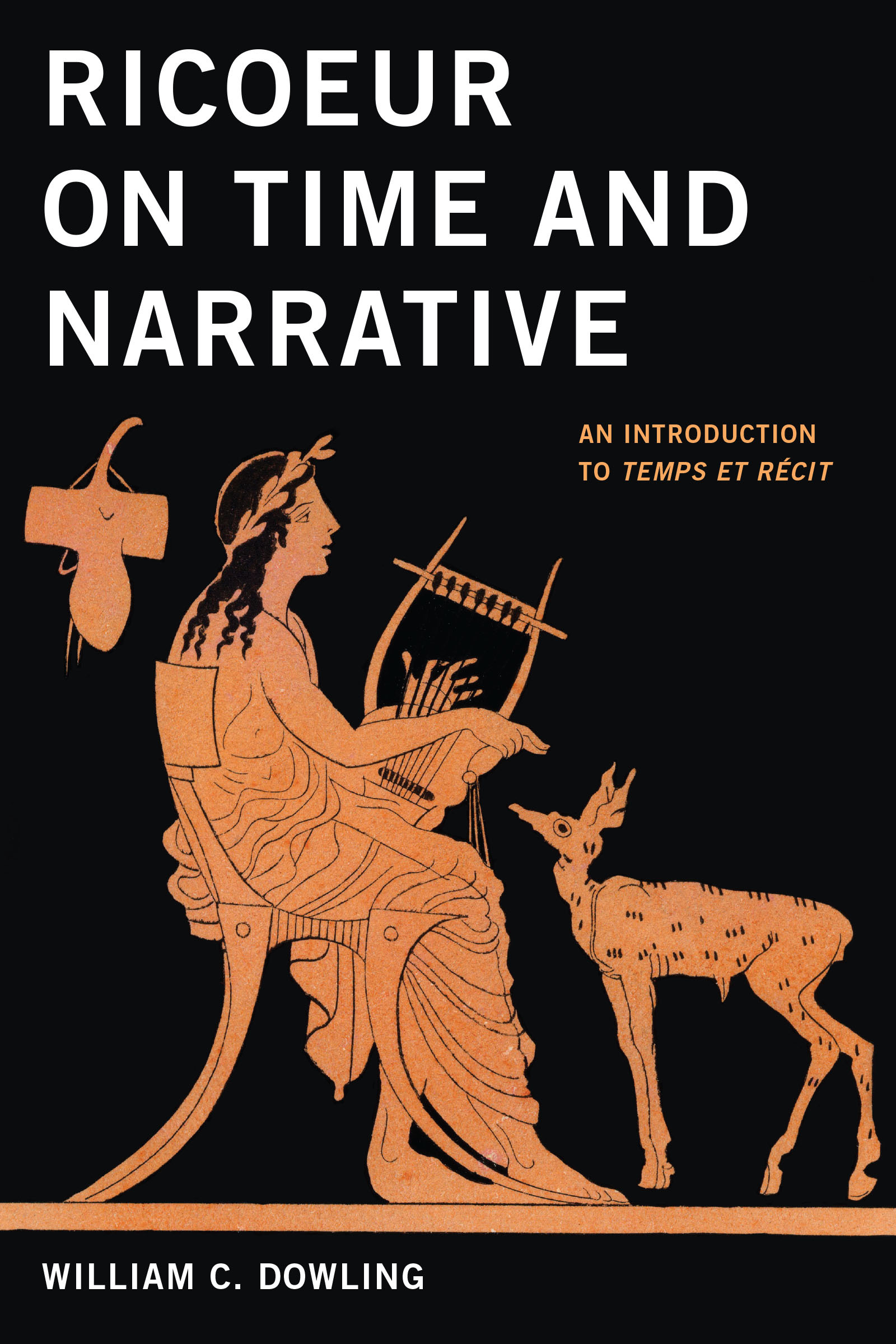
Ricoeur on Time and Narrative
An Introduction to Temps Et Récit
Dowling clarifies Ricoeur’s extended argument, tracing its concepts across six focused chapters.
- Themes
- Ricoeur’s philosophical method, Time and narrative, Poetics of history and fiction
Ricoeur’s Argument
Come here for
- A clear account of Ricoeur’s argument in Time and Narrative
- Chapters on mimesis, time, narrativity, and poetics
Expect
- A preface on the French intellectual context of Ricoeur’s method
- An appendix with Ricoeur reflecting on his career in interview
Where it sits
How strongly BookFrontier reads the book as belonging to each subject.
Nearest books
Matched by our semantic model. Ordered by what its readers also loved.
 The Seventh Function of LanguageLaurent Binet44% subject match
 Discourse on the Origin of InequalityJean-Jacques Rousseau42% subject match
 At the Existentialist CaféSarah Bakewell43% subject match
 AusterlitzW.G. Sebald41% subject match
Start with three books, and this one can be the first.
Members get a new edition every morning: a route out from their books to essays, research and talks, with the reason for each.
Sign upAbout this book
?The object of this book,? writes William C. Dowling in his preface, ?is to make the key concepts of Paul Ricoeur?s Time and Narrative available to readers who might have felt bewildered by the twists and turns of its argument.? The sources of puzzlement are, he notes, many. For some, it is Ricoeur?s famously indirect style of presentation, in which the polarities of argument and exegesis seem so often and so suddenly to have reversed themselves.
Continue reading
For others, it is the extraordinary intellectual range of Ricoeur?s argument, drawing on traditions as distant from each other as Heideggerian existentialism, French structuralism, and Anglo-American analytic philosophy. Yet beneath the labyrinthian surface of Ricoeur?s Temps et récit, Dowling reveals a single extended argument that, though developed unsystematically, is meant to be understood in systematic terms. Ricoeur on Time and Narrative presents that argument in clear and concise terms, in a way that will be enlightening both to readers new to Ricoeur and those who may have felt themselves adrift in the complexities of Temps et récit, Ricoeur?s last major philosophical work. Dowling divides his discussion into six chapters, all closely involved with specific arguments in Temps et récit: on mimesis, time, narrativity, semantics of action, poetics of history, and poetics of fiction. Additionally, Dowling provides a preface that lays out the French intellectual context of Ricoeur's philosophical method. An appendix presents his English translation of a personal interview in which Ricoeur, having completed Time and Narrative, looks back over his long career as an internationally renowned philosopher. Ricoeur on Time and Narrative communicates to readers the intellectual excitement of following Ricoeur?s dismantling of established theories and arguments?Aristotle and Augustine and Husserl on time, Frye and Greimas on narrative structure, Arthur Danto and Louis O. Mink on the nature of historical explanation?while coming to see how, under the pressure of Ricoeur?s analysis, these ideas are reconstituted and revealed in a new set of relations to one another.
Publisher details
Publisher categories
- French Literary Criticism
- Modern Philosophy
- Philosophical Criticism
- Authors
- William C. Dowling
- Publisher
- University of Notre Dame Press
- Published
- October 30, 2011
- Format
- Print & ebook
- Reading lane
- French Literary Criticism