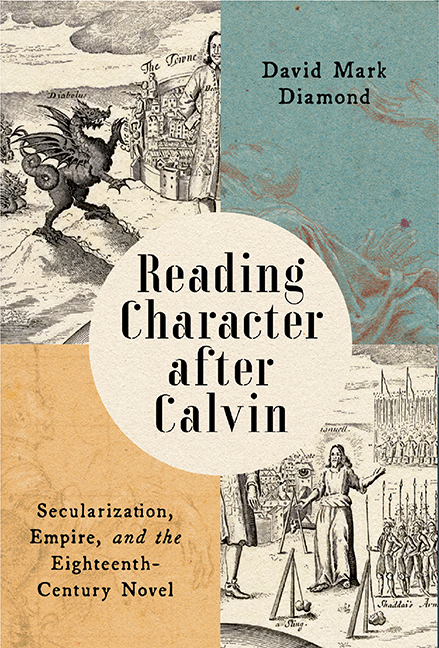
Reading Character after Calvin
Secularization, Empire, and the Eighteenth-century Novel
David Mark Diamond traces how Calvinist ideas of spiritual status shaped character in eighteenth-century fiction.
Calvinist Character
Come here for
- Calvinist theology as a key to reading fictional character
- How character detection shifts toward imperial race-making
Expect
- A study of religious hypocrisy in early novels
- Attention to how fiction questions or naturalizes imperial violence
Where it sits
How strongly BookFrontier reads the book as belonging to each subject.
Nearest books
Matched by our semantic model. Ordered by what its readers also loved.
 Theology, Horror and FictionJonathan Greenaway57% subject matchShares Religion in Literature
 Novel TranslationsBethany Wiggin56% subject matchShares 18th Century Literature
 American LazarusJoanna Brooks55% subject match
 American Literary MisfitsD. Berton Emerson54% subject match
 Gothic ReflectionsPeter Garrett54% subject match
 Unintended ReformationBrad S. Gregory54% subject match
 DominionTom Holland52% subject match
 The Catholic Revival in English Literature, 1845-1961Ian Ker51% subject matchShares Religion in Literature
Start with three books, and this one can be the first.
Members get a new edition every morning: a route out from their books to essays, research and talks, with the reason for each.
Sign upAbout this book
How Calvinist theology helps us read characters in the early British novel, shedding new light on the origins of modern secularism
The strangeness of fictional characters in the eighteenth-century novel has been well documented. They are two-dimensional yet complex; they suggest unstable correspondences between the external and the internal.
Continue reading
In Reading Character after Calvin, David Mark Diamond traces the religious genealogy of such figures, arguing that two-dimensionality reproduces through form a model of interpretation that originates in Calvinist Protestant theology.
In Calvin’s teachings, every person possessed a spiritual status as saved or damned, and their external features ostensibly reflected this inward condition. This belief, however, was always haunted by the possibility of a discrepancy between the two. Diamond shows how Calvinism survives in the pages of early novels as a guide to discerning religious hypocrisy and, eventually, distinctions related to imperial race-making. He tracks the migration of Calvinist character detection from its original, sectarian contexts to the worlds of eighteenth-century fiction, revealing the process by which religion came unbound from doctrinal orthodoxy and was grafted onto the ambition of racialized global dominion.
Analyzing a diverse set of texts, Diamond offers a fresh account of both how literary character worked and how it works to naturalize, question, or critique the violence of empire.
Publisher details
Publisher categories
- Literary Theory
- 18th Century Literature
- Religion in Literature
- Race & Culture in Literature
Show all 6 publisher categories
- The Novel as a Form
- Calvinist Christianity
- Authors
- David Mark Diamond
- Publisher
- University of Virginia Press
- Published
- April 1, 2024
- Format
- Print & ebook
- Reading lane
- Literary Theory