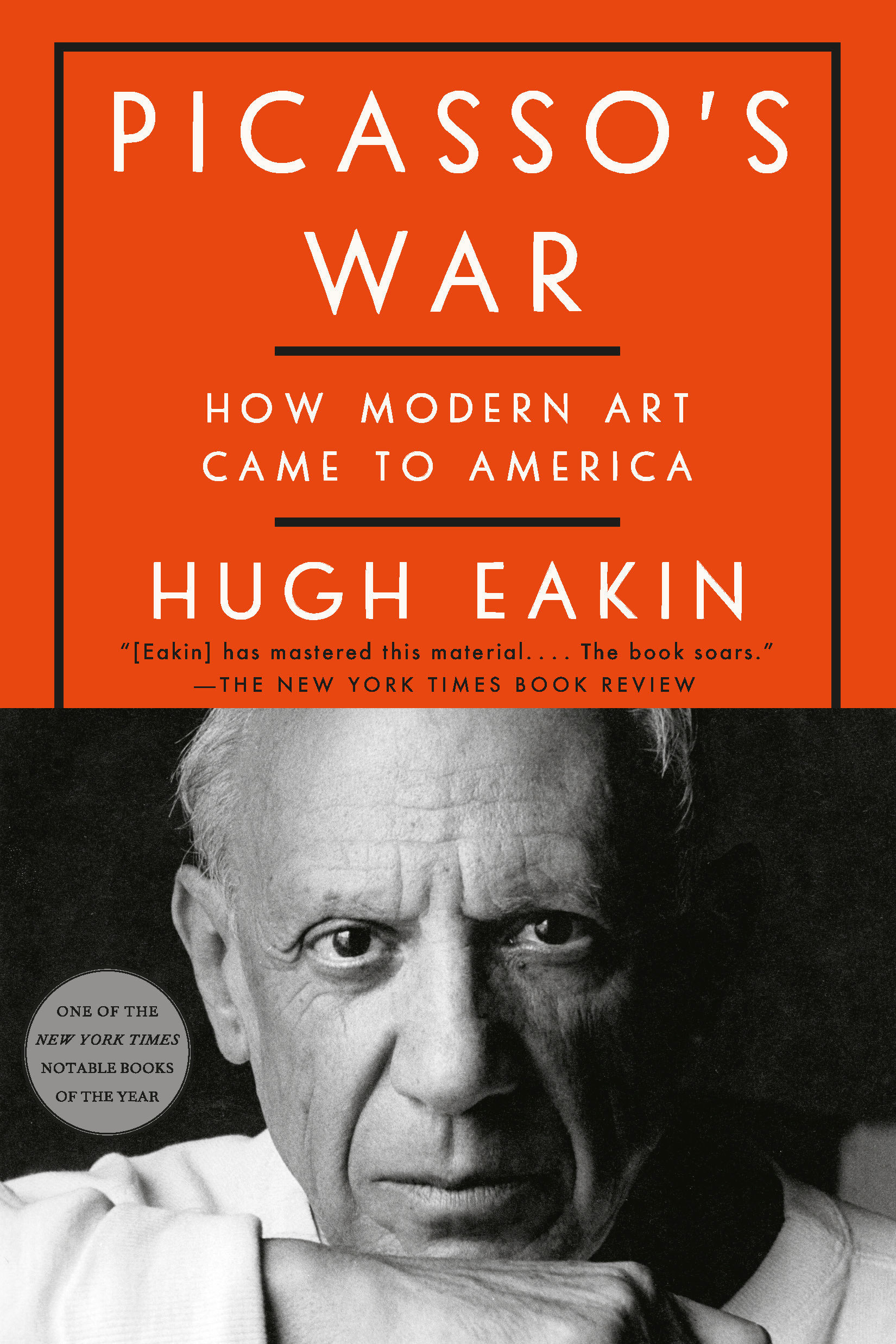
Picasso's War
How Modern Art Came to America
A vivid account of the ambitions and wartime pressures that carried Picasso into American culture.
- Themes
- Modern art in America, Picasso’s rise to fame, Art threatened by the Nazis
Art in Motion
Come here for
- The tangled ambitions behind Picasso’s American breakthrough
Expect
- Art history shaped by personalities, politics, and a looming war
Where it sits
How strongly BookFrontier reads the book as belonging to each subject.
Nearest books
Matched by our semantic model. Ordered by what its readers also loved. Most of these share its genre: Artists' Lives.
 Camille PissarroAnka Muhlstein58% subject match
 Frida in AmericaCelia Stahr57% subject match
 The Power of ArtSimon Schama67% subject match
 Allies at WarTim Bouverie50% subject matchAlso shares World War II: European Theater
 Chasing BeautyNatalie Dykstra53% subject match
 The Night PortraitLaura Morelli53% subject match
 They All Came to BarneysGene Pressman50% subject match
For younger readers: The Mona Lisa Vanishes, Artifice, The History of Western Art in Comics Part One: From Prehistory to the Renaissance
Start with three books, and this one can be the first.
Members get a new edition every morning: a route out from their books to essays, research and talks, with the reason for each.
Sign upAbout this book
A riveting story of how dueling ambitions and the power of prodigy made America the cultural center of the world—and Picasso the most famous artist alive—in the shadow of World War II
“[Eakin] has mastered this material. . . . The book soars.”—The New York Times Book Review (Editors’ Choice)
ONE OF THE BEST BOOKS OF THE YEAR: Vanity Fair, The New York Times Book Review, The New Yorker
Continue reading
In January 1939, Pablo Picasso was renowned in Europe but disdained by many in the United States. One year later, Americans across the country were clamoring to see his art. How did the controversial leader of the Paris avant-garde break through to the heart of American culture?
The answer begins a generation earlier, when a renegade Irish American lawyer named John Quinn set out to build the greatest collection of Picassos in existence. His dream of a museum to house them died with him, until it was rediscovered by Alfred H. Barr, Jr., a cultural visionary who, at the age of twenty-seven, became the director of New York’s new Museum of Modern Art.
Barr and Quinn’s shared goal would be thwarted in the years to come—by popular hostility, by the Depression, by Parisian intrigues, and by Picasso himself. It would take Hitler’s campaign against Jews and modern art, and Barr’s fraught alliance with Paul Rosenberg, Picasso’s persecuted dealer, to get Picasso’s most important paintings out of Europe. Mounted in the shadow of war, the groundbreaking exhibition Picasso: Forty Years of His Art would launch Picasso in America, define MoMA as we know it, and shift the focus of the art world from Paris to New York.
Picasso’s War is the never-before-told story about how a single exhibition, a decade in the making, irrevocably changed American taste, and in doing so saved dozens of the twentieth century’s most enduring artworks from the Nazis. Through a deft combination of new scholarship and vivid storytelling, Hugh Eakin shows how two men and their obsession with Picasso changed the art world forever.
Publisher details
Publisher categories
- Modern Art History (to 1945)
- Artists' Lives
- World War II History
- Authors
- Hugh Eakin
- Publisher
- Crown
- Published
- September 26, 2023
- Format
- Print & ebook
- Reading lane
- Modern Art History (to 1945)