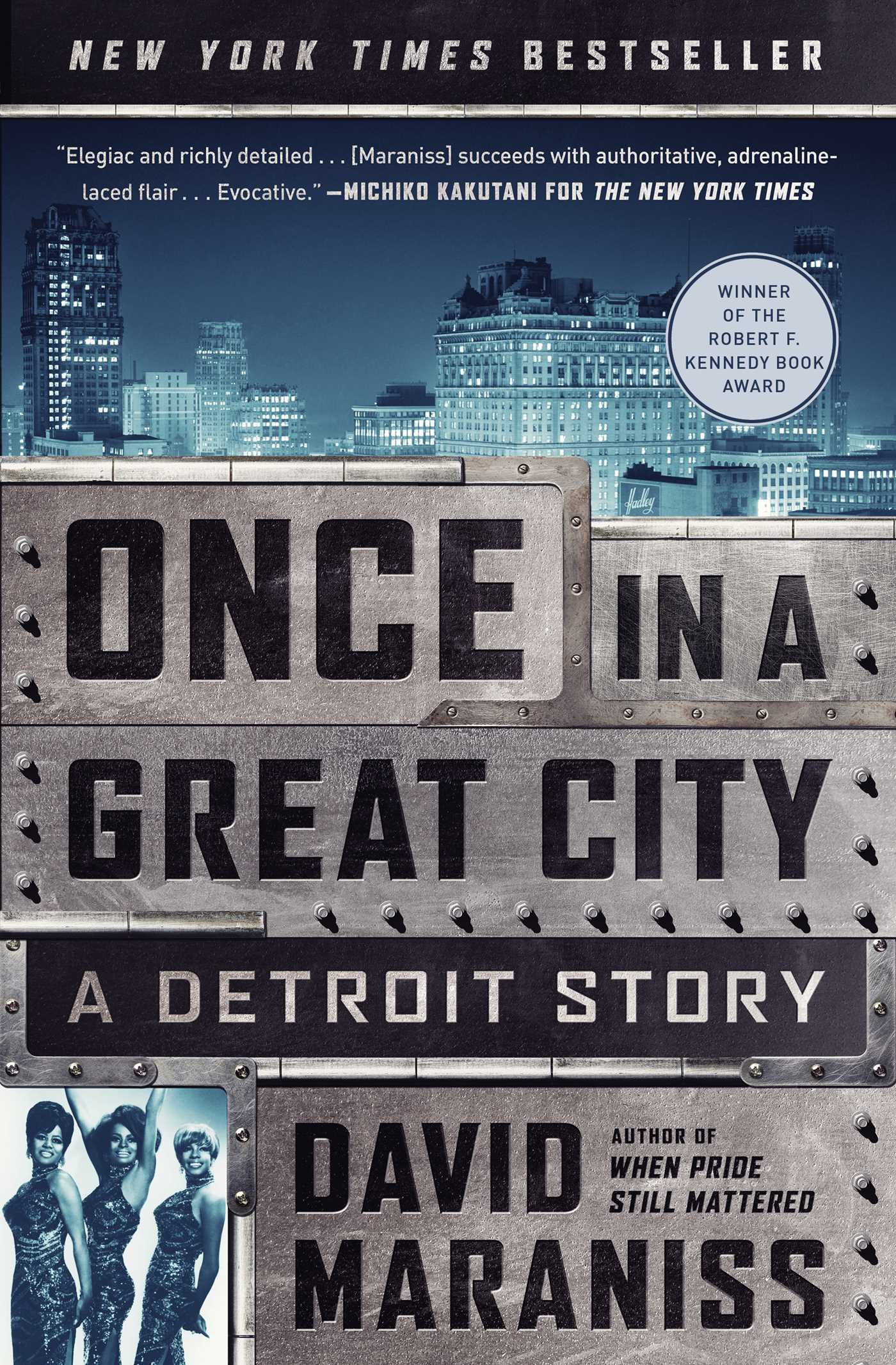
Once in a Great City
A Detroit Story
David Maraniss renders Detroit in 1963 as a city thriving in public and shadowed by change.
Promise and Unease
Come here for
- Detroit at its 1963 peak, with promise and unease in the same frame
- A city’s fortunes read through its leaders, industries, and changing economy
Expect
- Richly detailed city history with political, racial, economic, and cultural strands
- An affectionate portrait that keeps the signs of decline in view
Where it sits
How strongly BookFrontier reads the book as belonging to each subject.
Nearest books
Matched by our semantic model. Ordered by what its readers also loved.
 A Prayer for the CityBuzz Bissinger49% subject matchShares Cities & Urban Planning
 Car Guys vs. Bean CountersBob Lutz59% subject match
 Engines of ChangePaul Ingrassia60% subject matchShares 20th-Century America
 This Is Chance!Jon Mooallem49% subject match
 The Soul of AmericaJon Meacham48% subject matchShares 20th-Century America
 FordlandiaGreg Grandin57% subject matchShares 20th-Century America
 August SnowStephen Mack Jones56% subject match
For younger readers: A Few Red Drops, Who Was Henry Ford?, 1968: Today's Authors Explore a Year of Rebellion, Revolution, and Change
Start with three books, and this one can be the first.
Members get a new edition every morning: a route out from their books to essays, research and talks, with the reason for each.
Sign upAbout this book
“A fascinating political, racial, economic, and cultural tapestry” (Detroit Free Press), Once in a Great City is a tour de force from David Maraniss about the quintessential American city at the top of its game: Detroit in 1963.
Detroit in 1963 is on top of the world.
Continue reading
The city’s leaders are among the most visionary in America: grandson of the first Ford; Henry Ford II; Motown’s founder Berry Gordy; the Reverend C.L. Franklin and his daughter, the incredible Aretha; Governor George Romney, Mormon and Civil Rights advocate; car salesman Lee Iacocca; Police Commissioner George Edwards; Martin Luther King. The time was full of promise. The Detroit auto industry was selling more cars than ever before. Yet the shadows of collapse were evident even then as urban decline and racial tension simmered beneath the surface.
“Elegiac and richly detailed” (The New York Times), in Once in a Great City David Maraniss shows that before the devastating riot, before the decades of civic corruption and neglect, and white flight; before people trotted out the grab bag of rust belt infirmities and competition from abroad to explain Detroit’s collapse, one could see the signs of a city’s ruin. Detroit at its peak was threatened by its own design. It was being abandoned by the new world economy and by the transfer of American prosperity to the information and service industries. In 1963, as Maraniss captures it with power and affection, Detroit summed up the American Dream of prosperity that was already past history. “An encyclopedic account of Detroit in the early sixties, a kind of hymn to what really was a great city” (The New Yorker).
Publisher details
Publisher categories
- History
- 20th-Century America
- Midwest History
- Authors
- David Maraniss
- Publisher
- Simon & Schuster
- Published
- September 20, 2016
- Format
- Print & ebook
- Reading lane
- History