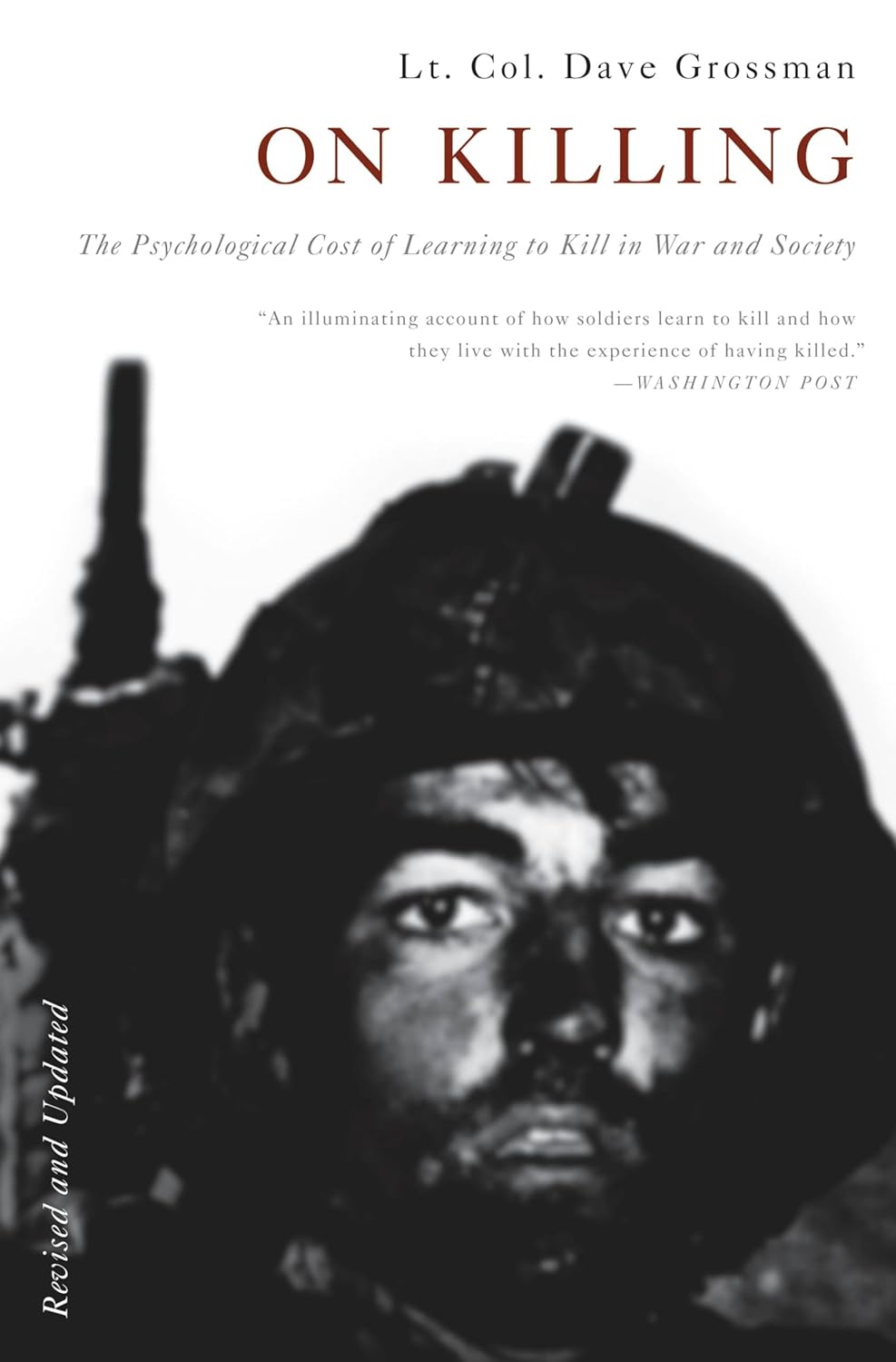
On Killing
The Psychological Cost of Learning to Kill in War and Society
Little, Brown and Company · Print & ebook · June 22, 2009
The revised and updated edition of Lt.
We earn from qualifying purchases.
- Who it’s for
- For readers interested in the psychology of combat and killing.
- Themes
- Psychology of combat, Post-combat stress, Media violence and society
- Genres
- Violence in Society, Military History, Security Studies
Nearest books
Matched by what the books are about, then ordered by what their readers also loved.
 Generation KillEvan Wright, Patrick Lawlor52% match
 Black HeartsJim Frederick56% match
 The Body Keeps the ScoreBessel van der Kolk M.D., Bessel van der Kolk54% match
 Science and Human BehaviorB.F Skinner50% match
 Trauma and MemoryPeter A. Levine, Ph.D.49% match
 The WarriorsJ. Glenn Gray65% matchShares Military History
 About FaceCol. David H. Hackworth, Jocko Willink50% match
 The UnthinkableAmanda Ripley50% match
Start with three books, and this one can be the first.
Members get a new edition every morning: a route out from their books to essays, research and talks, with the reason for each.
Join the waitlistAbout this book
The revised and updated edition of Lt. Col. Dave Grossman's modern classic about the psychology of combat. "An illuminating account of how soldiers learn to kill and how they live with the experiences of having killed." —Washington Post The twentieth century, with its bloody world wars, revolutions, and genocides accounting for hundreds of millions dead, would seem to prove that human beings are incredibly vicious predators and that killing is as natural as eating.
Continue reading
But Lieutenant Colonel Dave Grossman, a psychologist and U.S. Army Ranger, demonstrates this is not the case. The good news, according to Grossman—drawing on dozens of interviews, first-person reports, and historic studies of combat, ranging from Frederick the Great's battles in the eighteenth century through Vietnam—is that the vast majority of soldiers are loath to kill. In World War II, for instance, only 15 to 25 percent of combat infantry were willing to fire their rifles. The provocative news is that modern armies, using Pavlovian and operant conditioning, have learned how to overcome this reluctance. In Korea about 50 percent of combat infantry were willing to shoot, and in Vietnam the figure rose to over 90 percent. The bad news is that by conditioning soldiers to overcome their instinctive loathing of killing, we have drastically increased post-combat stress—witness the devastated psychological state of our Vietnam vets as compared with those from earlier wars. And the truly terrible news is that contemporary civilian society, particularly the media, replicates the army's conditioning techniques and—according to Grossman's controversial thesis—is responsible for our rising rates of murder and violence, particularly among the young. In the explosive last section of the book, he argues that high-body-count movies, television violence (both news and entertainment), and interactive point-and-shoot video games are dangerously similar to the training programs that dehumanize the enemy, desensitize soldiers to the psychological ramifications of killing, and make pulling the trigger an automatic response.
Who it’s for
- For readers interested in the psychology of combat and killing.
- For readers exploring media violence and its effects on society.
Where it sits
| Violence in Society | 74% |
|---|---|
| Military History | 41% |
| Security Studies | 25% |
Percentages are BookFrontier’s reading of the book.
Publisher categories
- Military History
- Other Military Conflicts
- Violence in Society
- Authors
- Lieutenant Colonel Dave Grossman
- Publisher
- Little, Brown and Company
- Published
- June 22, 2009
- Format
- Print & ebook
- Theme
- Psychology of combat · Post-combat stress · Media violence and society
- Reading lane
- Military History