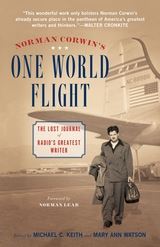
Norman Corwin's One World Flight
The Lost Journal of Radio's Greatest Writer
Norman Corwin’s newly published journal records his travels and observations across 17 countries in 1946.
Corwin’s 1946 Journal
Come here for
- Corwin’s personal journal from a 1946 trip through 17 countries
- His observations on the postwar world and international communications
Expect
- A personal account of Corwin’s postwar travels
- Observations on international communications
Where it sits
How strongly BookFrontier reads the book as belonging to each subject.
Nearest books
Matched by our semantic model. Ordered by what its readers also loved.
 Berlin DiaryWilliam L. Shirer57% subject match
 Last Call at the Hotel ImperialDeborah Cohen56% subject match
 Radio OnSarah Vowell53% subject match
 Travels with HerodotusRyszard Kapuscinski51% subject matchShares Travel Writing
 Into Unknown SkiesDavid K. Randall51% subject match
For younger readers: Flight, Alphamaniacs, Amelia Lost
Start with three books, and this one can be the first.
Members get a new edition every morning: a route out from their books to essays, research and talks, with the reason for each.
Sign upAbout this book
In 1946, legendary broadcaster Norman Corwin traveled to 17 countries to document the postwar world for the radio series, One World Flight. Here, recently discovered and now published for the first time, is his personal journal of that historic trip. A towering figure in broadcast history, Norman Corwin has long been known as "Radio's Poet Laureate." In the late 1930s, a creative revolution was underway in the medium.
Continue reading
What some people still called "the wireless" was maturing from a novelty into an art form. After a ten-year career as a newspaperman, columnist, and critic-which began at the age of 17-Corwin joined the ranks of aural provocateurs such as Archibald MacLeish, Arch Oboler, and Orson Welles. Toward the end of 1944, with an Allied victory in Europe apparently assured, CBS asked Corwin to prepare a program celebrating the anticipated event. On May 8, 1945, just after the collapse of Germany, CBS airedOn a Note of Triumph, an epic aural mosaic. This program is considered to be the climax of the luminous period in radio history when writing of high merit, produced with consummate skill was nurtured and protected from commercial interference. After the broadcast, phone calls and letters of praise flooded the network, including a letter from Carl Sandburg callingOn a Note of Triumph"one of the all the all-time great American poems." Corwin went on to win the first Wendell Willkie Award-a trip around the world sponsored by Freedom House and the Common Council for American Unity. Corwin accepted the Willkie Award on the condition it would be a working trip. He wanted the opportunity to record people in various countries and develop a series of documentaries on the state of the postwar world. CBS offered full support. The thirteen-part series,One World Flight, aired in 1947.Norman Corwin's One World Flightprovides the reader with an unrivaled perspective. During Corwin's travels to 17 countries in 1946, he kept a journal of his personal thoughts and observations. It was put in a drawer where it remained for decades. More than sixty years after the trip, media historian Michael Keith asked Corwin-who is now in his nineties-if he had kept a log or journal of his One World travels. He had, and his analysis of international communications still rings true today.
Publisher details
Publisher categories
- Sociology
- Authors
- Michael C. Keith, Mary Ann Watson
- Publisher
- Continuum: 33 1/3
- Published
- September 1, 2009
- Format
- Print & ebook
- Reading lane
- Sociology