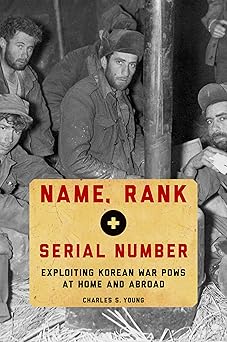
Name, Rank, and Serial Number
Exploiting Korean War POWs at Home and Abroad
Charles S. Young traces how POW propaganda shaped Korean War negotiations and the veterans’ return home.
POWs and Propaganda
Come here for
- American POWs used in propaganda during the Korean War
- The politics behind voluntary repatriation
Expect
- Chinese propaganda about alleged germ warfare
- U.S. campaigns over prisoner defections and repatriation
Where it sits
How strongly BookFrontier reads the book as belonging to each subject.
Nearest books
Matched by our semantic model. Ordered by what its readers also loved. Most of these share its genre: Korean War History.
 Remembered Prisoners of a Forgotten WarLewis H. Carlson79% subject matchAlso shares Veterans' Stories
 In Combat in KoreaRyan Walkowski, Ed Gruber68% subject matchAlso shares Veterans' Stories
 The Korean WarBruce Cumings67% subject match
 The LineWilliam T. Bowers66% subject match
 Mao's Generals Remember KoreaXiaobing Li, Allan R. Millett65% subject matchAlso shares Cold War History
 Hidden History of the Korean WarI.F. Stone64% subject matchAlso shares Cold War History
 Cold War FriendshipsJosphine Nock-Hee Park63% subject matchAlso shares Cold War History
 The Unlikely War HeroMarc Leepson60% subject match
For younger readers: I Remember Korea, Men of the 65th, Cold War Correspondent
Start with three books, and this one can be the first.
Members get a new edition every morning: a route out from their books to essays, research and talks, with the reason for each.
Sign upAbout this book
Vietnam POWs came home heroes, but twenty years earlier their predecessors returned from Korea to shame and suspicion. In the Korean War (1950-1953) American prisoners were used in propaganda twice, first during the conflict, then at home. While in Chinese custody in North Korea, they were pressured to praise their treatment and criticize the war.
Continue reading
When they came back, the Department of the Army and cooperative pundits said too many were weaklings who did not resist communist indoctrination or "brainwashing." Ex-prisoners were featured in a publicity campaign scolding the nation to raise tougher sons for the Cold War. This propaganda was based on feverish exaggerations that ignored the convoluted circumstances POWs were put in, which decisions in Washington helped create. POWs became pivotal to the Korean War after peace talks began in summer 1951. Since fighting had stalemated, both sides raced to win propaganda victories. The Chinese publicized American airmen who confessed to alleged germ warfare atrocities. American commanders worked to discredit communism by encouraging thousands of North Korean and Chinese prisoners to defect. Clandestine agents and a fraternity of anticommunist prisoners launched a violent campaign to inflate the number of POWs refusing repatriation after the war. Armistice negotiations floundered while China and North Korea demanded their soldiers back. United States delegates held out for what they called "voluntary repatriation," but in reality, thousands of prisoners were terrorized into renouncing their right of return. American POWs remained captive for eighteen more months of fighting over the terms of a compromised prisoner exchange. In the United States, details of the voluntary repatriation policy were suppressed. Name, Rank, and Serial Number explains how this provides new insight into why Korea became "the forgotten war."
Publisher details
Publisher categories
- Korean War History
- Authors
- Charles S. Young
- Publisher
- Oxford University Press
- Published
- May 15, 2014
- Format
- Print & ebook
- Reading lane
- Korean War History