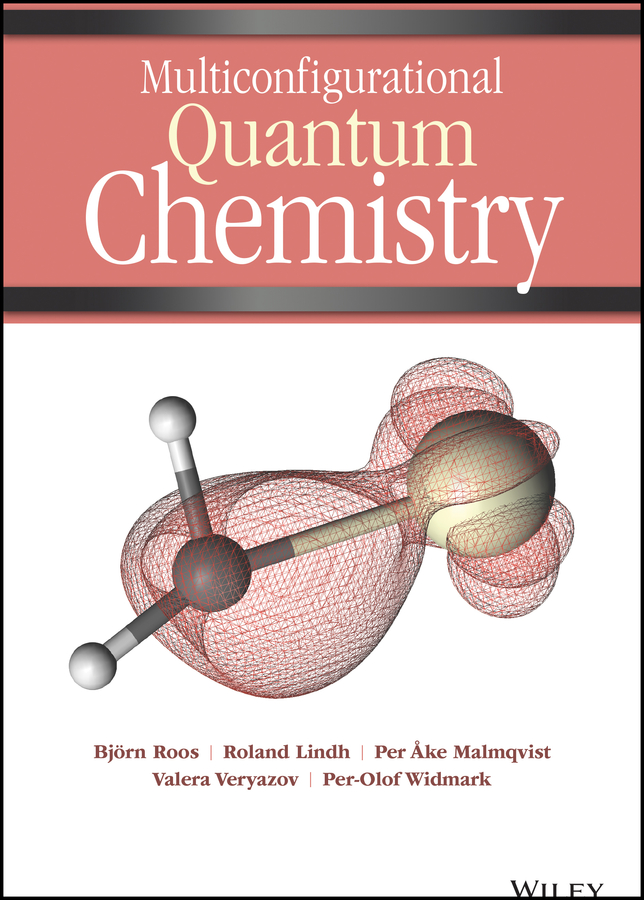
Multiconfigurational Quantum Chemistry
1st Edition, Kindle Edition
Explore wavefunction-based methods, their limits, and applications across chemical systems.
Quantum Chemistry Methods
Come here for
- Illustrative examples in ground- and excited-state reactions
- Coverage of transition metals and other heavy-element systems
Expect
- Drawbacks and limits of DFT and coupled-cluster methods
- Wavefunction-based alternatives for smaller molecules
Where it sits
How strongly BookFrontier reads the book as belonging to each subject.
Nearest books
Matched by our semantic model. Ordered by what its readers also loved. Most of these share its genre: Physical Chemistry.
 Handbook of Computational Quantum ChemistryDavid B. Cook65% subject matchAlso shares Molecular Modeling and Atomic & Molecular Physics
 Quantum ChemistryDonald A. McQuarrie63% subject matchAlso shares Molecular Modeling
 Molecular Symmetry and Group TheoryRobert L. Carter60% subject match
 Quantum ChemistryIra N. Levine59% subject matchAlso shares Molecular Modeling
 Problems and Solutions to Accompany McQuarrie and Simon's Physical ChemistryHeather Cox58% subject match
 Kinetics and Catalysis in Microheterogeneous SystemsMichael Gratzel58% subject match
 Physical ChemistryDonald A. McQuarrie, John D. Simon58% subject matchAlso shares Atomic & Molecular Physics
 Quantum ChemistryMichael Springborg, Meijuan Zhou58% subject matchAlso shares Molecular Modeling and Atomic & Molecular Physics
For younger readers: CHEM MAT & CHG SE
Start with three books, and this one can be the first.
Members get a new edition every morning: a route out from their books to essays, research and talks, with the reason for each.
Sign upAbout this book
The first book to aid in the understanding of multiconfigurational quantum chemistry, Multiconfigurational Quantum Chemistry demystifies a subject that has historically been considered difficult to learn.
Continue reading
Accessible to any reader with a background in quantum mechanics and quantum chemistry, the book contains illustrative examples showing how these methods can be used in various areas of chemistry, such as chemical reactions in ground and excited states, transition metal and other heavy element systems. The authors detail the drawbacks and limitations of DFT and coupled-cluster based methods and offer alternative, wavefunction-based methods more suitable for smaller molecules.
Publisher details
Publisher categories
- Physical Chemistry
- Authors
- Björn O. Roos, Roland Lindh, Per ke Malmqvist
- Publisher
- Wiley
- Published
- August 3, 2016
- Format
- Ebook
- Reading lane
- Physical Chemistry