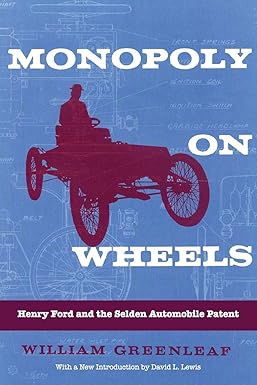
Trace the patent battle linking automobile pricing, invention, and Ford's reputation.
The Selden Patent
Come here for
- The Selden patent case and its challenge by automakers
- Automobiles as mass-produced, low-priced commodities
Expect
- A contentious eight-year trade war
- Implications for patents and technological progress beyond the auto industry
Where it sits
How strongly BookFrontier reads the book as belonging to each subject.
Nearest books
Matched by our semantic model. Ordered by what its readers also loved. Most of these share its genre: Automobile Industry.
 Wheels for the WorldDouglas G. Brinkley63% subject match
 FinsWilliam Knoedelseder55% subject matchAlso shares Automotive History
 Preston Tucker and His Battle to Build the Car of TomorrowSteve Lehto55% subject matchAlso shares Automotive History
 Engines of ChangePaul Ingrassia49% subject matchAlso shares Automotive History
 American DriveRichard Dauch, Hank H. Cox49% subject match
 FordlandiaGreg Grandin49% subject match
For younger readers: Who Was Henry Ford?, The Electric War, Many Voices
Start with three books, and this one can be the first.
Members get a new edition every morning: a route out from their books to essays, research and talks, with the reason for each.
Sign upAbout this book
In 1895, visionary Rochester, New York, attorney George B. Selden was granted a patent for a "road-carriage" that he had designed but not built. In anticipation of a burgeoning American auto industry, Selden had filed a series of amendments to his application, delaying the process for sixteen years in order to stretch his claim out as long as possible.
Continue reading
As a result, the Selden patent covered all gasoline-powered vehicles designed since 1879 and manufactured, sold, or used in the United States during a seventeen-year period ending in 1912. Selden's ally, the Association of Licensed Automobile Manufacturers, granted licenses and collected royalties on cars made by other manufacturers until 1903, when the patent was challenged by a coalition of automakers led by Henry Ford.
In this classic study of the Selden patent case, author William Greenleaf argues that Ford's defiance of the patent was considered heroic and that his victory in court after a contentious eight-year trade war was historic. Based on Greenleaf's extensive research in the Ford corporate archives, Monopoly on Wheels shows that the real issue at stake in the Selden patent case was the democratization of the automobile as a mass-produced, low-priced commodity as opposed to its former status as the exclusive property of the wealthy elite. Greenleaf shows that the suit was a foundation stone, along with the Model T, mass production methods, and the five-dollar day, upon which Ford's reputation as a rugged individualist was built. Greenleaf also investigates implications that the legal battle had beyond the auto industry for inventions, patents, and technological progress in general.
Monopoly on Wheels vividly illustrates how the Selden patent battle became a landmark in the social and technological revolution of the early twentieth century. On the one-hundredth anniversary of the Selden patent case and fifty years after it was first published, this volume will be a welcome addition to any auto historian's library. This reprinted edition also includes a new introduction by David L. Lewis.
Publisher details
Publisher categories
- Automobile Industry
- Corporate Histories
- 20th-Century America
- Authors
- William Greenleaf
- Publisher
- Wayne State University Press
- Published
- March 15, 2011
- Format
- Print & ebook
- Reading lane
- Automobile Industry