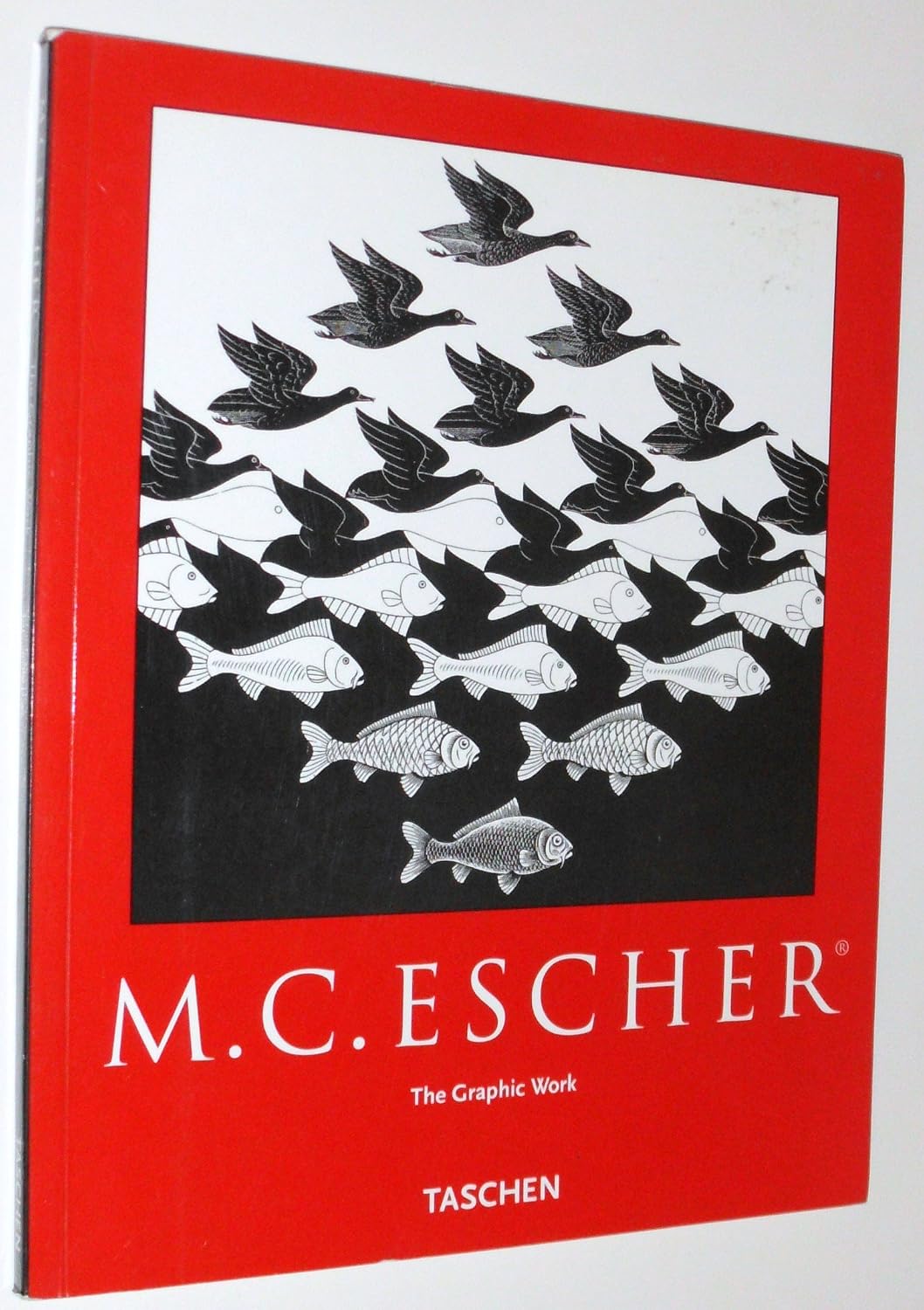
M.C. Escher: The Graphic Work
- Themes
- Dimensional and perspectival illusions, Limits of sensory perception, M.C. Escher's life and art
Who it’s for
- Readers interested in M.C. Escher's impossible-world imagery
- Readers exploring visual perception through art
Where it sits
How strongly BookFrontier reads the book as belonging to each subject.
Nearest books
Matched by our semantic model. Ordered by what its readers also loved. Most of these share its genre: Artists' Lives.
 Andrew Wyeth at Kuerner FarmWilliam L. Coleman, Allison C. Slaby41% subject matchAlso shares Artist Monographs
 Aubrey BeardsleyJan Marsh40% subject matchAlso shares Artist Monographs
 LeonardoFrank Zöllner50% subject matchAlso shares Artist Monographs
 Mortal LessonsRichard Selzer40% subject match
 Bento's SketchbookJohn Berger50% subject match
 GaudiGijs van Hensbergen48% subject match
For younger readers: Mosque, Erno Rubik and His Magic Cube, The Seuss, the Whole Seuss and Nothing But the Seuss
Start with three books, and this one can be the first.
Members get a new edition every morning: a route out from their books to essays, research and talks, with the reason for each.
Sign upAbout this book
Presenting the structurally unthinkable as though it were a law of nature
M.C. Escher was born in 1898 in Leeuwarden (Netherlands). He received his first drawing lessons during secondary school from F.W. van der Haagen, who also taught him the block printing, thus fostering Escher’s innate graphic talents.
Continue reading
From 1912 to 1922 he studied at the School of Architecture and Ornamental Design in Haarlem, where he was instructed in graphic techniques by S. Jessurun de Mesquita, who greatly influenced Escher’s further artistic development. Between 1922 and 1934 the artist lived and worked in Italy. Afterwards Escher spent two years in Switzerland and five in Brussels before finally moving back to Barn in Holland, where he died in 1972.
M.C. Escher is not a surrealist drawing us into his dream world, but an architect of perfectly impossible worlds who presents the structurally unthinkable as though it were a law of nature. The resulting dimensional and perspectival illusions bring us into confrontation with the limitations of our sensory perception.
About the Series:
Each book in TASCHEN’s Basic Art series features:
- a detailed chronological summary of the life and oeuvre of the artist, covering his or her cultural and historical importance
- a concise biography
- approximately 100 illustrations with explanatory captions
Publisher details
Publisher categories
- European Art
- Authors
- TASCHEN
- Publisher
- TASCHEN
- Published
- February 1, 2001
- Format
- Print & ebook
- Reading lane
- European Art