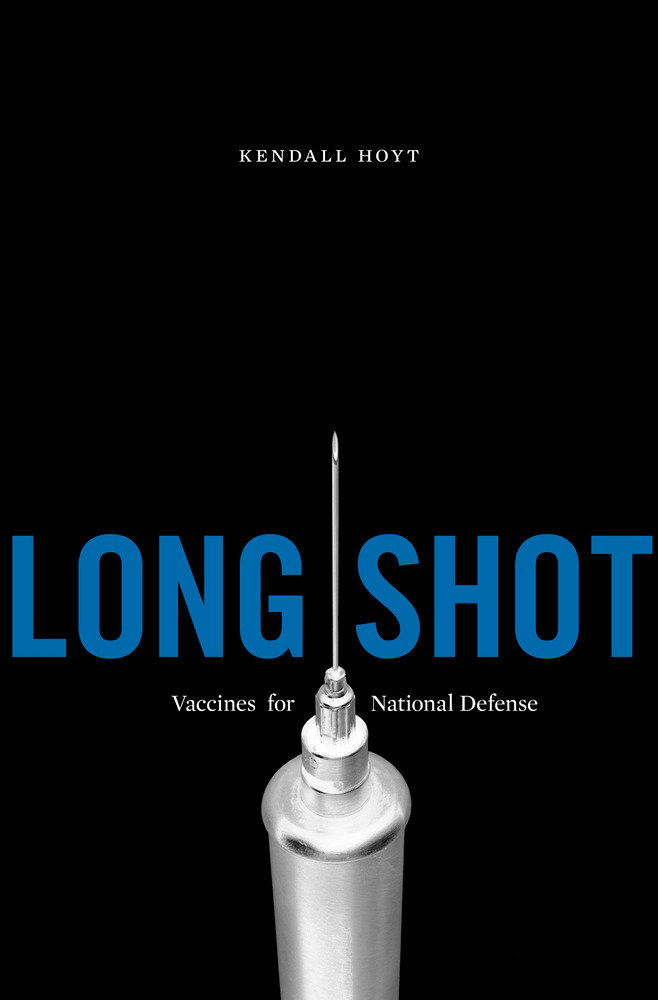
Long Shot
Vaccines for National Defense
Kendall Hoyt traces vaccine innovation from World War II programs to today’s biodefense challenges.
Vaccine Innovation
Come here for
- The contrast between wartime vaccine programs and the stalled anthrax vaccine effort
- An account of how collaboration shaped vaccine development
Expect
- Historical analysis of vaccine development and national health emergencies
- An argument about collaboration, outsourcing, and innovation
Where it sits
How strongly BookFrontier reads the book as belonging to each subject.
Nearest books
Matched by our semantic model. Ordered by what its readers also loved. Most of these share its genre: Chemical & Biological Warfare.
 American BiodefenseFrank L. Smith III68% subject match
 Biological WeaponsJeanne Guillemin64% subject match
 The Gathering Biological Warfare StormJim A. Davis, Barry R. Schneider64% subject match
 Plague MakersWendy Barnaby62% subject match
 VaccinatedPaul A. Offit, M.D.62% subject matchAlso shares Vaccinations and Medical History
 The Contagion of LibertyAndrew M. Wehrman61% subject matchAlso shares Medical History
 Booster ShotsAdam Ratner, MD, MPH61% subject matchAlso shares Vaccinations
 The Demon in the FreezerRichard Preston60% subject match
For younger readers: Patient Zero, New York Times Deadly Invaders, Very, Very, Very Dreadful
Start with three books, and this one can be the first.
Members get a new edition every morning: a route out from their books to essays, research and talks, with the reason for each.
Sign upAbout this book
At the turn of the twenty-first century, the United States contended with a state-run biological warfare program, bioterrorism, and a pandemic. Together, these threats spurred large-scale government demand for new vaccines, but few have materialized. A new anthrax vaccine has been a priority since the first Gulf War, but twenty years and a billion dollars later, the United States still does not have one. This failure is startling.
Continue reading
Historically, the United States has excelled at responding to national health emergencies. World War II era programs developed ten new or improved vaccines, often in time to meet the objectives of particular military missions. Probing the history of vaccine development for factors that foster timely innovation, Kendall Hoyt discovered that vaccine innovation has been falling, not rising, since World War II. This finding is at odds with prevailing theories of market-based innovation and suggests that a collection of nonmarket factors drove mid-century innovation. Ironically, many late-twentieth-century developments that have been celebrated as a boon for innovation—the birth of a biotechnology industry and the rise of specialization and outsourcing—undercut the collaborative networks and research practices that drove successful vaccine projects in the past.
Hoyt’s timely investigation teaches important lessons for our efforts to rebuild twenty-first-century biodefense capabilities, especially when the financial payback for a particular vaccine is low, but the social returns are high.
Publisher details
Publisher categories
- Chemical & Biological Warfare
- Health Policy
- Public Health
- Authors
- Kendall Hoyt
- Publisher
- WW Norton
- Published
- February 14, 2012
- Format
- Print & ebook
- Reading lane
- Chemical & Biological Warfare