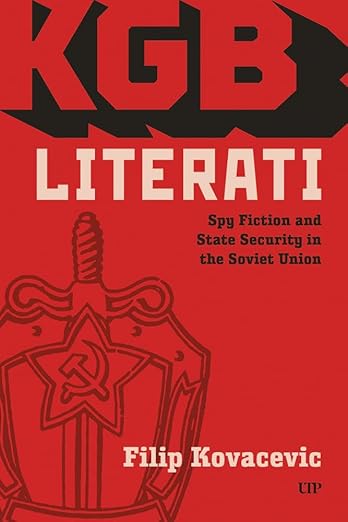
KGB Literati
Spy Fiction and State Security in the Soviet Union
KGB Literati examines Soviet spy fiction as both literary output and a tool of counterintelligence.
Soviet Spy Fiction
Come here for
- Analysis of spy fiction written by Soviet intelligence and counterintelligence officers
- Connections between these texts and Soviet efforts to counter Western cultural influence
Expect
- Research drawing on KGB archives and long-out-of-print Soviet publications
- An account of spy fiction’s role in Soviet popular culture
Where it sits
How strongly BookFrontier reads the book as belonging to each subject.
Nearest books
Matched by our semantic model. Ordered by what its readers also loved. Most of these share its genre: Cold War History.
 The Spy and the TraitorBen Macintyre66% subject match
 Cold WarriorsDuncan White64% subject matchAlso shares Intelligence & Spycraft
 RedwoodBen Macintyre58% subject match
 The Talbot OdysseyNelson DeMille56% subject match
 The CIA Book ClubCharlie English55% subject matchAlso shares Intelligence & Spycraft
 A Spy Among FriendsBen Macintyre55% subject match
 Book and DaggerElyse Graham54% subject matchAlso shares Intelligence & Spycraft
For younger readers: The Dark Game, Spies, Eyes on the Ice
Start with three books, and this one can be the first.
Members get a new edition every morning: a route out from their books to essays, research and talks, with the reason for each.
Sign upAbout this book
Once out of active service, many former spies have turned to writing spy fiction. They drop the dagger and pick up the pen. Some are very successful, like James Bond’s creator Ian Fleming or the novelists John Le Carré and Graham Greene. Their Soviet counterparts have rarely been afforded the same attention or examination.
Continue reading
Drawing on materials from KGB archives and Soviet publications long out of print, KGB Literati offers the first-ever account of spy fiction written, frequently with institutional support, by Soviet intelligence and counterintelligence officers. Spy fiction can give insights into the operational workings of clandestine agencies and the personal dimensions of secret service work. By analysing the literary output of KGB spies and counterspies, the book shows that for the KGB, this type of intervention into Soviet popular culture was a crucial component of their overall counterintelligence strategy. These texts played an instrumental role in the Soviet state’s efforts to neutralize and counter Western cultural influences on the Soviet population.
Filip Kovacevic’s research is of great relevance today, given that a large segment of the Russian ruling elite is still composed of former KGB officers, including Russian president Vladimir Putin. KGB Literati illuminates the deep-seated KGB myths, values, aspirations, and fears that continue to have a profound impact on the foreign and domestic policies of the Russian Federation.
Publisher details
Publisher categories
- Eastern European History
- Russian Lit Crit
- Pop Culture Studies
- Authors
- Filip Kovacevic
- Publisher
- University of Toronto Press
- Published
- November 4, 2025
- Format
- Print & ebook
- Reading lane
- Eastern European History